


Edwardian Starburst Pendant
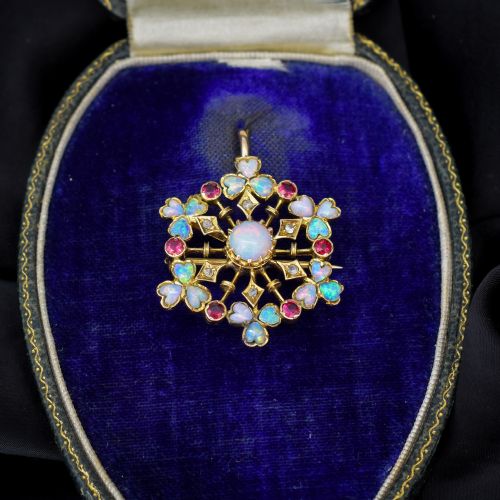
An edwardian starburst pendant brings celestial brilliance to the neckline, combining fine gem-setting with the unmistakable romance of turn-of-the-century design.
Edwardian Starburst Pendant
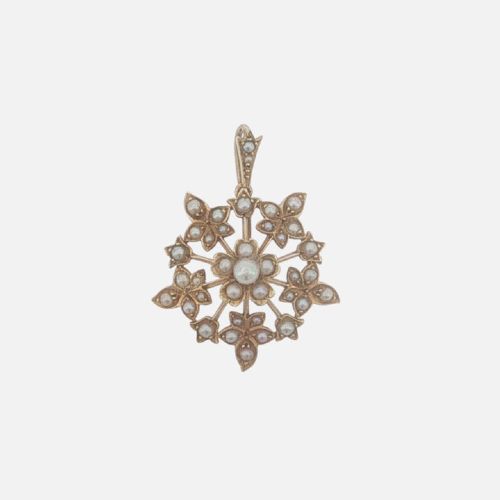
An edwardian starburst pendant captures the celestial fascination of the late nineteenth and early twentieth centuries, appearing frequently in versatile pendant and brooch combinations. These pieces draw the eye with radiating points that mimic distant starlight, often suspended delicately from fine chains.
The selections available range from restrained 9ct and 18ct gold sunbursts set with seed pearls to substantial diamond and silver-topped configurations spanning the late Victorian and Edwardian eras. Buyers frequently encounter dual-purpose mounts that transition effortlessly from lapel brooches to neck ornaments.
The form embraces both strict geometric symmetry and organic, swirling motifs, occasionally incorporating peridots, rubies, and opals at the blazing centre. Each example reflects the jeweller's mastery of proportion within a compact, luminous silhouette.
Materials and construction methods
Master jewellers constructed these pieces using a combination of silver and gold, frequently mounting diamonds in silver-topped settings to enhance the brilliance of old-cut stones while utilising gold for the structural reverse. Yellow gold, rose gold, and higher carat white metals form the robust backbones of these intricate frames.
Gemstones including seed pearls, diamonds, peridots, and opals are secured via delicate prong and collet settings that maximise light entry from multiple angles. Many items utilise hinged loops and pin mechanisms to allow dual wear as both pendants and brooches.
Listings span the late Victorian, Edwardian, and Art Deco periods, incorporating diamonds, seed pearls, opals, peridots, and diverse gold carats.
Distinctions in craftsmanship
The finest examples demonstrate exceptional precision in the graduation of radiating points and the meticulous hand-setting of old-cut diamonds or matched seed pearls. Superior construction ensures that the central stone sits securely while the surrounding rays maintain rigid structural integrity without distortion.
Quality also manifests in the fluidity of conversion mechanisms, where folding bails and pin stems operate smoothly without compromising the symmetrical balance of the star motif.
The Edwardian Starburst Pendant Glossary
- Old-cut diamond
- A historical diamond cutting style featuring a small table, high crown, and open culet, designed to sparkle warmly under candlelight.
- Seed pearl
- A very small, natural or cultured freshwater pearl, typically half-drilled and glued or pegged onto delicate gold wire settings.
- Collet setting
- A low collar of metal that surrounds the girdle of a gemstone, holding it securely within the mount.
- Pendant brooch
- A versatile piece of jewellery fitted with both a folding loop for a chain and a pin finding for garment wear.
- Culet
- The small facet at the bottom tip of a gemstone, preventing chipping and altering light return.
Edwardian Starburst Pendant: Frequently Asked Questions
How do I wear a pendant brooch?
These versatile jewels feature a discreet folding bail and a secure pin mechanism on the reverse. You can thread them onto a fine chain for the neckline or fasten them directly to a lapel.
When converting between formats, ensure the pin catch locks firmly to prevent loss during wear.
How can I date my star pendant?
Dating relies on stylistic clues, metal hallmarks, and the specific stone cuts utilised by the maker. Pieces from the Edwardian period often feature lighter platinum or white gold accents alongside yellow gold backs.
Consulting the accompanying material descriptions helps narrow down the era from late Victorian through to the Art Deco transition.
What is an old-cut diamond?
Old-cut diamonds possess hand-faceted surfaces designed to catch the ambient light of gas lamps and candles. They typically display smaller tables and softer brilliance than modern brilliant-cut stones.
This characteristic cut adds distinct historical charm and authenticity to Edwardian and Victorian celestial motifs.