
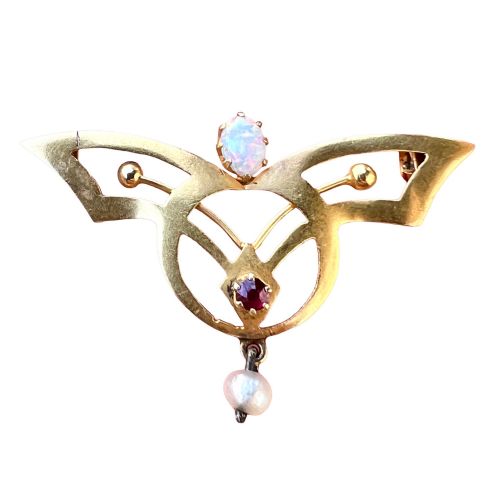


18ct Gold Pearl Brooch
An 18ct gold pearl brooch brings together fine metalwork and lustrous gems, offering a versatile piece of antique jewellery to wear today.
18ct Gold Pearl Brooch
When searching for an 18ct gold pearl brooch, buyers encounter a diverse range of items spanning the Victorian, Edwardian, and Art Deco eras, extending into the 1920s. These pieces often serve a dual purpose as both pendants and brooches, adapting easily to different garments and necklines.
The most common forms on this page include bar brooches, sunburst and starburst designs, and romantic motifs such as double hearts and pierced hearts. Gemstones frequently accompany the pearls, with diamonds, garnets, rubies, and opals appearing alongside the central metal.
The materials reflect the tastes of the late nineteenth and early twentieth centuries, combining high-karat gold with platinum settings in later examples. Natural pearls take centre stage, supported by detailed metalwork that defines each distinct period style.
Materials and Craftsmanship
The construction relies heavily on 18ct yellow gold, providing a warm foundation that pairs with both traditional silver-topped mounts and later platinum settings. Master jewellers combined this high-karat gold with intricate wirework, pierced elements, and cast forms to build durable yet delicate frames.
Pearls are integrated alongside old-cut diamonds, coloured gemstones such as rubies and sapphires, and decorative elements like plique-à-jour enamel. Techniques such as collet setting and grain setting secure each stone firmly within the gold framework, ensuring the longevity of the jewellery.
Enthusiastic Victorian jewellers occasionally turned entire insects into wearable art, setting rubies and emeralds into buzzing beetle and bee brooches.
Distinguishing Quality
The distinction between tiers of quality rests upon the complexity of the design and the harmony of the stones. Pieces featuring high-weight diamonds, natural pearls, and intricate enamel work demand superior skill and elevate the status of the item.
The crispness of the gold pierces, the precision of the stone settings, and the overall integrity of the convertible mechanisms - such as detachable pendant loops - demonstrate the level of workshop execution. Superior examples retain their original components and show minimal surface wear to the softer pearls.
The 18ct Gold Pearl Brooch Glossary
- Plique-à-jour
- An enamelling technique where the enamel is applied without a backing, creating a translucent, stained-glass effect within the gold frame.
- Old-cut diamond
- A vintage diamond cutting style characterised by a small table, high crown, and large facets, designed to catch candlelight.
- Convertible pendant
- A piece of jewellery engineered to function as both a brooch and a necklace pendant through the use of hidden loops.
- Sunburst
- A radiating design motif inspired by the sun, frequently set with diamonds and pearls around a central focal point.
18ct Gold Pearl Brooch: Frequently Asked Questions
How do I wear a brooch today?
These pieces pin securely onto jacket lapels, heavy scarves, or the neckline of a structured dress. Convertible items also slide onto chains to serve as pendants.
Ensure the safety catch functions correctly before fastening the pin to thicker fabrics to protect the gold and gems.
How do I clean pearls safely?
Pearls are organic gems that require gentle care, avoiding harsh chemicals, ultrasonic cleaners, and immersion in water. Wipe them clean with a soft, damp cloth after wearing.
Store the brooch separately in a lined box to prevent the pearls from scratching against other harder gemstones.
What is the difference between Victorian and Edwardian styles?
Victorian designs often embrace romantic motifs, rich-hued gemstones like garnets, and heavier yellow gold settings. Edwardian pieces shift towards lighter platinum mounts, delicate openwork, and diamond-heavy starbursts.
Examining the metal colour and overall weight helps distinguish the earlier romantic aesthetic from the later lace-like platinum phase.
Are these pearls natural?
Many items from the nineteenth and early twentieth centuries feature natural pearls formed organically in saltwater or freshwater molluscs. Each pearl exhibits unique lustre and slight variations in shape.
Consulting individual piece descriptions provides specific details regarding the origin and nature of the pearls used.