
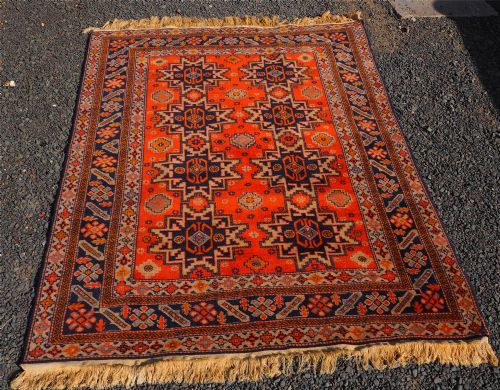


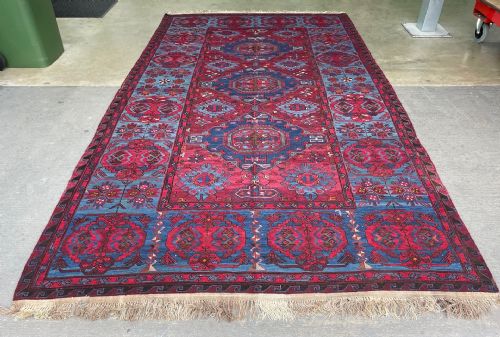


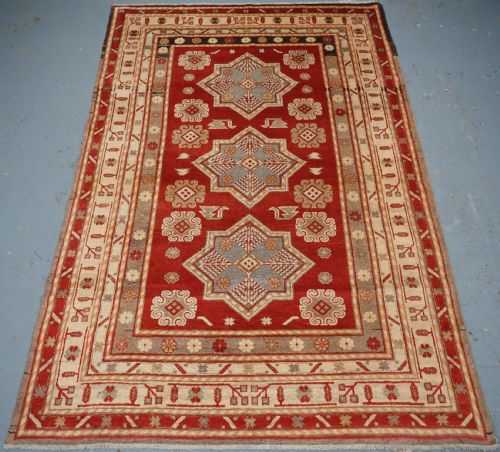

Star Medallion Carpet
These star medallion carpet examples bring distinctive geometric motifs and regional character to a room, offering rich visual history underfoot.
Star Medallion Carpet
The pieces span production dates from the late nineteenth century into the early twentieth century, specifically covering the 1880s, 1890s, 1900s, 1910s, 1920s, and 1930s. On this page, buyers most frequently encounter tribal and village weaves displaying single or multiple star medallions on varied coloured grounds.
How they were made
These carpets are constructed primarily using wool and cotton foundations and pile, worked through traditional hand-knotting and flatweaving techniques characteristic of their respective regions. The structural materials provide durability and distinct tactile qualities that define antique village and tribal textiles.
Dyes and wool preparation determine the depth of the field colours, ranging from mellow tones to striking contrasts on ivory or saturated grounds. Weavers utilised local materials to execute complex geometric layouts, including multi-medallion formats and surrounding border guards.
Certain antique runners casually mix star medallions with large, inquisitive peacocks strutting across the wool field.
What varies in quality
The distinction between standard and superior examples lies in the crispness of the geometric drawing and the complexity of the star medallion composition. Finer pieces demonstrate precise knot density and harmonious colour saturation across the field and borders.
Proportion and regional fidelity separate average utility rugs from exceptional collector pieces. Well-executed examples maintain balanced proportions across unusual sizes, runners, and large formats, preserving clear tribal iconography without structural distortion.
The Star Medallion Carpet Glossary
- Medallion
- A central ornamental motif placed in the middle of the carpet field. In these pieces, it frequently takes a geometric star shape.
- Pile
- The upright yarn loop surface of a carpet that forms the soft texture. It is knotted onto the foundation warps and wefts during weaving.
- Runner
- A long and narrow carpet format suited for hallways and corridors. Several examples on this page utilise this elongated layout.
- Soumak
- A flatweave technique utilising a wrapping method that leaves floating threads on the reverse. It creates a sturdy structure without a cut pile.
- Ground
- The background colour or surface field behind the central medallions and secondary motifs. Common examples include ivory and mellow tones.
Star Medallion Carpet: Frequently Asked Questions
What is a star medallion carpet?
A star medallion carpet is an antique woven textile featuring prominent geometric star designs as the central focus of the field. These pieces originate from traditional weaving centres across the Caucasus, Persia, Anatolia, and East Turkestan.
They encompass various formats including square area rugs, long runners, and large carpets produced from the late nineteenth century through the early twentieth century.
How were these carpets used?
These textiles served practical floor-covering functions in residential spaces, adding warmth and insulation in domestic interiors. Runners decorated hallways and narrow spaces, while larger formats anchored principal rooms.
Today, buyers utilise them to introduce historical texture and grounding colour into modern or traditional interiors.
How do I live with an antique carpet?
Living with an antique rug involves placing it in low-to-moderate traffic areas to preserve the historical wool pile. Using a quality underlay prevents slippage and reduces friction against hard flooring.
Regular gentle rotation ensures even wear patterns across the field and exposes different sections to natural light equally over time.
How do I tell regional types apart?
Distinguishing regional types depends on analysing the specific geometry of the star medallions, the border arrangements, and the palette utilised. Caucasian and Anatolian pieces often display bolder, sharper tribal geometry, while Persian and East Turkestan examples incorporate softer curves or distinct ground tones.
Examining the weave structure and material handling provides further clues to whether a piece originates from Daghestan, Shirvan, or surrounding weaving regions.