



Spiral Turn Candlesticks
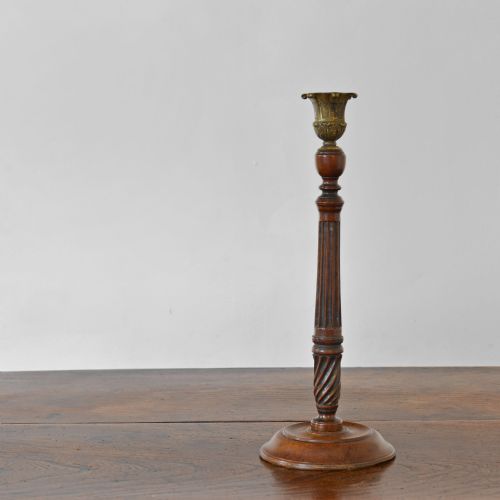
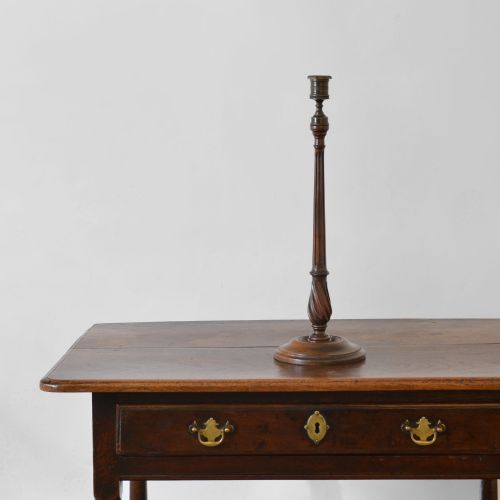
These spiral turn candlesticks bring tactile warmth to a room, wrought from timber and brass across several distinct eras.
Spiral Turn Candlesticks
Spiral turn candlesticks are functional items designed to elevate a candle, taking various forms from single tall columns to balanced pairs. When you search for spiral turn candlesticks, you encounter pieces spanning the Georgian, Victorian, Edwardian, and early twentieth-century periods.
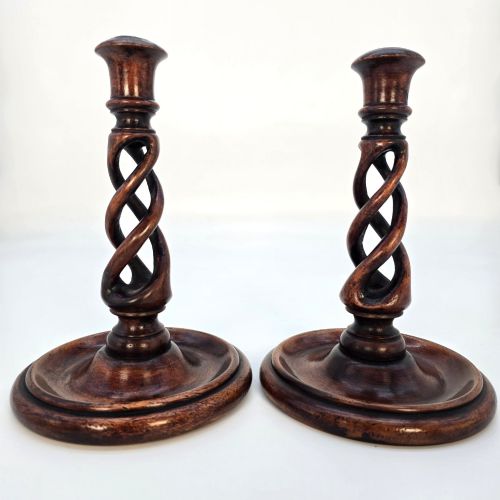
The materials vary across the selection, appearing in timbers such as mahogany, fruitwood, oak, and walnut, alongside polished brass examples. Oak and mahogany dominate the wooden pieces, often showcasing the barley twist or open twist carving characteristic of these forms.
Originating as practical household lighting, these items now serve decorative roles on mantelpieces, side tables, and chests. Examples range from folk-art creations to pieces styled in the manner of earlier eras like the George III period and Jacobean Revival.
How they were made
Makers shaped the wooden shafts using turning techniques on a lathe to create the rhythmic, helical twists seen in barley twist and open twist designs. Selected hardwoods including mahogany, walnut, and fruitwood provided the dense grain necessary for sharp turning profiles.
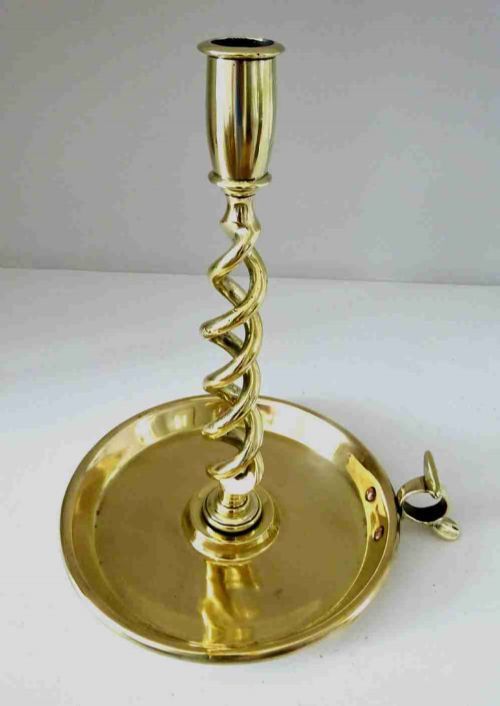
Brass examples utilise cast components, combining fitted bases with socket tops to secure candles safely. Wood and metal frequently merge in composite designs, featuring brass fittings mounted onto turned oak or mahogany bodies.
Listings feature items in oak, mahogany, walnut, fruitwood, and brass, spanning Georgian, Victorian, Edwardian, and early twentieth-century periods.
What varies in quality
Quality rests in the crispness of the turning and the depth of the helical twist carved into the timber or cast into the metal. Finer pieces demonstrate precise symmetry and proportion, whereas simpler folk-art examples lean towards rustic charm and individual character.
The choice of material dictates the visual weight of the candlestick, with dense mahoganies and dark oaks offering a richer patina than softer woods. Integration of fitted brass components also separates standard utilitarian items from more ambitious decorative pairs.
The Spiral Turn Candlesticks Glossary
- Barley twist
- A carved or turned helical column resembling a stalk of barley. This profile became popular in English furniture and candlesticks during the seventeenth century and saw revivals in later periods.
- Open twist
- A complex turning style where the helix is pierced through, leaving open space between the spiral strands. This technique requires considerable skill to execute without fracturing the wood.
- Fruitwood
- A generic term for timber sourced from fruit-bearing trees such as apple, pear, or cherry. It provides a tight, fine grain favoured for detailed turning.
- Jacobean Revival
- A nineteenth and early twentieth-century design style emulating the heavy, ornamented furniture of the early seventeenth century. Pieces in this style often feature dark oak and pronounced turns.
Spiral Turn Candlesticks: Frequently Asked Questions
What periods do these candlesticks come from?
The selection spans multiple eras, including Georgian, Victorian, and Edwardian periods, alongside pieces dating around nineteen hundred and nineteen ten.
Craftsmen produced these designs across several centuries, with later pieces often reviving seventeenth-century turning styles.
Were these made in pairs?
Many examples survive as matched pairs, though individual single candlesticks also appear within the available selection.
Pairs offer symmetry for mantelpieces and sideboards, while single pieces function well as accent items on smaller surfaces.
What woods were used for the timber versions?
Makers utilised a variety of hardwoods, predominantly oak and mahogany, alongside walnut and fruitwood.
Dark oak and rich mahogany provide heavier visual weight, while fruitwood offers a finer grain and lighter tone.
Do they feature metal components?
Several pieces incorporate brass, either as entire cast candlesticks or as fitted bases and nozzle tops mounted on wooden shafts.
This combination of brass and dark oak or mahogany creates a distinct contrast of materials popular in Edwardian and turn-of-the-century production.