
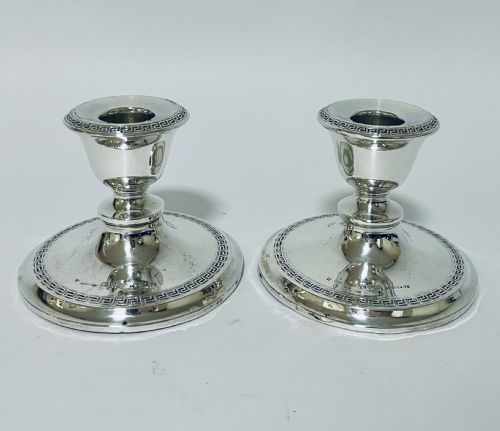


Solid Silver Taper Holders
Solid silver taper holders are domestic lighting accessories crafted in sterling silver, prized for holding small wax candles on desks and dressing tables.
Solid Silver Taper Holders
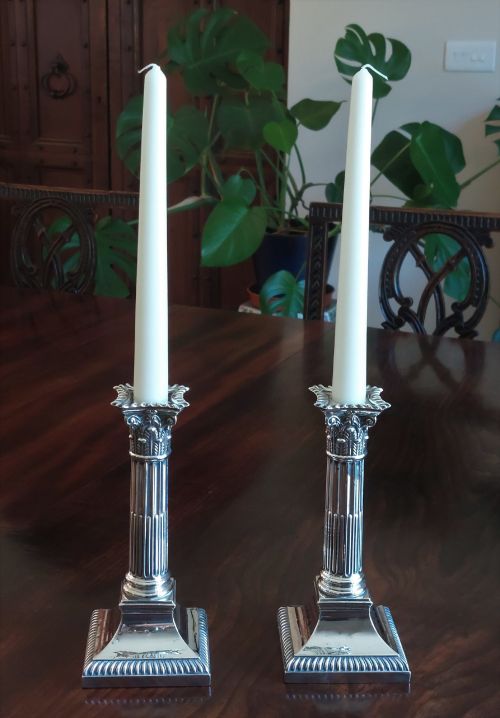
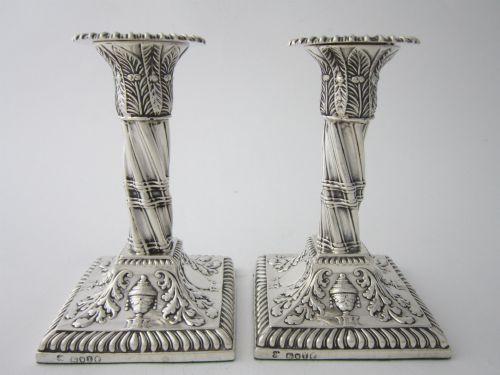
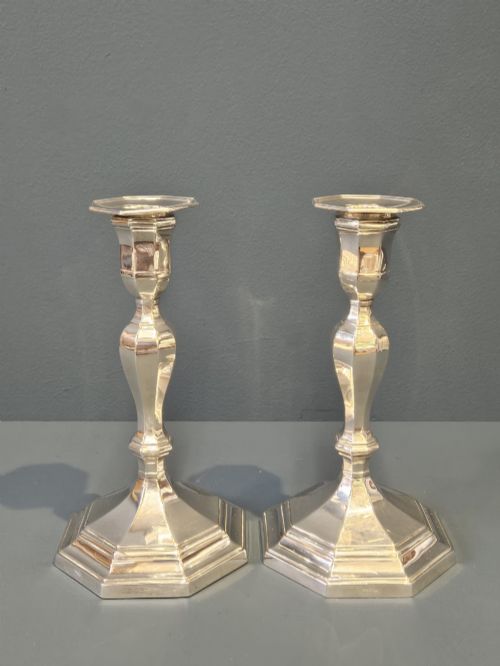
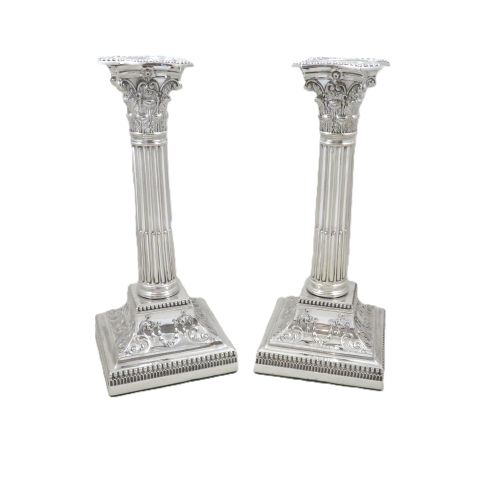
Solid silver taper holders appear primarily as small candlesticks, chambersticks, and desk accessories designed to hold thin candles or wax tapers. These items emerge across Victorian, Edwardian, and twentieth-century periods, including George V examples and Georgian revival pieces.
The most common forms on this page include matched pairs of candlesticks alongside single chambersticks fitted with finger rings and drip pans. Makers and assay offices span London, Sheffield, and Birmingham, reflecting centuries of British silver production.
How they were made
These pieces are manufactured from sterling silver and standard silver, utilising traditional silversmithing techniques such as casting, hammering, and soldering. Bases are frequently weighted with internal resin or loaded cores to provide stability for the upright stem and candle socket.
Surface decoration relies on applied borders, reeded accents, and neoclassical revival motifs stamped or chased directly into the metal. Hallmarks struck into the silver record the assay office, date letter, and maker's mark.
What varies in quality
Quality rests upon the crispness of the chased or cast ornament and the proportion of the weighted base relative to the height of the stem. Earlier Georgian and Victorian examples often display hand-finished detailing that differs from later mass-produced or revival casting.
The integrity of the original hallmarks and the retention of clean lines without excessive polishing distinguish superior items. Complete pairs matching in maker and date letter command greater interest than assembled groups.
Garrard & Co·James Dixon & Sons·Robert Hennell
The Solid Silver Taper Holders Glossary
- Sterling silver
- An alloy consisting of ninety-two point five percent silver and seven point five percent other metals, typically copper. This standard is guaranteed by official assay office hallmarks.
- Chamberstick
- A low candlestick fitted with a saucer base and a handle for carrying through a house at night. These items often include a small conical snuffer.
- Bougie box
- A small cylindrical container designed to hold a coiled wax taper for lighting fires or sealing letters. These portable desk accessories date mainly to the eighteenth and nineteenth centuries.
- Assay office
- An official body responsible for testing the purity of precious metals and striking hallmarks. Common British offices include London, Sheffield, and Birmingham.
Solid Silver Taper Holders: Frequently Asked Questions
What is a taper holder?
A taper holder is a small lighting device designed to support thin wax tapers rather than heavy household candles. They sit easily on writing desks, mantelpieces, and bedside tables.
These pieces appeared in various forms throughout the Georgian, Victorian, and Edwardian eras, serving both practical and decorative roles in homes.
How do I clean solid silver?
Cleaning solid silver requires a soft cloth and a specialised silver polish to remove tarnish without scratching the soft metal. Avoid abrasive pads or harsh chemical dips that strip away patination.
Regular, gentle wiping keeps the hallmarks legible and preserves the fine details of the cast or chased decoration on the stem and base.
Why are silver candlesticks weighted?
Silver candlesticks are weighted internally with resin, plaster, or other dense materials to prevent them from tipping over. Because solid silver sheet or cast metal alone would make the top heavy, the filled base provides essential balance.
Most weighted candlesticks feature a green baize or felt covering on the underside to protect furniture surfaces.
How do I date antique silver?
Dating antique silver relies on the set of hallmarks stamped directly into the metal by an official assay office. These marks typically include a maker's mark, a standard mark for sterling silver, a town mark, and an annual date letter.
Comparing the specific shape of the date letter shield against published assay office tables reveals the exact year the piece was hallmarked.