


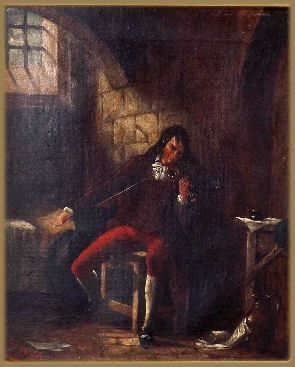

Small Framed Canvas Painting
These small framed canvas painting works bring compact historic scenes and portraits into your rooms.
Small Framed Canvas Painting
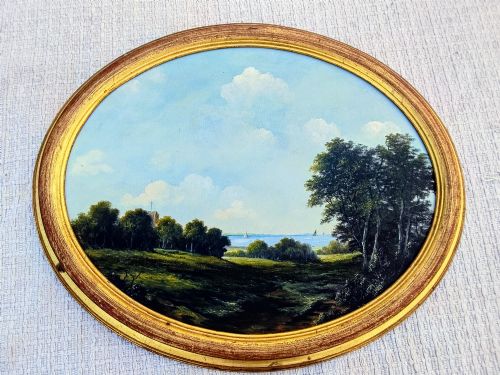
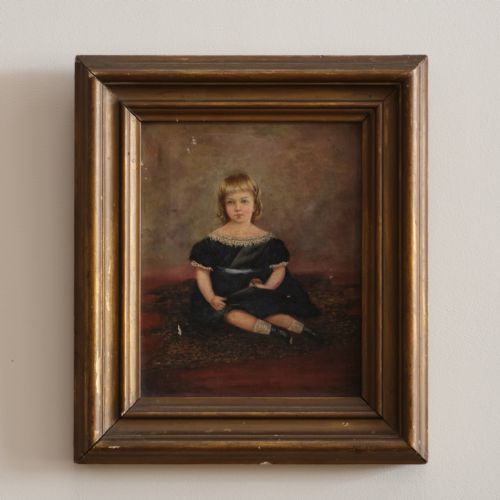
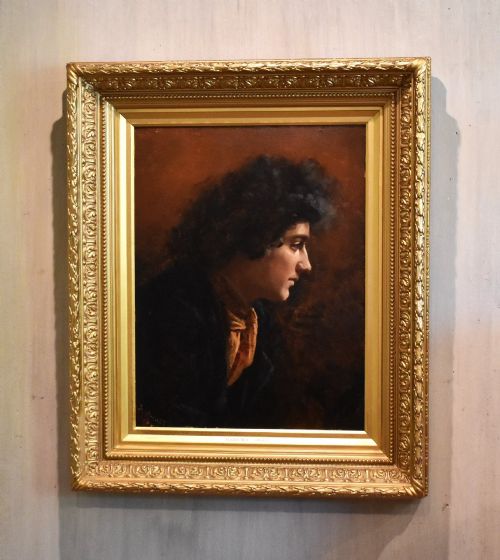
When you search for a small framed canvas painting, you encounter portable works executed in oil on canvas stretched across wooden supports and held within period frames. The selection spans the Georgian era, the nineteenth century, and twentieth-century British production, offering intimate views into past subjects.
You meet maritime scenes, rural landscapes, portraits, still life arrangements of fruit and flowers, and naive representations of animals and villages. These pieces originate from traditional English and Scottish schools, capturing local views and domestic subjects on a modest scale.
The most common formats on this page are compact landscape views and portraits produced by named and regional artists working across the Victorian and Edwardian periods. Their reduced dimensions make them suitable for grouping on walls or placing in limited spaces.
Materials and construction
Makers applied oil paint directly to woven canvas stretched over wooden frames, building up pigment layers to create landscapes, portraits, and still life subjects. Artists used oil mediums that allowed for subtle blending and rich colour retention over decades.
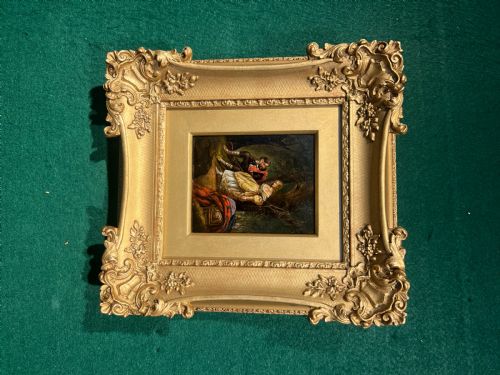
The enclosing frames combine wood with gesso mouldings, often finished with gold leaf or gilding to complement the painted imagery. These surrounds protect the edges of the canvas and provide a finished architectural boundary for the artwork.
One canvas preserves a quiet portrait of a Havanese dog named Eliza Maddock on the Isle of Man.
Quality variations
The distinction between ordinary and superior pieces rests on the dexterity of the brushwork and the precision of the composition. Finer examples display confident handling of light in landscapes or acute characterisation in portraits, whilst simpler works rely on stiffer execution.
The integrity of the original wood frame and the retention of unlined canvas influence the standing of a piece. Well-preserved gesso ornamentation and untouched painted surfaces elevate the overall merit of the object.
Florence Small·J. Phipps·M. C. Hider·Ferdinand Barth·Oliver Clare
The Small Framed Canvas Painting Glossary
- Canvas
- A heavy woven fabric used as a surface for oil painting. It is typically stretched tightly over a wooden frame before work begins.
- Gesso
- A plaster mixture applied to wooden frames as a smooth base for gilding and ornamentation. It is moulded to create decorative borders.
- Oil paint
- A slow-drying paint made by combining pigment particles with a drying oil such as linseed. This medium allows artists to achieve depth and luminosity.
- Gold leaf
- Thin sheets of hammered gold applied to frames over gesso. It provides a reflective, decorative metallic finish.
- Naive
- A term describing work by artists lacking formal academic training. These pieces possess a charming directness in perspective and proportion.
Small Framed Canvas Painting: Frequently Asked Questions
How do I hang a small framed canvas painting safely?
Use appropriate picture hooks rated for the weight of the wood and gesso frame. Ensure the cord or wire at the back is secure before mounting.
Position the work away from direct sunlight and damp walls to protect both the canvas and the oil pigments over time.
What periods do these paintings cover?
The pieces span several centuries, including Georgian, Victorian, and twentieth-century examples up to nineteen sixty. Each era brings distinct framing styles and subject matters.
Nineteenth-century works dominate the selection, offering traditional maritime scenes, rural realism, and detailed portraiture.
Are the frames original to the paintings?
Many retain their period wooden and gesso frames, which show appropriate signs of age. Gilded surfaces often display minor craquelure or wear consistent with their history.
Examining the fit and corner construction helps determine whether the frame belongs to the same period as the canvas.
How do I clean a canvas painting?
Dust the surface very gently with a soft, dry brush to remove loose particles. Avoid using water, liquid cleaners, or household chemicals on the painted canvas.
Professional conservators should handle any deeper cleaning or removal of discoloured varnish to prevent damaging the original oil layers.