
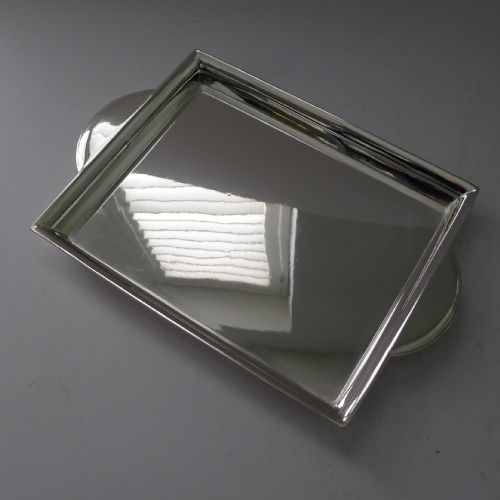
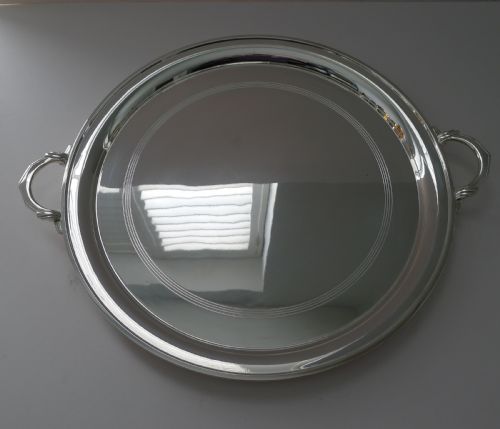
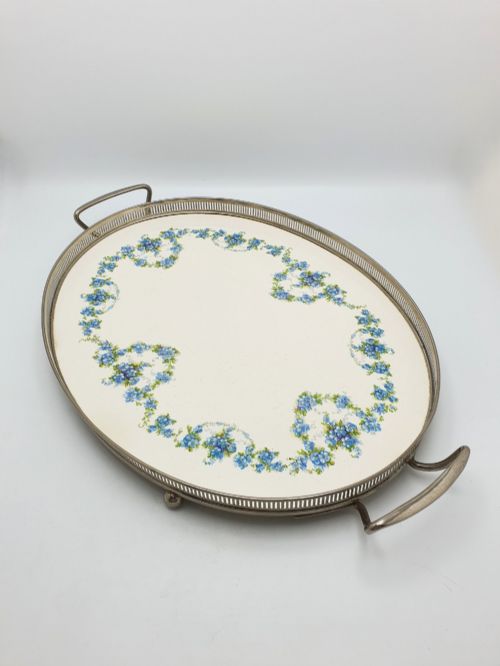
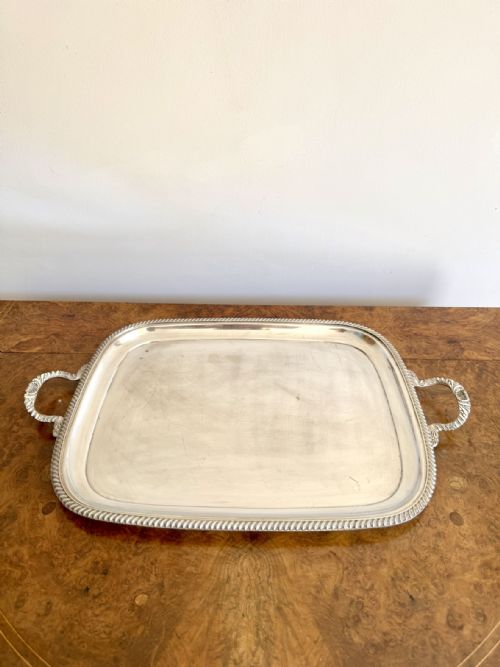


Silvered Metal Serving Tray
A silvered metal serving tray brings weight and shine to a room, offering a practical surface shaped by decades of dining and entertaining.
Silvered Metal Serving Tray
When you search for a silvered metal serving tray, you encounter everything from compact cocktail pieces to large presentation platters designed for formal gatherings. The selection spans the nineteenth century through the art deco period, taking in Victorian examples alongside continental decorative work.
You meet various forms, including round salvers, oval serving dishes, and hammered pewter chargers. Many feature raised detailed rims, engraved surfaces, or pierced repousse borders that reflect the shift in dining habits over the decades.
How they were made
Makers utilised base metals such as copper and nickel silver, applying electroplated nickel silver or standard silver plate to achieve a bright finish. Old Sheffield plate examples employ a fused layer of silver over a copper core, visible where generations of use have softened the edges.
Craftsmen shaped the metal through hammering, piercing, and casting, adding applied borders with shell motifs or floral details. Engraved surfaces require steady handwork, cutting lines into the metal plate to create geometric patterns or floral centres.
Listings feature items spanning the eighteenth century, the Victorian era, and the art deco period of the 1920s and 1930s.
What varies in quality
Quality rests on the weight of the metal blank and the crispness of the applied decoration. Heavy gauge copper or nickel silver provides a solid foundation that resists bending, whereas thinner plates feel light and flexible.
The skill of the silversmith shows in the definition of pierced work and the depth of chased or engraved detailing. Maker attribution also influences standing, with pieces carrying marks from notable firms commanding attention for their design integrity.
Keith Murray For Mappin & Webb·Liberty & Co.·Hukin & Heath·John Collyer & Co.·Brille, Paris·Frank Cobb & Co.·J.H. Potter
The Silvered Metal Serving Tray Glossary
- Electroplated Nickel Silver
- A base metal alloy of copper, nickel, and zinc coated with a layer of pure silver through an electrical process. This method became common in the nineteenth century as a cost-effective alternative to solid silver.
- Old Sheffield Plate
- A composite material made by fusing a thin sheet of silver to a thicker copper core before rolling them into sheets. The underlying copper often shows subtly at the cut edges of older pieces.
- Repousse
- A metalworking technique where the artisan hammers the design from the reverse side to raise relief patterns on the front. Pierced repousse combines this relief work with open cutouts.
- Salver
- A flat tray, typically circular and raised on feet, traditionally used for presenting drinks or visiting cards. Victorian and Edwardian examples often feature heavily engraved centres.
- Pewter
- A malleable metal alloy consisting principally of tin, combined with copper and antimony. It yields a duller, softer lustre than silver plate and suits plain rim chargers and arts and crafts dishes.
Silvered Metal Serving Tray: Frequently Asked Questions
How do I clean a silvered metal serving tray?
Use a soft cloth and a gentle cream formulated for silver plate, avoiding harsh abrasive dips that strip the remaining finish.
Rinse the tray in lukewarm water and dry it immediately to prevent water spots from forming on the surface.
Can I use these trays for serving food?
Most silver plated and pewter trays serve drinks, canapies, or bread effectively during gatherings.
Acidic foods left for extended periods can mark old plating, so line the tray with a cloth or doily for fruit and citrus.
What is the difference between silver plate and old sheffield plate?
Silver plate involves depositing a thin layer of silver onto a base metal via electrolysis, a method standard from the Victorian era onward.
Old Sheffield plate relies on a mechanical fusion of silver sheet onto copper, identifiable by subtle copper lines at the borders.
How do I date an unmarked tray?
Examine the weight, the style of the engraved motifs, and the form of the handles or feet against known design periods.
Art deco pieces favour geometric clarity, while Victorian designs run to heavy floral borders and dense surface engraving.