
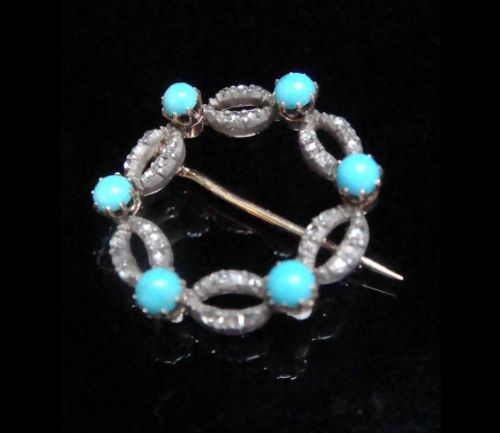


Silver Gold Diamond Pin
A silver gold diamond pin brings together two metals and precious stones across Victorian, Edwardian, and Art Deco designs.
Silver Gold Diamond Pin
A silver gold diamond pin spans Victorian, Edwardian, and Art Deco periods, taking the form of brooches and pendants shaped as stars, floral sprays, bows, and bar pins. These jewels combine silver and gold, frequently mounting diamonds alongside rubies, sapphires, emeralds, or turquoise.
Victorian examples range from starbursts and foliate motifs to animal and insect subjects like monkeys and butterflies, often combining yellow gold with silver settings. Edwardian pieces tend towards lighter platinum, silver, and 18ct gold constructions, while Art Deco items introduce geometric bar brooch layouts.
How they were made
Maker techniques rely on combining silver and gold, using gold for structural strength and silver at the front to showcase diamond settings. Old European-cut and rose-cut diamonds are standard, secured alongside natural sapphires, rubies, and emeralds in multi-gem configurations.
What varies in quality
Quality rests in the harmony of the metalwork and the integration of the stones, where silver-topped gold heightens the brilliance of old cut diamonds. Superior examples maintain balanced proportions across complex motifs like floral sprays, star bursts, and insects.
The choice of secondary stones, such as natural sapphires, rubies, or emeralds, influences the character of the piece. Execution of fine details in foliate designs or bow formations marks the distinction between standard work and exceptional studio output.
The Silver Gold Diamond Pin Glossary
- Bar brooch
- A horizontal pin form popular during the Edwardian and Art Deco periods, often set with diamonds and rubies along a linear shaft.
- Old European cut
- An early brilliant diamond cut with a small table, heavy crown, and open culet, commonly seen in nineteenth-century and Edwardian jewellery.
- Rose-cut diamond
- A vintage diamond cut featuring a flat base and a domed crown with triangular facets, frequently utilised in Georgian and Victorian jewels.
- Silver-topped gold
- A historical manufacturing method where gold forms the backing and pin structure while silver faces the front to enhance white diamond brilliance.
- Starburst brooch
- A celestial jewellery motif radiating outwards from a central stone, executed with multiple diamond points during the Victorian and Edwardian eras.
Silver Gold Diamond Pin: Frequently Asked Questions
How do I wear a silver gold diamond pin?
These pieces function traditionally as brooches or pendants, securing cleanly onto lapels, heavy fabrics, or scarves. Many incorporate hidden bails to transform easily from a pin to a neck pendant.
Position the fastening securely through woven textiles to support the weight of gold, silver, and multi-stone settings during daily use.
What periods do these pins come from?
The selection covers Georgian, Victorian, Edwardian, Art Deco, and mid-century eras, spanning from the eighteenth century through to the twentieth century. Each period introduces distinct stylistic traits, from Georgian rose-cut clusters to geometric Art Deco bar designs.
Victorian pieces often favour starbursts and natural motifs, whereas Edwardian variants lean towards platinum, silver, and lighter lace-like filigree work.
Can I convert my brooch into a pendant?
Certain pieces are designed from origin as pendant brooches, featuring integrated loops or drop components alongside standard pin backs. Others remain strictly configured as brooches for fastening to clothing.
Inspect the reverse of the setting to identify hinged loops or removable pins before attempting any conversion work.