
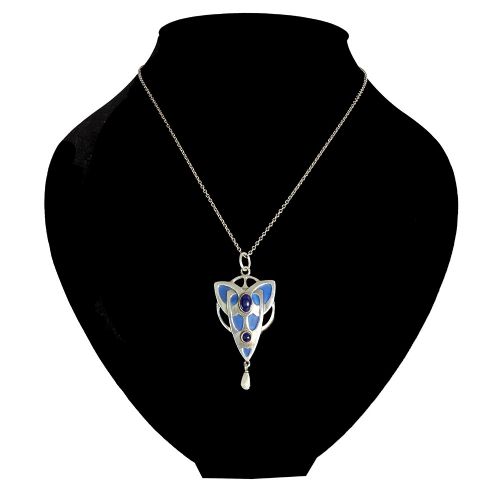
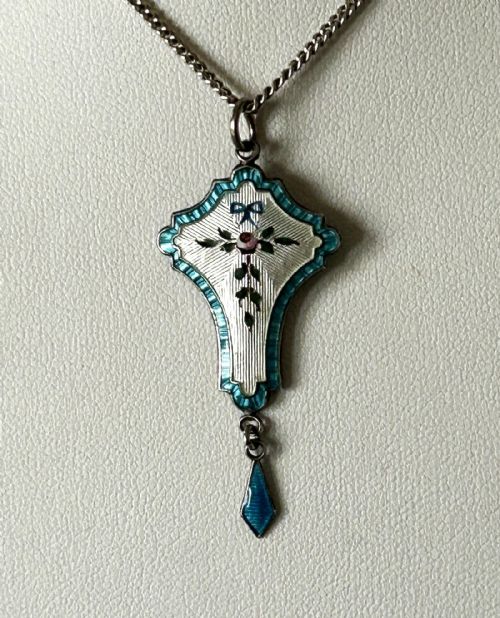


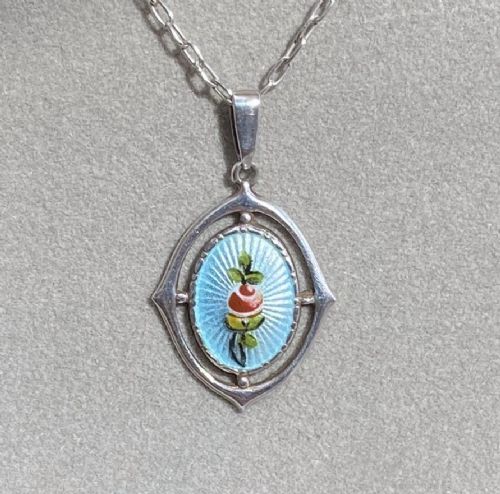


Silver Enamel Drop Necklace
A silver enamel drop necklace brings fluid botanical lines and vitreous colour right to the collarbone.
Silver Enamel Drop Necklace
A silver enamel drop necklace is a pendant piece suspended from a chain, defined by coloured vitreous glass fired onto metalwork. These jewels appear predominantly in Art Nouveau and Arts and Crafts forms, alongside Edwardian and later modernist designs.
The pieces on this page span the nineteenth century through to the mid-twentieth century, capturing periods when makers favoured organic motifs and hand-wrought silver. Pendant necklaces and convertible pendant brooches form the majority of the selection.
Buyers encounter stones such as pearl, amethyst, chalcedony, and chrysoprase integrated into the metal drops. Silver gilt and standard silver serve as the primary foundational metals for these vitreous compositions.
Materials and construction methods
Craftsmen utilised sterling silver and silver gilt as the baseline armature, shaping wire and sheet metal to form delicate bezels and borders. Vitreous enamel was then applied in powdered form and fired in a kiln to achieve a permanent glossy finish.
Techniques such as plique-à-jour suspended translucent enamel within open wire cells to resemble stained glass, while cloisonné utilised soldered metal strips to contain the coloured paste. Pearls and cabochon gemstones were set by hand to complete the dangling drop components.
Some pendants double as brooches, offering an antique two-for-one versatility that keeps modern wardrobes endlessly amused.
Distinctions in execution and design
Quality rests on the precision of the metalwork and the clarity of the fired enamel. Superior examples display even translucent colour without cracking, alongside crisp hand-beating in the silver frames.
The integration of stones alters the calibre of the piece, with natural pearls and well-matched cabochons elevating the composition. Attribution to documented makers or discernible workshop marks further separates standard production from exceptional artistry.
Archibald Knox·Liberty and Co·Murrle Bennett·Wilhelm Fuhner·Levinger and Bissinger·Otto Prutscher·Charles Horner·Eduard Loss·Ludwig Knupfer·Theodor Fahrner·Meyle and Meyer
The Silver Enamel Drop Necklace Glossary
- Plique-à-jour
- An enamelling technique where the glass is fired in open cells without a backing, allowing light to pass directly through the translucent colour. This method requires considerable skill to prevent surface tension from breaking the film during firing.
- Vitreous enamel
- A material made by fusing powdered glass to a metallic substrate by firing at high temperatures. The resulting compound provides a durable, glossy surface that resists fading over centuries.
- Cabochon
- A gemstone shaped and polished with a smooth, convex domed surface rather than faceted edges. This cut highlights the natural internal qualities of stones like amethyst and chalcedony.
- Silver gilt
- Sterling silver that has been coated with a thin layer of gold, often providing a warm contrast to blue or green enamel work. This finish was common in nineteenth and early twentieth-century decorative jewellery.
- Cloisonné
- An ancient technique where metal wires are soldered to a base plate to create compartments that hold enamel paste. The piece is then fired and polished flat.
Silver Enamel Drop Necklace: Frequently Asked Questions
How do I clean my silver enamel drop necklace?
Clean silver components gently with a soft microfibre cloth designed for jewellery care, avoiding abrasive dips that can damage the glass surface.
Keep moisture away from the reverse side of set pearls and avoid ultrasonic cleaners entirely, as vibration risks cracking historical enamel work.
Are these necklaces sturdy enough for daily wear?
While these pieces were built for ornamentation rather than heavy daily use, careful wear allows them to last for generations.
Store the necklace flat in a lined box to prevent the drop component from bending or catching on other items.
How can I tell an Art Nouveau piece from Arts and Crafts?
Art Nouveau designs typically feature asymmetrical, whiplash lines inspired by natural plant forms and flowing stems.
Arts and Crafts pieces tend to emphasise visible hand craftsmanship, hammered textures, and symmetrical geometric arrangements.
What is the difference between plique-à-jour and standard enamel?
Plique-à-jour lacks a solid metal backing behind the enamel, creating a stained-glass effect that glows when held to the light.
Standard enamel relies on a solid metal base underneath, which creates an opaque or richly saturated reflective colour field.