
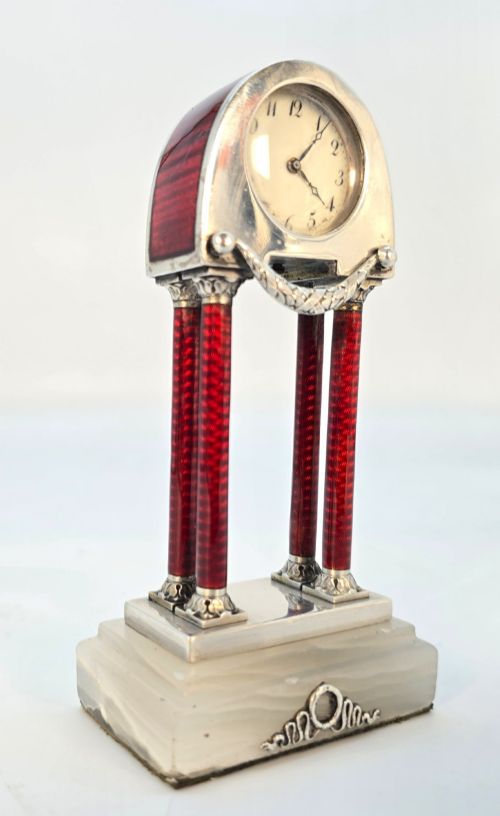


Silver Enamel Carriage Clock
These silver enamel carriage clock pieces are compact timepieces combining precious metal work with colourful vitreous decoration, built for travel and boudoir use.
Silver Enamel Carriage Clock
A silver enamel carriage clock is a portable timepiece housed in a precious metal case and embellished with decorative coloured glass or vitreous coatings. Collectors seek these items for their intricate craftsmanship and miniature scale, which bridges the gap between pocket watches and full-sized mantle clocks.
The versions most commonly met on this page span the late nineteenth century through to the nineteen-twenties, incorporating Edwardian, Art Nouveau, Belle Epoque, and Art Deco design aesthetics. They frequently appear in miniature or boudoir formats, alongside distinct regional examples originating from English and continental workshops.
Forms vary from simple rectangular travel cases to elaborate architectural portico designs and Tudric pewter creations. Makers utilise materials such as sterling silver, brass, onyx, and copper to construct the housing, while glass panels protect the delicate dial and movement within.
How they were made
Craftsmen built these portable timepieces by mounting mechanical movements inside heavy metal housings made from sterling silver, brass, or pewter. Artisans frequently chased the exterior metal surfaces with floral or geometric motifs before applying vibrant coatings.
Vitreous enamel work involved fusing powdered glass to metal surfaces through high-temperature firing, creating smooth, glossy panels in shades like blue guilloche. Glaziers fitted glass windows into the sides and top of the case to allow light into the movement and make the escapement visible from multiple angles.
Listings feature pieces spanning the nineteenth century, Edwardian period, and nineteen-twenties, incorporating materials like sterling silver, pewter, onyx, and copper.
What varies in quality
Quality in these portable timepieces rests on the crispness of the chased metalwork and the uniformity of the fused vitreous coating across the case. Superior examples display flawless enamel surfaces free from chipping or crazing, combined with finely detailed silver castings and signed mechanical movements.
Georg Adam Scheid·Archibald Knox·Liberty and Co·Henry Matthews
The Silver Enamel Carriage Clock Glossary
- Guilloche
- An ornamental technique where a precise, intricate geometric pattern is mechanically engraved into an underlying metal surface. This engraved texture shows through a translucent layer of enamel to create shimmering visual depth.
- Vitreous enamel
- A material made by fusing powdered glass to a metallic substrate at high temperatures. The resulting smooth, durable coating resists tarnishing and provides vibrant colour.
- Carriage clock
- A small, portable spring-driven timepiece originally designed for travellers during the nineteenth century. They typically feature a glass-panelled case and a carrying handle on top.
- Portico clock
- A timepiece housed within a miniature architectural frame supported by columns. This neoclassical form became popular in high-end Viennese workshops around nineteen hundred.
- Escapement
- The internal mechanical linkage that controls the release of power in a clock movement, allowing the wheels to advance at a regulated rate. The platform escapement is standard in portable carriage clocks.
Silver Enamel Carriage Clock: Frequently Asked Questions
What is guilloche enamel?
Guilloche is a decorative technique combining mechanical engine-turning with translucent vitreous enamel. The metal beneath is cut with precise repeating patterns that catch the light through the coloured glass coating.
This method was widely utilised during the Edwardian era and the nineteen-twenties on luxury boudoir items. It gives the surface a distinctive shimmering appearance that changes depending on the viewing angle.
How should I clean a silver clock case?
Dust the exterior metal gently with a soft, dry microfibre cloth to remove surface particles. Avoid liquid polishes near glass panels and enamel sections, as chemical residues can seep into the movement or discolour vitreous surfaces.
If the silver requires cleaning, use a specialist cloth applied sparingly away from the enamel work. Professional conservation is recommended for pieces with delicate gilding or restored mechanisms.
Why do some clocks have restored movements?
Antique mechanical movements rely on delicate steel springs and brass gears that experience wear over decades of use. Restoration involves cleaning the pivots, replacing worn bushings, and servicing the escapement to ensure accurate timekeeping.
Having a restored movement does not diminish the historical value of the piece if the work preserves original components. It simply means the clock is mechanically sound and ready for daily use.