
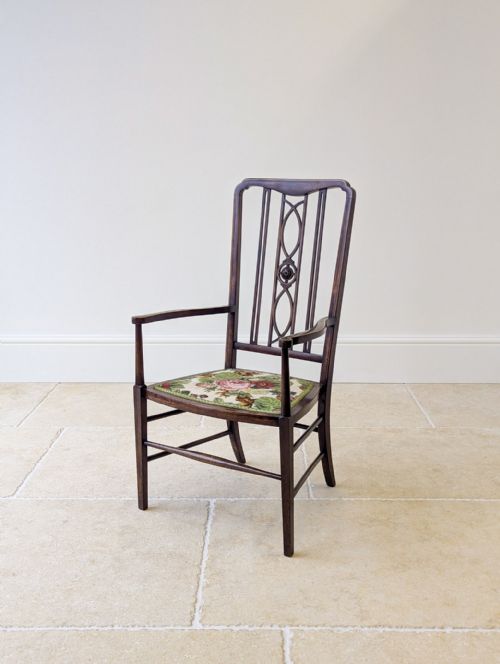
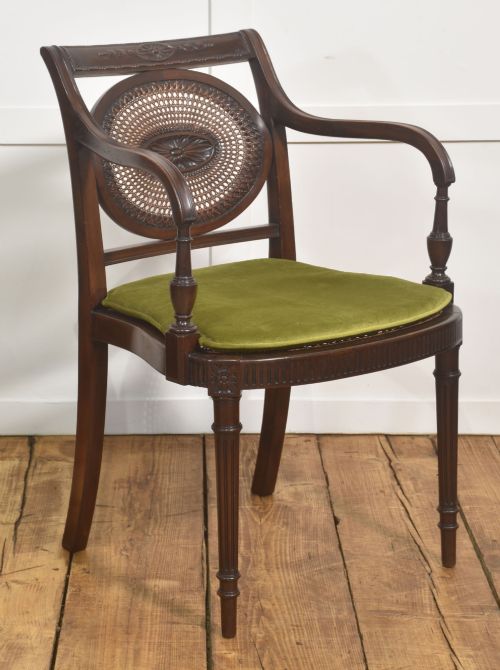
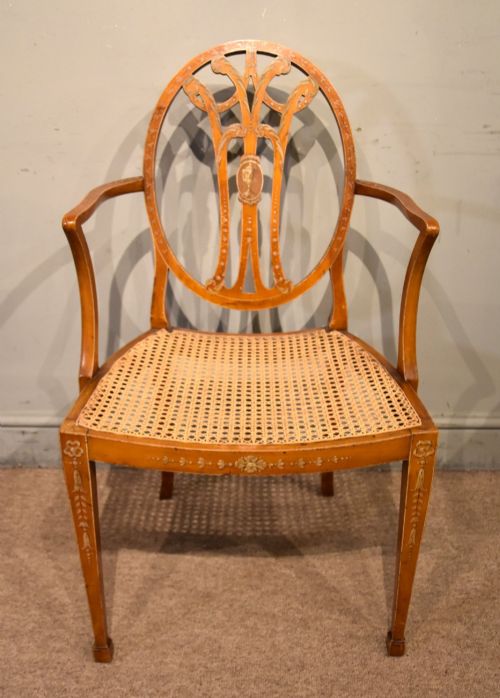
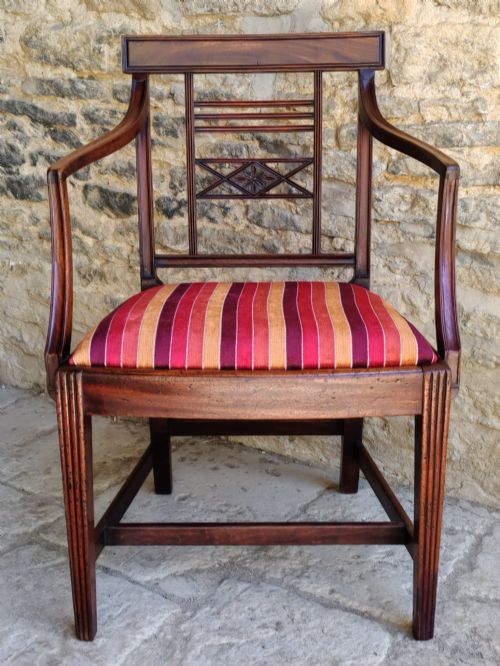


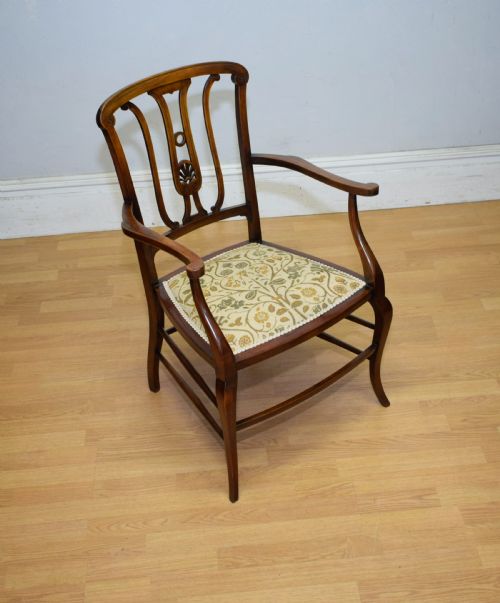

Sheraton Open Armchair
A sheraton open armchair brings classical rectilinear grace and refined neoclassical detail into any room.
Sheraton Open Armchair
A sheraton open armchair is a seating form defined by its geometric restraint, straight tapered legs, and rectilinear backrest. These pieces draw on late eighteenth-century design principles and their later revivals, offering a lighter alternative to heavier earlier seating styles.
Buyers searching for a sheraton open armchair will encounter examples ranging from eighteenth-century Georgian originals to nineteenth-century and early twentieth-century Sheraton Revival interpretations. The form appears in various domestic contexts, serving as a library, salon, desk, or carver chair.
The selection includes armchairs with solid wood frames, cane panels, and upholstered seats, often embellished with delicate inlay or hand-painted floral and musical decoration. Woods such as mahogany, satinwood, and walnut dominate the offerings across the different manufacturing periods.
How they were made
Makers constructed these frames predominantly from timber such as mahogany and satinwood, frequently employing boxwood for contrasting stringing and intricate marquetry inlay. Skilled cabinetmakers shaped the straight tapered legs and constructed the open arm supports using traditional joinery methods.
Decoration relied on contrasting veneers, hand-painted motifs, and delicate carving rather than heavy mouldings. Upholstered drop-in seats or cane panels provided the seating surface, finished with appropriate fabrics that matched the neoclassical aesthetic.
Some nineteenth-century makers added painted musical motifs to chair backs, letting owners literally sit down to a tune.
What varies in quality
The degree of refinement in the timber selection and the crispness of the inlay distinguish standard examples from finer pieces. Superior items display well-figured mahogany or satinwood alongside precise, unbroken stringing and subtle hand-painted details.
Structural integrity and the retention of original surfaces dictate the standing of an armchair. Pieces that maintain their original joinery, uncompromised cane work, and authentic period finishes hold greater integrity than those with extensive later alterations.
The Sheraton Open Armchair Glossary
- Sheraton Revival
- A late nineteenth and early twentieth-century design movement that recreated the lightness and classical motifs of eighteenth-century Sheraton furniture. This revival produced many of the satinwood and painted armchairs found in homes today.
- Carver chair
- A traditional term for an armchair, often made as part of a set of dining chairs to sit at the head of the table. These frames match the simpler side chairs while providing open arms for the principal diner.
- Satinwood
- A hard, durable timber with a natural golden sheen and a smooth grain, frequently used as a veneer on high-end neoclassical furniture. It provides a pale, reflective surface that takes painted decoration exceptionally well.
- Stringing
- Thin strips of contrasting wood inlaid into channels in the main timber to create decorative borders and linear patterns. This technique defines the edges of legs, rails, and back panels on classical furniture.
- Cane
- Woven rattan material used to create light, resilient panels for seat bases and backrests. It offers both flexibility and visual lightness to the upper sections of the chair.
Sheraton Open Armchair: Frequently Asked Questions
How do I identify a true Georgian period armchair?
Authentic eighteenth-century pieces display the tool marks, timber shrinkage, and structural wear consistent with age. Cabinetmakers of that era utilised specific construction methods and native hardwoods that differ from later revival techniques.
Examination of the underside and joint construction often reveals the hand-cut joinery and period fastenings that distinguish an original piece from a later nineteenth or twentieth-century copy.
Where should I place an open armchair?
These armchairs suit spaces where lightness and refined proportions matter, such as a study, bedroom, or drawing room. Their open arms and slender legs prevent them from visually crowding a corner or an intimate seating group.
They function well alongside writing desks or as occasional reading chairs, provided the seat height matches the surrounding furniture.
What is the difference between Sheraton and Sheraton Revival?
Original Sheraton pieces date from the late eighteenth century during the height of the designer's influence and the Georgian period. They were built to contemporary domestic demands using eighteenth-century joinery and timber stocks.
Sheraton Revival furniture dates from the late Victorian and Edwardian eras, when makers looked back to those earlier neoclassical designs to create decorative salon and library chairs for modern homes.
How do I care for a satinwood and painted chair?
Keep these delicate surfaces away from direct sunlight and excessive moisture to protect the painted decoration and the underlying satinwood veneer. Regular dusting with a soft, dry cloth prevents particulate accumulation without harming the finish.
Avoid applying modern silicone polishes, utilising instead a micro-layer of appropriate microcrystalline wax if the timber requires nourishment.