





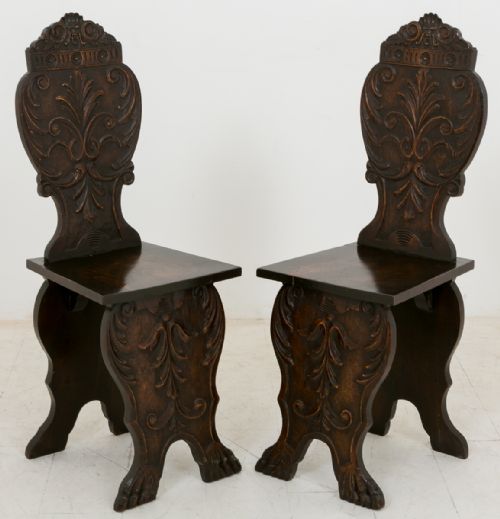
Sgabello Hall Chairs
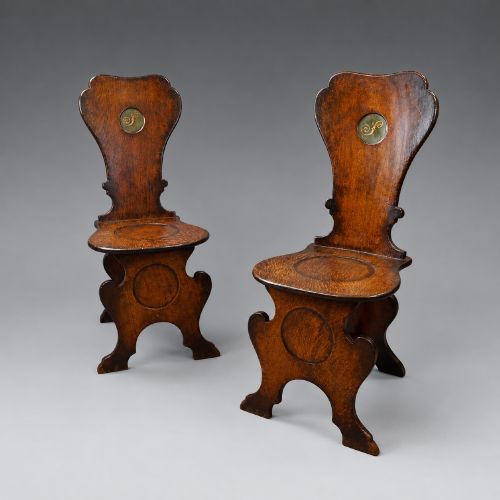
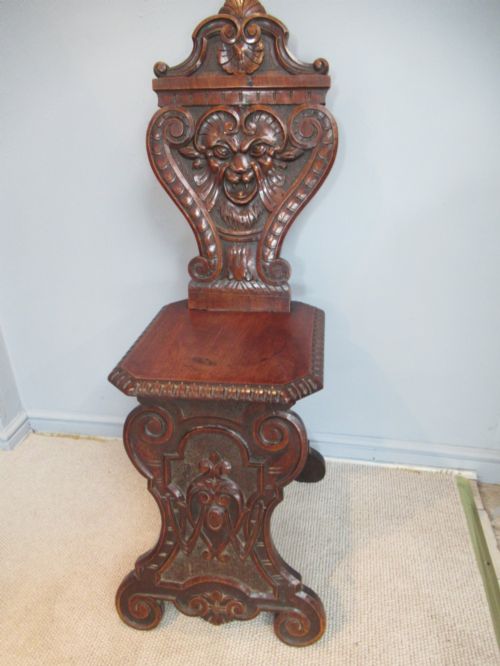
These sgabello hall chairs bring sculptural Italian Renaissance presence to a corridor or entryway, offering high-backed timber seating designed to catch the eye.
Sgabello Hall Chairs
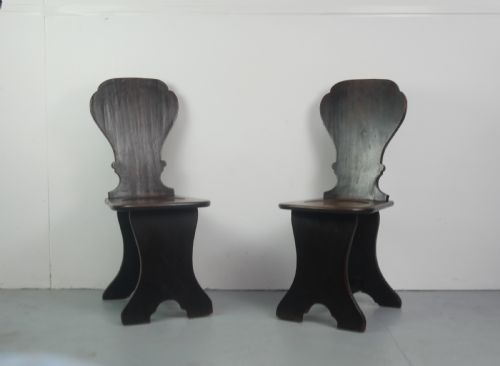
Sgabello hall chairs draw on historical Italian forms, featuring a distinct narrow wooden seat supported by shaped trestle boards rather than standard legs. You encounter these primarily in nineteenth-century revival interpretations alongside eighteenth-century Georgian examples.
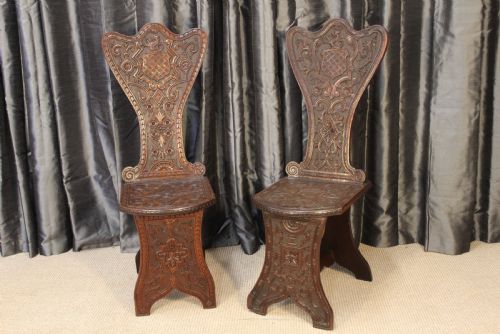
The form functions chiefly as architectural furniture meant for display in halls and passageways rather than long hours of relaxed sitting. Pieces frequently appear in pairs, utilising carved wood backs and sturdy planks to create an authoritative silhouette.
Makers adapted the pattern across various eras, ranging from heavily carved Flemish walnut to painted wood and lime wood versions. The selection includes occasional variations like hall benches and side chairs sharing the characteristic sgabello profile.
Materials and construction
Construction relies heavily on dense hardwoods such as oak, walnut, mahogany, and fruitwood, chosen for their ability to hold deep relief carving. Artisans shaped the vertical backrests and solid trestle supports from thick timber planks.
Surface decoration incorporates extensive hand carving, paintwork, and occasional bone inlay to accentuate the Renaissance revival aesthetic. Some examples utilise painted and parcel gilt finishes to highlight the sculptural details of the woodwork.
One inquisitive visitor attempted to play a sgabello like a cello, convinced the wooden trestle was an ancestor to the violin.
Assessing quality
Quality rests upon the crispness and depth of the timber carving, distinguishing masterwork execution from simpler provincial production. Dense grain in woods like walnut and mahogany allows for sharper lines that remain defined over centuries.
Proportion and structural integrity dictate the success of the piece, particularly where the vertical back meets the narrow seat board. Superior examples display balanced symmetry in the trestle supports and harmonious integration of any applied paint or inlay.
The Sgabello Hall Chairs Glossary
- Sgabello
- A light, movable wooden chair originating in the Italian Renaissance, featuring an octagonal or polygonal seat supported by two carved board legs.
- Trestle support
- A vertical board or frame that replaces traditional legs to bear the weight of the seat and back.
- Renaissance Revival
- A nineteenth-century architectural and decorative style drawing inspiration from fifteenth and sixteenth-century Italian design.
- Parcel gilt
- The practice of applying thin gold leaf to specific raised portions of a carved wooden surface.
Sgabello Hall Chairs: Frequently Asked Questions
What is a sgabello chair?
A sgabello is a historical Italian chair type defined by a shaped wooden seat resting on two vertical board supports instead of legs. They were historically placed in grand hallways to display wealth and artistic taste.
Today, these chairs serve as striking accent pieces in narrow entryways where standard seating would obstruct movement.
Are these chairs comfortable to sit on?
These pieces were built primarily for visual impact and brief use in passage areas rather than lounging. The upright wooden backs and firm wooden seats reflect their historical function as architectural hall furniture.
Placing a small cushion on the seat can soften the timber surface for occasional sitting.
How do I date an antique sgabello?
Dating relies on examining the timber species, tool marks, and stylistic indicators such as revival detailing versus eighteenth-century construction methods. Georgian examples often show simpler, elegant mahogany grain while nineteenth-century revival pieces display heavier, theatrical carving.
Matching the wood patination and wear patterns to the stated period helps confirm authenticity.
Where should I place a hall chair?
These chairs fit well against a hallway wall, in a grand landing, or as a sculptural accent in a living room. Their narrow profile allows them to occupy minimal floor space while making a strong visual statement.
Pairing matching chairs together on either side of a console table creates a balanced, formal arrangement.