


Sevres Panel Clock
A sevres panel clock brings nineteenth-century French elegance to a mantelpiece through gilded bronze and hand-painted porcelain.
Sevres Panel Clock
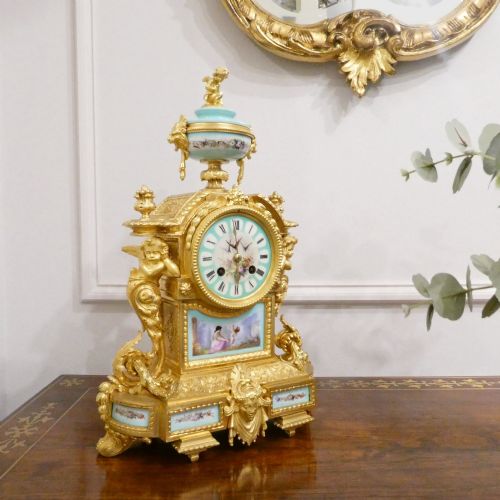
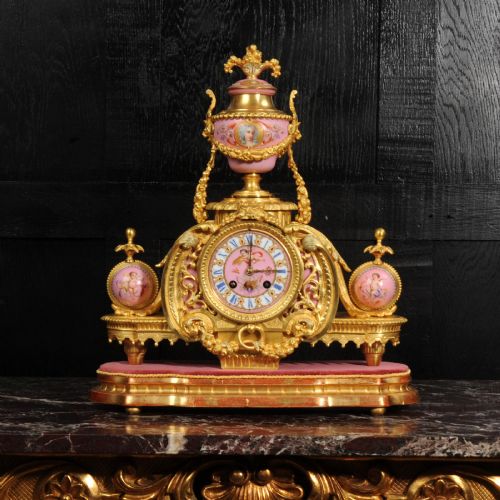
A sevres panel clock is a nineteenth-century French mantel timepiece mounted with porcelain plaques and set within a gilt metal case. These decorative objects emerge primarily from the Victorian era and the 1870s and 1880s, reflecting historicist revivals such as Louis XVI and Rococo.
The pieces appearing on this page take the form of mantel clocks, occasionally accompanied by stands and glass domes. Variants include crystal regulators and carriage clocks, all carrying painted ceramic sections alongside the main metal housing.
Materials and construction
The construction relies on the pairing of cast metal frames with ceramic components. Artisans utilised ormolu, gilt bronze, gilt brass, and gilt metal to form the structural case, often incorporating bevelled glass panels.
Porcelain plaques, styled after Sevres production and frequently hand-painted, are inserted into the metal chassis alongside enamel dials. Some configurations incorporate velvet linings and protective glass domes over the completed assembly.
Assessing quality in French mantel clocks
Quality rests upon the crispness of the gilt metal casting and the artistry of the painted porcelain panels. Finer examples display meticulous detailing in the ormolu mounts and delicate brushwork on the ceramic plaques.
The reputation of the maker also dictates standing, with documented firms commanding greater attention from collectors. Complete sets retaining original garnitures and protective glass domes represent the upper tier of surviving examples.
Achille Brocot·Japy Frères·Henri Jacot·JP Delettrez·Servant of Paris
The Sevres Panel Clock Glossary
- Ormolu
- Gilded bronze produced through a mercury amalgamation technique on cast metal. This finish provides the bright metallic lustre characteristic of nineteenth-century French cases.
- Garniture
- A matching set of decorative objects, often comprising a central clock flanked by vases or candelabra. These groups were designed to sit together on a mantelpiece.
- Crystal Regulator
- A clock housed within a glazed metal frame that exposes the movement from multiple sides. Pink porcelain panels frequently accent these specific transparent cases.
- Bell Striking
- A mechanical function where the clock sounds the hours or half-hours upon an internal bell. This auditory feature distinguishes striking clocks from silent timepieces.
- Enamel
- A glassy substance fused to metal dials to create a smooth, white surface for painted numerals. These dials are typical of nineteenth-century French clockmaking.
Sevres Panel Clock: Frequently Asked Questions
What periods do these clocks come from?
The available selection dates predominantly from the nineteenth century, with specific examples centred around the 1850s, 1870s, and 1880s. These pieces align with the Victorian period and French revival movements.
Stylistic influences lean heavily toward French Second Empire, Louis XVI Revival, and Rococo Revival aesthetics popular during that era.
How are porcelain panels incorporated?
Porcelain plaques are set directly into the gilt bronze or ormolu case, frequently featuring hand-painted pastoral scenes or floral motifs. These ceramic sections appear on the front plinth, sides, and dials.
Some designs utilise pink porcelain panels within transparent crystal regulator housings to showcase the internal mechanism.
Do these clocks come with glass domes?
Certain pieces are accompanied by their original glass domes and matching stands. These domes served to protect the delicate ormolu surfaces and painted porcelain from dust.
When present, the glass dome sits over the clock assembly, sometimes resting upon a velvet-lined wooden base.
How do I identify a Sevres style panel?
Sevres style panels on these clocks feature hand-painted imagery, often framed by gilt borders on a coloured porcelain ground. They mimic the distinctive aesthetic of the historic French porcelain manufactory.
These ceramic inserts work in tandem with the surrounding ormolu mountings to create a unified decorative object.