



Serpentine Marble Top Sideboard
When you search for serpentine marble top sideboard, you are looking at substantial display furniture defined by curved stone tops and rich timbers.
Serpentine Marble Top Sideboard
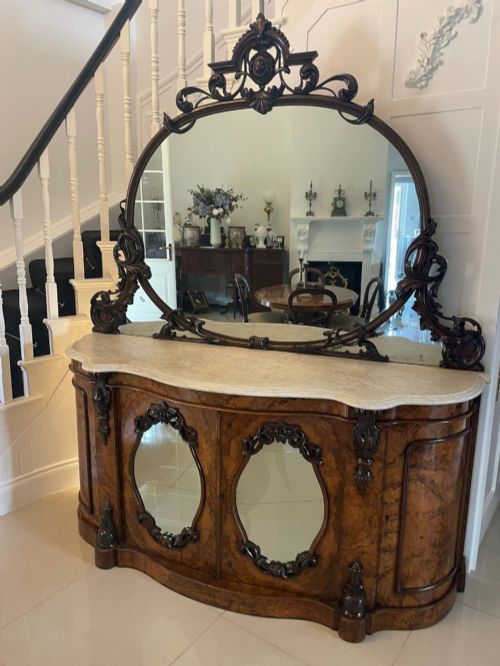
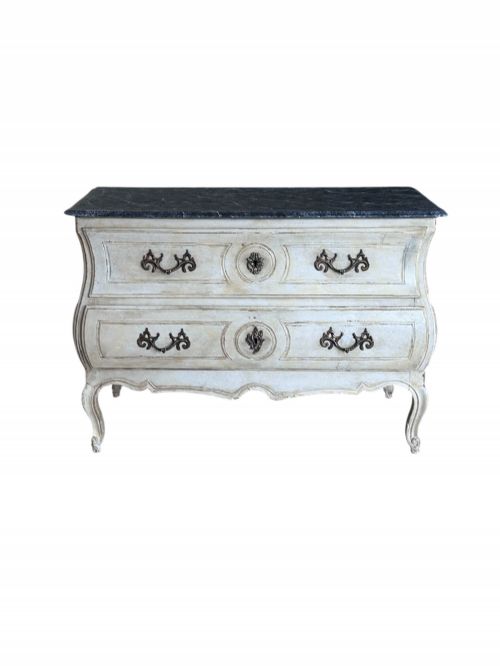
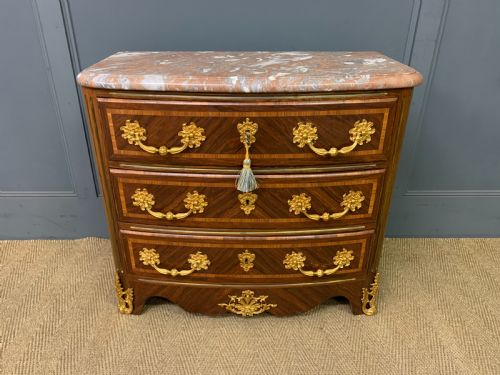
A serpentine marble top sideboard unites the distinctive undulating curves of a serpentine front with the cool elegance of fitted stone. Pieces meeting this description span several decades, encompassing nineteenth century Victorian iterations alongside continental commodes and credenzas.
The dominant forms on this page include credenzas, side cabinets, and commodes featuring prominent marble surfaces shaped to follow the flowing lines of the wooden carcass below. These items typically serve as principal focal points in reception rooms, providing both surface utility and substantial storage within domestic interiors.
Origins stretch from English workshops of the Victorian era to French ateliers influenced by Louis XV and Rococo styles. Buyers encounter everything from mirror-backed walnut credenzas to marquetry-inlaid mahogany cabinets and gilt bronze mounted pieces.
Materials and construction methods
Construction relies heavily on robust timber carcases built from walnut, burr walnut, mahogany, oak, and kingwood, often enhanced by intricate marquetry and contrasting veneers. Craftsmen shaped these woods to create the characteristic undulating front profiles.
Heavy marble slabs were meticulously cut and polished to match the complex curves of the wooden framework exactly. Ormolu, brass, and bronze mounts provide structural accents and decorative borders, secured alongside glass doors and carved mirror backs in specific Victorian and continental examples.
The recorded inventory spans the eighteenth century through the Victorian era into the early twentieth century.
Distinctions in quality and execution
Superior examples reveal themselves through the precision of the timber matching, particularly in burr walnut and marquetry patterns, alongside the crispness of bronze and ormolu mounts. The thickness and figuring of the marble top also indicate the original investment in materials.
Joinery standards define the upper tier, visible in the careful shaping of the serpentine timber fronts and the seamless integration of doors and drawers. Finer pieces demonstrate careful hand-carving and substantial hardware that remain solid and aligned across the centuries.
Gillows
The Serpentine Marble Top Sideboard Glossary
- Serpentine
- A front profile characterised by a central convex curve flanked by two concave curves. This shape requires advanced woodworking skill to execute properly.
- Credenza
- A grand display cabinet or sideboard typically featuring glass doors and decorative mounts. They gained prominence in elite Victorian and continental interiors.
- Ormolu
- Gilded bronze used for decorative mounts and furniture feet. The finish provides a rich metallic contrast against dark hardwoods like kingwood and walnut.
- Marquetry
- Inlaid wood designs forming decorative patterns across the surface of the furniture. Artisans use contrasting timber veneers to achieve pictorial or geometric effects.
- Commode
- A low chest of drawers, often highly decorative and associated with French design traditions. They frequently feature marble tops and gilt bronze mounts.
Serpentine Marble Top Sideboard: Frequently Asked Questions
How do I style a serpentine marble top sideboard?
These imposing pieces anchor a room naturally when placed against a principal wall in a dining room or drawing-room. Keep surface objects minimal to let the natural grain of the timber and the figuring of the stone remain the primary focus.
Pair the furniture with neutral wall colours that complement the warm tones of walnut, mahogany, or kingwood. Avoid overcrowding the marble surface, allowing the carved details and mounts to catch the light.
What is the difference between a credenza and a commode?
A credenza typically functions as a sideboard or display cabinet, often incorporating glass-fronted compartments and sometimes an elevated mirror back. They emerged strongly during the Victorian period for formal entertaining spaces.
Commodes originate primarily from continental traditions as decorative chests of drawers. They focus more on enclosed storage beneath the stone surface rather than display shelving.
How should I care for the marble top?
Clean the stone surface regularly with a soft, damp cloth and neutral soap, avoiding acidic substances like lemon or vinegar that can etch the polish. Use coasters beneath glasses and place mats under decorative objects to prevent scratching.
Apply a specialist stone sealer periodically if recommended by a conservator to protect against staining. Treat the surrounding wood with appropriate waxes rather than silicone-based polishes.
How can I tell a Victorian piece from an eighteenth-century one?
Eighteenth-century examples often display continental Rococo or Régence characteristics with lighter fruitwood timbers, elaborate ormolu mounts, and hand-cut dovetailed drawer construction. French commodes from this period carry distinct regional cabinet-making traits.
Victorian pieces frequently utilise heavier domestic timbers like burr walnut, sometimes incorporating mirror backs or robust four-door credenza configurations. Examining the interior secondary woods and construction hardware provides clear dating clues.