
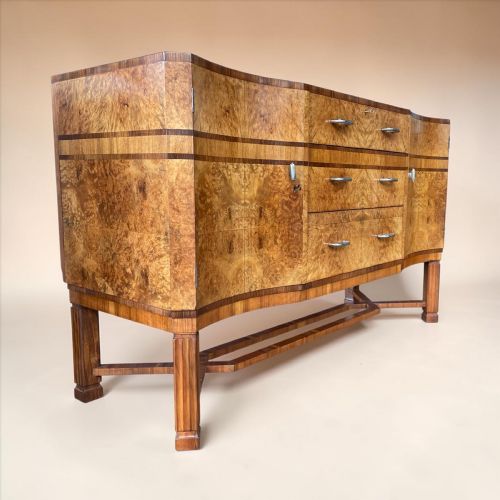
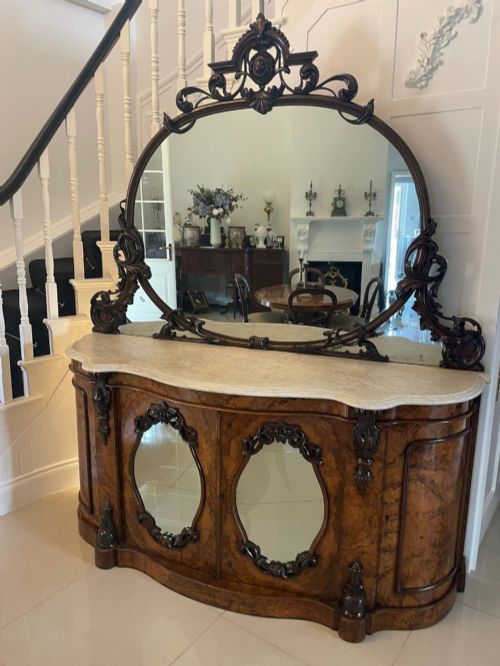
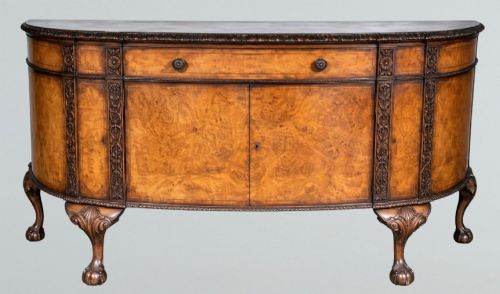
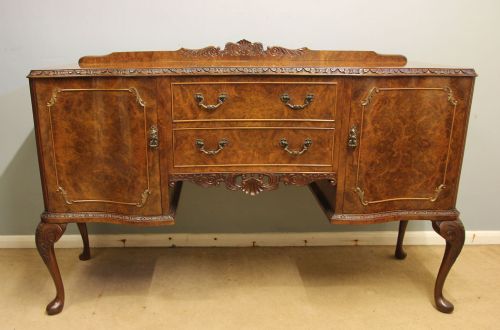
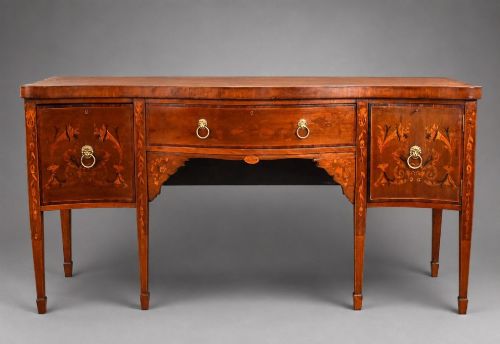
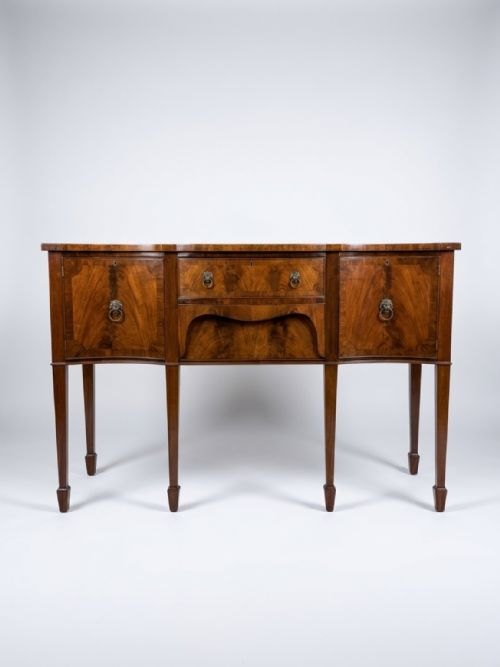
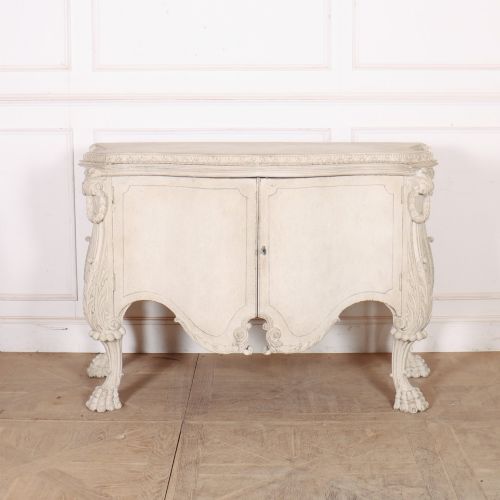
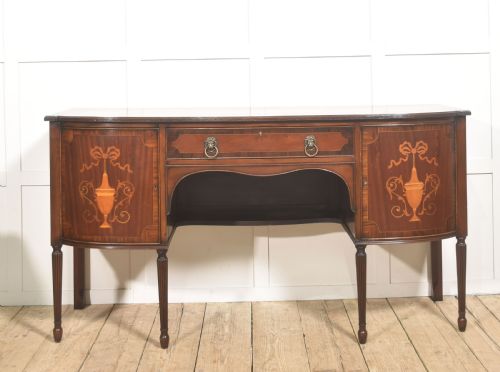


Serpentine Front Buffet Cabinet
These serpentine front buffet cabinet designs bring sweeping curves and substantial storage into a room, offering both presence and practicality.
Serpentine Front Buffet Cabinet
A serpentine front buffet cabinet search leads you to a varied selection of sideboards, credenzas, and commodes defined by their undulating, curved fronts. The pieces found here span multiple periods, ranging from 18th century Georgian examples to later Victorian, Edwardian, and Art Deco interpretations.
Mahogany and burr walnut dominate the forms on this page, often accompanied by marquetry, inlay, and occasional painted finishes. You will encounter everything from large four-door credenzas to compact servers and side cupboards.
Origins stretch across British, French, and Italian traditions, encompassing styles such as George III, Queen Anne Revival, and Italian Rococo. These furnishings served primarily for dining room storage and display, a function they continue to fulfil in modern interiors.
Materials and construction
Cabinet makers utilised choice hardwoods such as mahogany and burr walnut, frequently applying intricate marquetry patterns and contrasting inlays to the curved surfaces. Flame mahogany veneer provides strong grain figures on Georgian and later dining room pieces.
Mounts of brass and ormolu accent the cabinetry on specific credenzas and sideboards, adding metallic contrast to the timber. Glass doors appear on display compartments, whilst marble tops feature on select continental commodes and side cabinets.
Some sideboards arrive with hidden compartments designed specifically for concealing your best cutlery sets away from prying eyes.
Judging quality in curved cabinetry
The execution of the serpentine curve sets standard examples apart from exceptional ones, requiring precise joinery to maintain structural integrity along the undulating front. Finer pieces display continuous grain matching across multiple drawers and doors, particularly on burr walnut and flame mahogany surfaces.
The sophistication of the secondary decoration dictates the tier of the piece, from subtle boxwood stringing to elaborate pictorial marquetry and chased ormolu mounts. Exhibition quality items combine architectural scale with meticulous hand-carving and superior internal fittings.
The Serpentine Front Buffet Cabinet Glossary
- Serpentine front
- A furniture front characterised by a concave central section flanked by two convex ends, or the reverse. This undulating contour requires advanced woodworking skill to shape accurately.
- Credenza
- A grand display cabinet or sideboard, frequently featuring glass doors, mirrored backs, or ormolu mounts. Victorian examples in burr walnut are typical of this form.
- Marquetry
- The art of applying pieces of veneer to a structure to form decorative patterns and pictures. Walnut and various exotic woods provide contrasting tones in these designs.
- Ormolu
- Gilded bronze mounts applied as ornamentation to cabinet doors, corners, and friezes. This technique is prominent on nineteenth-century continental pieces.
- Commode
- A low decorative chest of drawers or cupboard, often of French or Italian origin. They frequently incorporate shaped marble tops and elaborate marquetry.
Serpentine Front Buffet Cabinet: Frequently Asked Questions
What is a serpentine front?
A serpentine front is a shaped furniture face that curves inward centrally and outward at the sides, creating a wave-like profile. This design adds dynamic movement and visual depth to large case pieces.
Crafting this contour demands precise carpentry to ensure doors and drawers fit seamlessly within the curved framework.
Where were these cabinets used?
These furnishings were traditionally placed in dining rooms and formal reception spaces to store cutlery, linen, and glassware. Credenzas and sideboards also provided a surface for serving food and displaying silver.
Today, they function effectively in living rooms, hallways, and dining spaces as both storage solutions and focal points.
How do I care for burr walnut?
Burr walnut veneer requires protection from direct sunlight and excessive moisture to prevent fading and splitting. Regular dusting with a soft, dry cloth preserves the polished surface.
Occasional application of appropriate wax polish maintains the natural lustre of the timber without building up heavy residues.
How do I distinguish Georgian from Victorian pieces?
Georgian pieces generally favour solid mahogany with restrained classical lines, subtle stringing, and functional proportions. They reflect the architectural focus of the eighteenth century.
Victorian items often embrace burr walnut, elaborate carving, mirrored backs, and decorative ormolu mounts, showing a taste for ornate revival styles.