


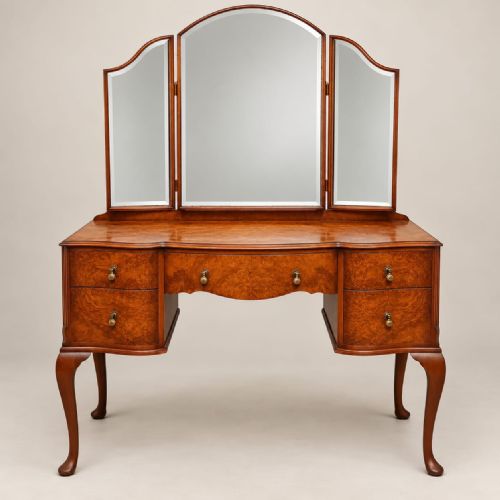
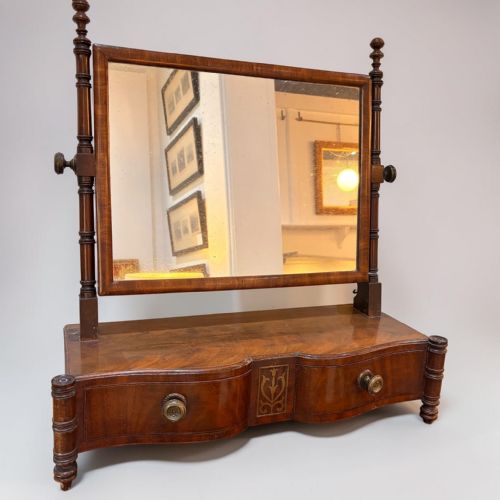

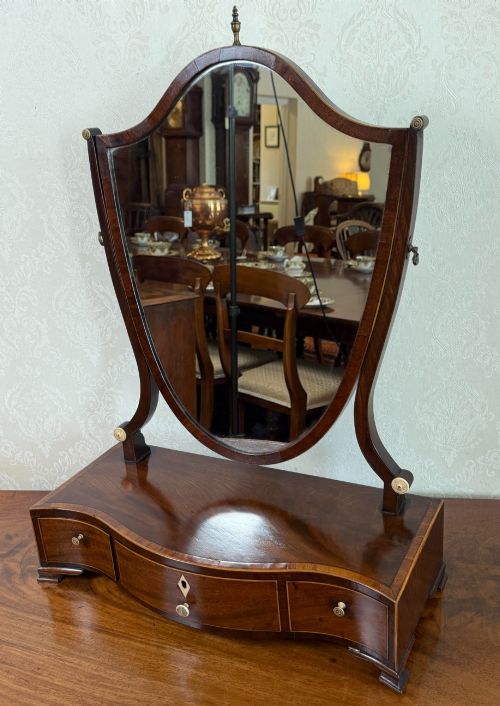

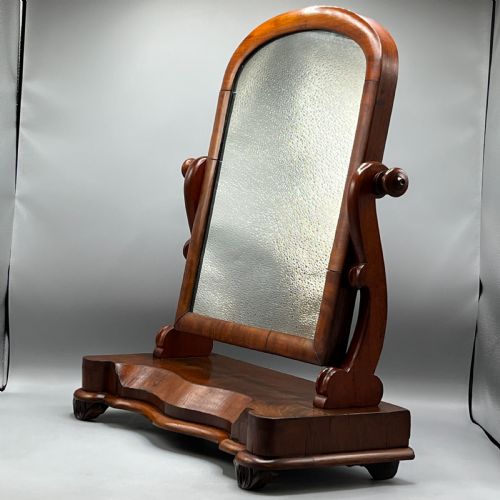


Serpentine Dressing Table Mirror
A serpentine dressing table mirror brings fluid, undulating lines to a chest or table, offering a practical glass set within a shaped wooden frame.
Serpentine Dressing Table Mirror
A serpentine dressing table mirror sits on a tabletop or box base, featuring a glass plate held by upright arms above a small set of drawers. The serpentine outline curves inward at the centre and swells outward at the ends, creating a rhythmic profile that distinguishes these pieces from straight-fronted alternatives.
Most examples found here date from the eighteenth and nineteenth centuries, spanning the Georgian, Regency, and Victorian periods. Mahogany predominates as the primary timber, often enhanced by boxwood inlay or stringing, alongside occasional walnut and painted finishes.
Forms vary between rectangular plates, oval glasses, and shield shapes perched on box bases containing three small drawers. They function as movable toilet mirrors designed to sit upon larger dressing tables or chests.
Materials and Construction
Cabinetmakers constructed these mirrors using solid mahogany and walnut, shaping the characteristic curved front by cutting the timber or bending veneer over a shaped carcase. Boxwood inlay and fine stringing frequently accent the drawer fronts and edges, adding linear contrast to the figured wood.
Brass pivot screws and side arms connect the mirror frame to the upright supports, allowing the glass to tilt at different angles. Small bone or ivory escutcheons often surround the keyholes on the miniature drawers set into the base.
Serpentine Dressing Table Mirror Retail Price Guide 2026
Typical asking prices for serpentine dressing table mirror among the pieces listed under this phrase on Sellingantiques today, from the lower quarter to the upper quarter. They describe what is for sale here now, not the wider market.
Many miniature drawers are just deep enough to lose a pair of cuff links forever.
Judging Quality and Execution
Quality rests in the precision of the serpentine curve and the selection of the timber, where heavily figured flame mahogany or plum pudding mahogany elevates a piece above plain stock. Sharp, clean lines in the boxwood inlay and well-proportioned drawer spacing distinguish superior workshop production.
The integration of the base box to the mirror frame shows the maker's hand, particularly where dovetails are cut finely and original brass hardware remains intact. Heavier, less fluid shaping in the wood indicates standard commercial work rather than top-tier cabinetmaking.
The Serpentine Dressing Table Mirror Glossary
- Serpentine
- A curved shape featuring a convex centre flanked by concave wings, or vice versa, creating a flowing wave pattern along the front edge.
- Toilet Mirror
- A period term for a dressing table mirror designed to sit on a chest or table for grooming.
- Stringing
- Thin bands of contrasting wood, often boxwood, inlaid into flush channels to create decorative borders.
- Shield Mirror
- A dressing glass cut into the shape of a heraldic shield, popular during the late eighteenth century.
- Box Base
- The compartmented plinth beneath the mirror frame containing small drawers for storage.
Serpentine Dressing Table Mirror: Frequently Asked Questions
What is a serpentine dressing table mirror?
A serpentine dressing table mirror is a small, movable glass set into upright supports mounted on a miniature drawer base. The front edge of this base curves in a distinct wave pattern.
Cabinetmakers produced these pieces primarily in mahogany during the Georgian and Victorian eras for placement on larger tables.
How do I date a dressing mirror?
Dating relies on timber choice, hardware, and the outline of the frame. Eighteenth-century examples often display fine mahogany with boxwood stringing and delicate bracket feet.
Victorian pieces tend to be heavier in scale, sometimes utilising flame mahogany or painted finishes while retaining the pivoting glass design.
Were these mirrors attached to tables?
Most serpentine dressing table mirrors are freestanding tabletop objects rather than fixed components. Their heavy box bases keep them stable without requiring permanent fastenings to the surface beneath.
Owners could move them freely between dressing tables, sideboards, and chests of drawers.