

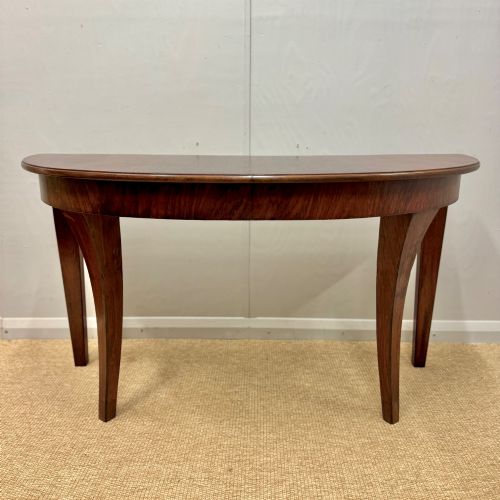
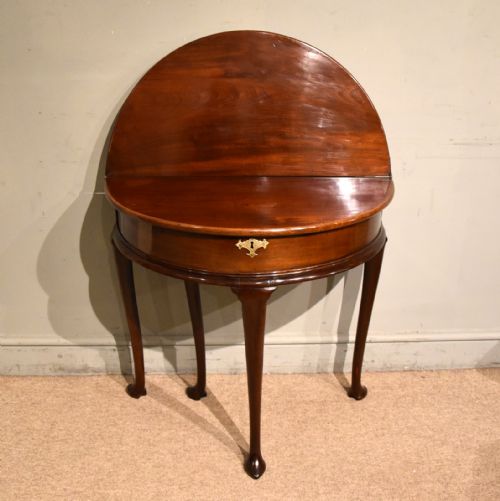


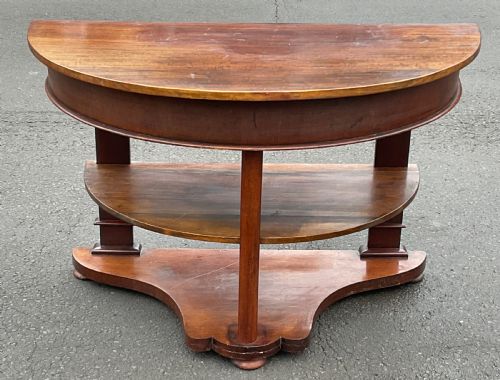

Semicircular Console Table
These semicircular console table pieces bring architectural grace and compact wall-fitting utility to a room.
Semicircular Console Table
A semicircular console table offers a flat straight edge to sit against a wall while curving outward into the room, making it a natural choice for narrow hallways, reception rooms and drawing rooms where floor space is limited. When you search for a semicircular console table, you encounter half-round demi-lune forms that often double as fold-over card or tea tables for dual-purpose entertaining.
The selections available span the Georgian, Regency and Victorian eras, alongside continental examples including French, Dutch and Swedish pieces. You find straightforward timber constructions as well as elaborate revival designs following Adam and Louis XVI neoclassical styles.
Most pieces date from the eighteenth and nineteenth centuries, utilising traditional cabinet-making proportions designed to stand elegantly beneath mirrors or paintings without protruding too far into the walkway.
Materials and construction methods
Makers constructed these tables from dense cabinet timbers including mahogany, rosewood, oak and satinwood, frequently applying crossbanding and intricate inlay work to the top surfaces. Bleached mahogany and rich giltwood also appear, showing how cabinetmakers adapted timber tones and gilded highlights to suit changing interior fashions.
Many versions incorporate figured veneers laid over sturdy secondary woods, requiring precise carpentry to maintain the smooth curve of the demi-lune apron. Heavy white or variegated marble tops feature on specific continental examples, resting upon structural wooden frames designed to bear the stone weight.
Leg configurations vary from tapering straight supports to concave legs and formal neoclassical pillars, joined securely to the frieze to support the weight of a folding top or heavy marble slab.
Swedish makers contributed curved tables that brought a touch of pale Nordic restraint to the traditional English hallway.
Distinctions in standard and execution
The quality of a semicircular console table rests upon the crispness of its inlaid details, the choice of figured timber veneers, and the structural integrity of the curved framework. Superior examples demonstrate seamless joint work along the radius and precise alignment where folding leaves meet.
Design ambition separates standard functional furniture from high-style decorative pieces, seen in the depth of neoclassical carving, the proportion of the brass mounts, and the sophistication of painted or giltwood surfaces. Finer pieces command attention through harmonious proportions and carefully selected grain patterns that follow the curve of the top.
The Semicircular Console Table Glossary
- Demi-lune
- Half-moon shaped. This term describes tables built with a flat back for placement against a wall and a curved front.
- Crossbanding
- A border of veneer laid with the grain running perpendicular to the main surface. It frames the top of the table to create a neat geometric edge.
- Frieze
- The horizontal band beneath the tabletop. This area often carries inlay, veneer panels or decorative carving.
- Fold-over
- A hinged tabletop design that doubles the surface area when opened. It allowed dining or gaming use in smaller reception spaces.
- Neoclassical
- A style drawing inspiration from classical antiquity. It introduces symmetrical lines, urn motifs and tapered legs to furniture design.
Semicircular Console Table: Frequently Asked Questions
Where should I place a semicircular console table?
These tables suit hallways, entrance passages and drawing rooms where a deep rectangular piece would block the walkway. Their flat back rests flush against the wall while the curved front softens the geometry of the room.
They also sit effectively beneath wall mirrors or portrait paintings, creating a balanced focal point without demanding excessive floor space.
How do I use a fold-over console table?
A fold-over version functions primarily as a decorative side table against the wall when closed. Opening the hinged top swings out a rear support leg to reveal a larger surface intended historically for card games or tea service.
This dual-purpose design allows you to transform a narrow hallway piece into a functional table for entertaining guests when needed.
How do I tell Georgian tables from Victorian ones?
Georgian and George III pieces generally rely on refined mahogany, satinwood inlay and restrained neoclassical proportions. They emphasise balanced woodwork and subtle decorative banding.
Victorian and later nineteenth-century interpretations often feature bolder rosewood grains, heavier proportions or revival styling such as Adam and Louis XVI influences.
What is the difference between a demi-lune and a console table?
A console table is a general category for wall-mounted or freestanding tables designed to sit against a flat surface. A demi-lune specifically defines the half-moon shape of the table.
All demi-lune tables function as console tables, but not all console tables share the semicircular front.