


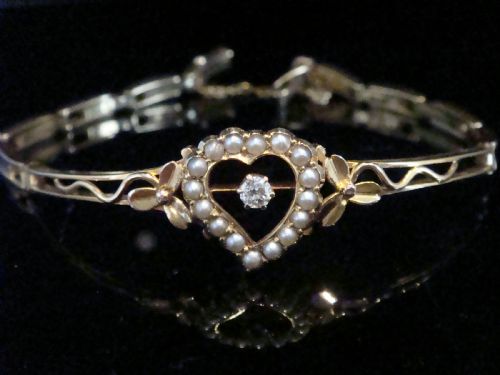


Seed Pearl Gold Bangle
A seed pearl gold bangle brings together delicate lustrous pearls and rich precious metal, capturing the romantic spirit of nineteenth and early twentieth-century jewellery.
Seed Pearl Gold Bangle
A seed pearl gold bangle is a rigid wrist ornament fashioned from gold and set with tiny pearls, frequently encountered on this page in Victorian and Edwardian iterations. These pieces span from the late nineteenth century into the 1930s, encompassing styles such as Art Deco alongside traditional Victorian and Edwardian designs.
The physical forms include hinged cuffs, twin bangles, and solid hoops, often incorporating symbolic motifs like double hearts, lovers knots, and horseshoes. Gemstones such as turquoise, diamond, amethyst, citrine, and moonstone regularly accompany the pearls within these bracelet formats.
Makers utilised various purities of gold, ranging from 9ct and 15ct to 18ct yellow and rose gold, alongside rolled gold and platinum. The selection on this page reflects a rich heritage of British and international craftsmanship from periods including 1880, 1900, 1910, and subsequent decades.
How they were made
Goldsmiths constructed these bangles using traditional casting, wire-work, and sheet-forming techniques in 9ct, 15ct, and 18ct gold, as well as platinum and rolled gold. Metal components were shaped into hollow or solid hoops, cuff structures, and articulated links designed to fit the wrist securely.
Tiny seed pearls were meticulously drilled and secured onto the metal work, often held by minute pins or prongs alongside supplementary stones like diamonds, turquoise, and garnets. Original presentation cases occasionally accompanied these items, pointing to the high regard in which such jewellery was originally held.
Some Victorian makers hid tiny glass locket compartments inside bangles so wearers could keep a lock of a loved one's hair close at hand.
What varies in quality
The grade of the gold, whether 9ct, 15ct, or 18ct, sets the baseline for intrinsic material value, while the presence of platinum adds further substance. Heavier gram weights and robust hinge construction distinguish substantial pieces from lighter everyday wear.
The uniformity, lustre, and security of the seed pearls, combined with the quality of accompanying gems like diamonds, sapphires, and aquamarines, elevate the refinement of the design. The survival of original details, such as fitted boxes or intricate metalwork like lover's knots and double hearts, marks the distinction between standard and exceptional pieces.
The Seed Pearl Gold Bangle Glossary
- Seed pearl
- A very small natural or cultured pearl, typically measuring under two millimetres in diameter. These tiny gems were often used in clusters or pavé settings during the Victorian and Edwardian eras.
- Bangle
- A rigid bracelet that slips over the hand or opens with a hinge and clasp. They are designed to encircle the wrist firmly rather than drape loosely.
- 15ct gold
- An alloy containing 62.5 percent pure gold, widely utilised in British jewellery manufacture during the Victorian and Edwardian periods before being largely replaced by 9ct and 18ct standards.
- Crossover
- A ring or bangle design where the two ends of the band cross over one another, often symbolising intertwined lives or embracing twin motifs.
Seed Pearl Gold Bangle: Frequently Asked Questions
How do I wear a seed pearl gold bangle?
These delicate bangles suit daily wear when treated with appropriate care, though their fine pearls require protection from harsh chemicals and rough impacts. Pairing them alone or alongside modern bracelets allows the historic metalwork and pearl lustre to remain the focal point of an outfit.
Because many examples feature secure box clasps or safety chains, they stay comfortably in place throughout the day. Storing them individually in soft pouches prevents the seed pearls from scratching against other items in a collection.
What periods do these bangles come from?
The pieces span the Victorian and Edwardian eras, with specific dates reaching back to 1880 and forward into the 1930s. Art Deco influences also appear in later examples from the twentieth century.
Design motifs and gold standards help identify the exact era of production. For instance, 15ct gold points firmly to nineteenth and early twentieth-century British manufacture.
How should I clean a pearl bangle?
Cleaning requires a soft, dry or barely damp cloth to gently wipe away surface dust without disturbing the delicate seed pearls. Submerging pearl jewellery in water or liquid cleaners can weaken the traditional stringing or adhesives used in setting.
Professional jewellers can inspect the settings to ensure every tiny pearl and gemstone remains secure within its gold mount. Regular gentle maintenance preserves the natural lustre of the pearls for years to come.
Are these bangles solid gold?
The listings include pieces fashioned from solid 9ct, 15ct, and 18ct yellow and rose gold, alongside variations involving platinum and rolled gold. Hallmarks and specific metal weights often indicate the exact composition of each item.
Solid gold items offer greater durability and intrinsic value compared to plated alternatives. Checking the individual details of a piece reveals whether the structure is entirely solid or incorporates hollow core construction for lightness.