

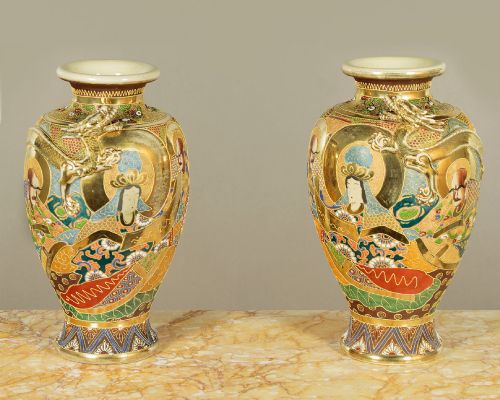


Satsuma Arhat Vase
A satsuma arhat vase brings intricate Meiji period earthenware and heavy gilt decoration into a room.
Satsuma Arhat Vase
A satsuma arhat vase is a ceramic vessel depicting figures of enlightened sages, known as arhats or rakan, often accompanied by dragons or processional scenes. These pieces belong predominantly to the 19th century and the Meiji period, reflecting Japanese ceramic traditions aimed at export and domestic display.
Buyers frequently encounter hexagonal forms, pairs, and monumental vases featuring religious and landscape panels. The visual impact relies on dense figural painting combined with elaborate surface ornament.
Origins trace to Kyoto and other production centres during the Victorian era and the early twentieth century, spanning Meiji, Taisho, and Showa periods.
Materials and construction
These vessels are formed from earthenware bodies, finished with intricate enamel work and enriched with gold leaf or gold gilt. Certain examples incorporate moulded elements such as elephant handles or raised moriage details.
The surface decoration requires precise brushwork to delineate individual arhat figures, dragons, and robed processions across complex geometric forms like polygons and hexagons.
Satsuma Arhat Vase Retail Price Guide 2026
Typical asking prices for satsuma arhat vase among the pieces listed under this phrase on Sellingantiques today, from the lower quarter to the upper quarter. They describe what is for sale here now, not the wider market.
Listings span the nineteenth century and the Meiji period, featuring earthenware decorated with enamel, gold leaf, and wood elements.
Distinctions in craftsmanship
Quality rests upon the precision of the figural painting and the density of the gilt decoration. Finer examples display disciplined control in the rendering of facial expressions and drapery on the arhats.
Scale and structural ambition also divide the range, separating modest miniature vessels from monumental Kyoto satsuma vases and matched pairs.
Hotoda·Seiko-en Chokei·Hattori
The Satsuma Arhat Vase Glossary
- Arhat
- A perfected person or Buddhist sage depicted in painted panels on these ceramics. They appear singly or in large groups alongside dragons.
- Meiji Period
- The era spanning from eighteen sixty-eight to nineteen twelve, which produced the majority of these decorated earthenware vessels. It marked a period of intense artistic output for export.
- Moriage
- A decorative technique using slip trailing to build up raised patterns on the ceramic surface. This adds tactile relief beneath the enamel and gilding.
- Shimazu Crest
- The heraldic badge of the Shimazu clan, frequently found on satsuma ware. It denotes patronage or production associated with the domain.
- Gilt
- Application of gold leaf or gold paint used to accentuate borders, robes, and background motifs. It provides the characteristic metallic richness of these pieces.
Satsuma Arhat Vase: Frequently Asked Questions
What are arhats on these vases?
Arhats are Buddhist sages or holy figures depicted in detailed figural processions and panel scenes across the ceramic body.
They appear alongside dragons and landscape elements, painted with individual expressions and traditional robes.
How do I identify a Meiji period piece?
Meiji period vessels date from the late nineteenth or early twentieth century, characterised by earthenware bodies and extensive gilt decoration.
Styles from this era often feature complex hexagonal shapes and signed artist panels.
Where were these vases made?
Production centres include Kyoto and other regions associated with Japanese satsuma ware during the nineteenth century.
Export demand shaped the large scale and intricate narrative scenes developed by workshops of the period.
How should I display a large satsuma vase?
Large and monumental examples require stable placement on sturdy surfaces to support their substantial earthenware weight and height.
Positioning them away from direct foot traffic protects the delicate enamel and gold gilt details.