
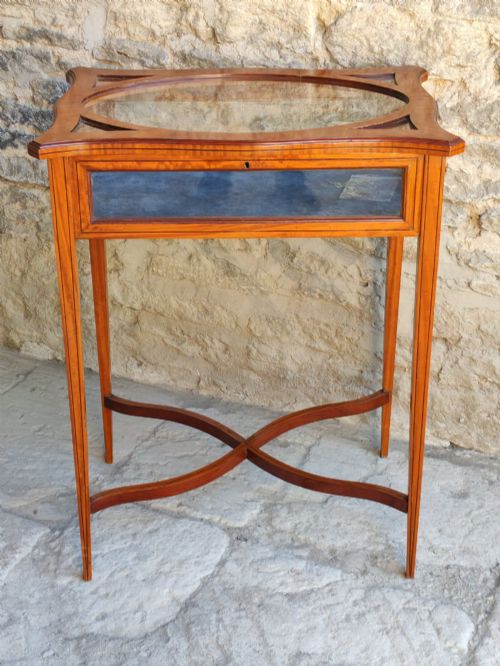
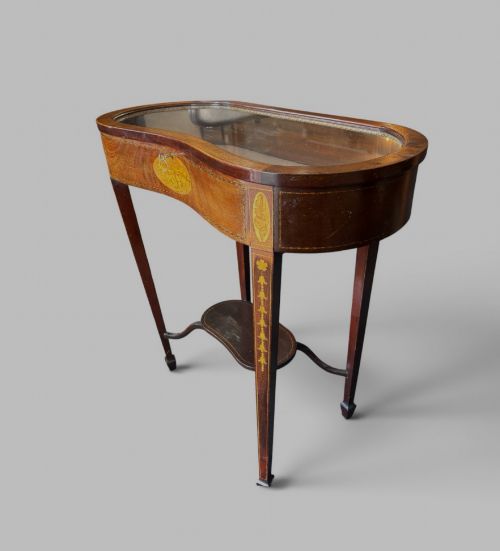


Satinwood Table Box
Satinwood table box examples bring together golden timbers and precise marquetry to hold letters, trinkets or sewing tools.
Satinwood Table Box
A satinwood table box is a compact lidded container designed to sit on a desk or table, often housing compartments for letters, sewing implements or small personal items. These pieces emerge in various forms across the eighteenth and nineteenth centuries, spanning Georgian, Regency, Victorian and Edwardian periods.
The versions most commonly met in this selection date from the nineteenth century and the Edwardian era, taking the shape of rectangular table boxes, work boxes and small cabinets. Makers frequently combined satinwood with contrasting timbers like mahogany, rosewood and boxwood to create geometric stringing or intricate pictorial inlays.
Materials and Construction
Makers built these pieces using solid timbers or applied fine satinwood veneers over a secondary wood base, often incorporating boxwood, harewood and ebony for contrasting stringing and borders. Surface decoration relied heavily on detailed marquetry and hand painting, sometimes pairing the pale, lustrous satinwood grain with darker rosewood crossbanding.
Internal fittings required precise cabinetmaking, using secondary woods to construct lift-out trays, compartmentalised inserts and small lidded wells. Brass hinges, locks and escutcheons secured the lids and doors, providing both structural durability and a decorative metallic contrast to the golden timber.
Listings feature satinwood combined with mahogany, rosewood, boxwood and harewood across Georgian, Victorian and Edwardian periods.
Judging Quality
Quality rests upon the selection of the timber and the precision of the cabinetwork, where beautifully figured, highly chatoyant satinwood grain distinguishes superior examples from plain surfaces. The crispness of the boxwood and ebony inlay reveals the hand of a skilled maker, maintaining tight joints without visible gaps or filler.
Internal execution matters just as much as exterior presentation, separating workshop standards through the neatness of fitted compartments, original brass hardware and undamaged linings of fabric or velvet. Pieces that retain their original working locks and key hold greater integrity than those altered or repaired over time.
Mappin & Webb
The Satinwood Table Box Glossary
- Satinwood
- A hard, durable timber with a natural golden sheen and close grain that accepts fine veneer work and polish readily.
- Marquetry
- Decorative patterns formed by fitting together small pieces of tinted or contrasting wood veneer into a surface.
- Crossbanding
- A strip of veneer applied to the border of a table top or box lid so that the grain runs at right angles to the central panel.
- Stringing
- Thin lines of contrasting timber inlaid into channels cut into the surface of the wood to outline panels or drawers.
- Bijouterie table
- A glass-topped display table designed to showcase small decorative objects, sharing materials with many work boxes.
Satinwood Table Box: Frequently Asked Questions
What is a satinwood table box used for?
These boxes served multiple domestic functions, primarily holding letters, stationery, sewing accessories or small personal valuables on a desk or side table.
Inside, many feature fitted trays and compartmentalised inserts designed to keep small implements organised and secure under a lockable lid.
How do I date a satinwood table box?
Dating relies on combining construction methods, hardware types, timber choices and the prevailing decorative style of the period.
Georgian and Regency examples often show clean lines with fine boxwood stringing, while Victorian and Edwardian pieces frequently incorporate heavier marquetry, hand painting or broader crossbanding.
Are these boxes made of solid satinwood?
Many examples utilise satinwood veneers applied over a stable secondary wood base like mahogany or pine to prevent warping.
Solid satinwood does appear on certain pieces, particularly in specific nineteenth-century trunks and work tables, though veneer remained standard for intricate decorative marquetry.
How should I care for a satinwood surface?
Satinwood requires protection from direct sunlight and extreme humidity fluctuations to prevent the natural timber from fading or drying out.
Gentle dusting with a soft, dry cloth maintains the finish, avoiding harsh commercial polishes that can build up a cloudy residue over the grain.