
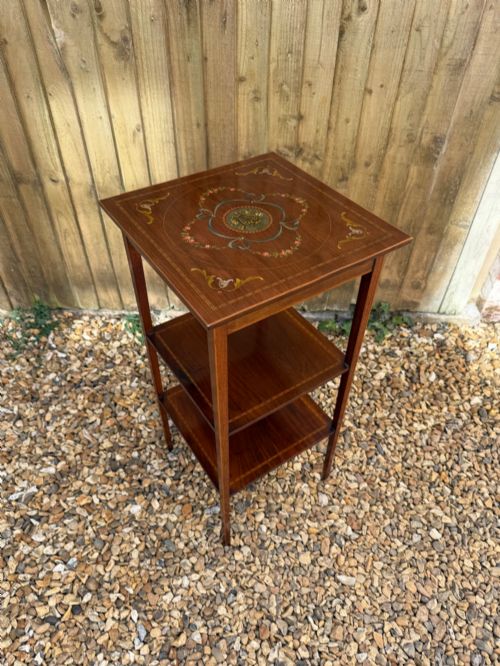


Satinwood Inlay Etagere
A satinwood inlay etagere brings tiered display and subtle timber contrast into a room.
Satinwood Inlay Etagere
A satinwood inlay etagere is a multi-tiered display table designed for ornaments and small objects, appearing frequently in Edwardian and Victorian forms. These pieces often combine satinwood with mahogany, rosewood, or walnut across oval and rectangular shapes.
The version most commonly met on this page is the Edwardian or late nineteenth-century two-tier table, often featuring delicate stringing or floral marquetry. Such pieces provide open surface space without dominating a room.
How these pieces were made
Construction relies on contrasting timbers such as mahogany and satinwood, enhanced by boxwood inlay, bone, and ebony details. Cabinetmakers shaped veneers over solid carcases to create smooth curved or oval shelves.
Marquetry and painted decoration are applied to upper surfaces to frame the grain of the wood. Brass fittings and glass elements appear selectively on cabinets and tray tables to complete the construction.
Materials recorded across current pieces include brass, glass, paint, and walnut alongside the principal satinwood and mahogany.
What varies in quality
Quality rests on the crispness of the inlay work and the depth of figure in the satinwood veneer. Finer examples display precise botanical or geometric banding that integrates cleanly into the surrounding timber.
The choice of secondary woods and the refinement of turned supports distinguish standard production from more ambitious cabinetmaking. Heavier structural proportions yield to lighter, balanced framing in better pieces.
The Satinwood Inlay Etagere Glossary
- Etagere
- A piece of furniture consisting of open shelves for displaying small objects or ornaments. It usually stands on slender legs and offers multiple tiers.
- Satinwood
- A dense, lustrous timber with a characteristic golden sheen used extensively for veneers and decorative banding. It catches the light differently depending on the grain orientation.
- Marquetry
- The art of applying pieces of veneer to a structure to form decorative patterns and pictures. Craftsmen cut various woods to fit together precisely within the surface.
- Stringing
- A narrow line of contrasting wood inlaid into a surface to form a border or outline. This technique defines the edges of panels and table tops.
- Whatnot
- An alternative nineteenth-century term for an etagere or multi-tiered open shelving unit. It served a similar purpose for domestic display.
Satinwood Inlay Etagere: Frequently Asked Questions
What is an etagere used for?
An etagere provides open tiers for holding small decorative objects, porcelain, or writing equipment.
Historically placed in reception rooms and parlours, it allowed owners to display collections without heavy cabinetry.
How do I date a satinwood etagere?
Dating relies on timber combinations, inlay style, and structural proportions recorded across the periods.
Edwardian pieces often show lighter framing and refined stringing, while Victorian examples lean towards heavier marquetry and denser timbers.
Are these tables sturdy?
Most etageres are built with slender uprights and multiple tiers designed for light decorative display rather than heavy loads.
Placing them against a wall or in a low-traffic corner helps protect the delicate legs and tiered joints.
What woods are combined with satinwood?
Makers most frequently paired satinwood with mahogany, rosewood, and walnut to create contrast through colour and grain.
Boxwood, ebony, and bone also appear in fine inlay work to add sharp linear definition.