

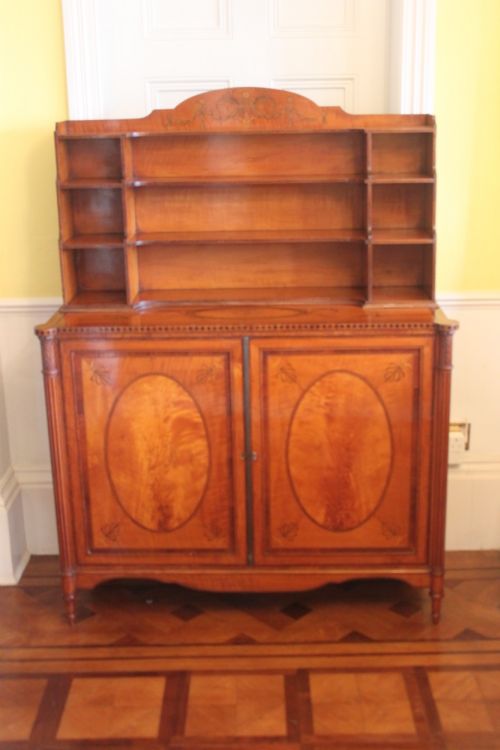
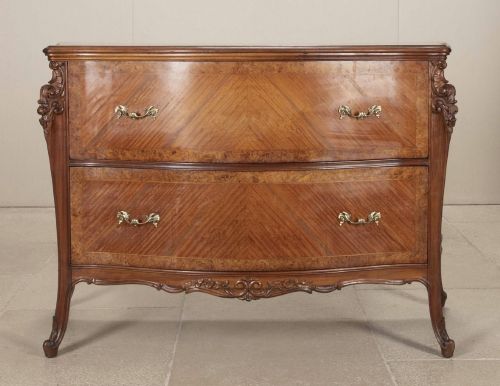
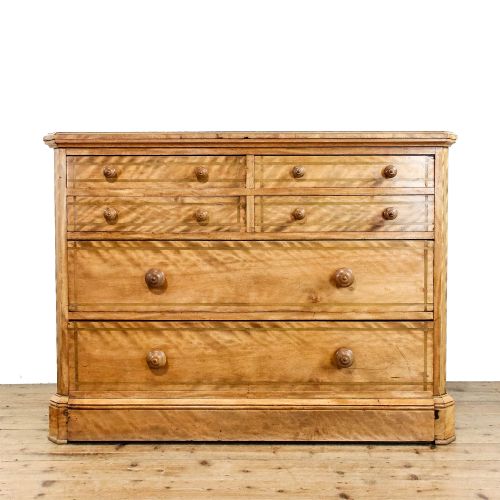
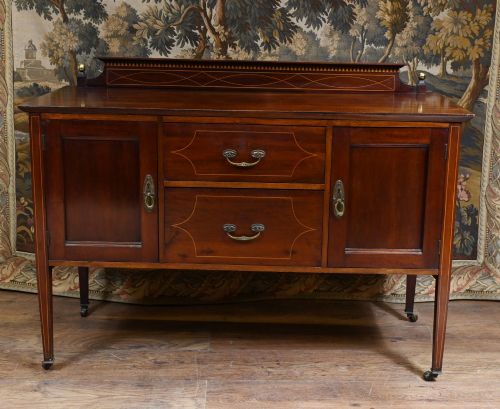
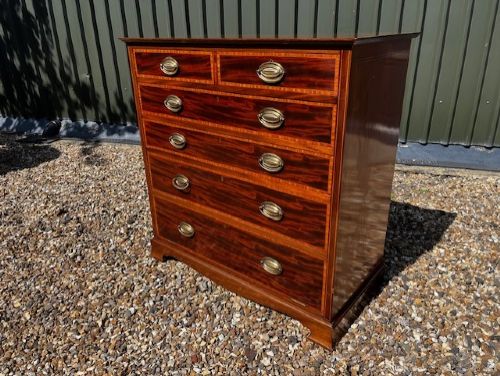


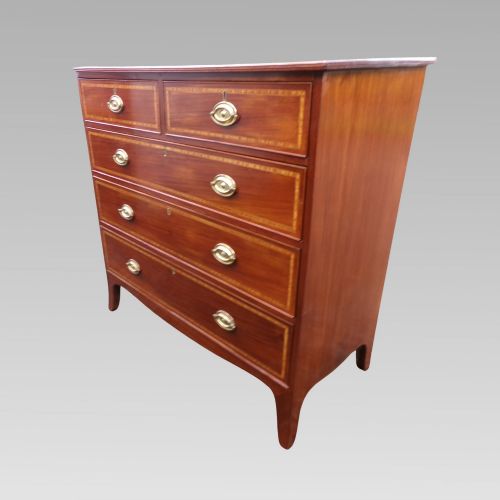


Satinwood Inlaid Dresser
A satinwood inlaid dresser brings bright timber contrast and refined geometric banding to a traditional storage piece.
Satinwood Inlaid Dresser
When you search for a satinwood inlaid dresser, you encounter pieces that function primarily as chests of drawers, sideboards, or commodes rather than traditional kitchen dressers. These items span periods from the 18th century through the Edwardian era, incorporating styles such as Sheraton, Georgian, and Regency.
The version most commonly met on this page is the Edwardian or 19th-century chest of drawers or sideboard constructed from mahogany or satinwood. These frequently feature contrasting timber inlay, line inlay, or serpentine fronts that reflect classical revival aesthetics.
How they were made
Cabinet makers utilised dense primary timbers like mahogany and satinwood, often accentuating surfaces with contrasting veneers such as burr walnut, satin birch, and harewood. These foundational woods provided stability and rich grain patterns suited for domestic furniture.
Timber inlay and marquetry techniques created intricate geometric borders and decorative motifs. Metal hardware in brass completed the construction, fastened alongside specialised joinery to support heavy drawer configurations.
Some cabinet makers hid secret compartments within standard drawer layouts to protect small valuables.
What varies in quality
The standard of a piece depends heavily on the precision of the timber inlay and the choice of secondary woods. Superior examples demonstrate tight alignment in their contrasting wood bands and sophisticated serpentine or bow front profiles.
Construction methods and overall proportions separate standard items from superior works. Finer pieces maintain balanced symmetry in their marquetry and retain robust structural integrity across large sideboards and tall chests.
Gillows
The Satinwood Inlaid Dresser Glossary
- Satinwood
- A pale, lustrous hardwood with a natural sheen, prized for decorative banding and veneers. It forms the visual centrepiece of many classical revival designs.
- Inlay
- A technique where pieces of contrasting timber are inserted into recesses within a solid wood surface to create flat patterns. Line inlay uses thin strips for simple framing.
- Serpentine
- A furniture front shape that curves outward in the middle and inward at the sides in an 'S' shape. This undulating profile requires advanced woodworking skill.
- Marquetry
- The art of applying small pieces of veneer to a structure to form decorative pictures or complex ornamental designs. It differs from simple inlay by covering entire surfaces.
- Commode
- A low chest of drawers or cabinet originating in France, commonly used for storage in bedrooms and formal reception rooms. British makers adopted the form during the 18th and 19th centuries.
Satinwood Inlaid Dresser: Frequently Asked Questions
What is satinwood?
Satinwood is a dense, light-coloured tropical hardwood known for its reflective, silky grain. Cabinet makers utilised it extensively for veneers and decorative banding.
Its bright appearance made it a favourite material for contrasting against darker timbers like mahogany during the 18th and 19th centuries.
How do I identify Sheraton revival pieces?
Sheraton revival furniture typically dates from the Edwardian period or late 19th century and imitates the light, classical forms of the 18th-century designer. Look for slender proportions, satinwood inlay, and symmetrical geometric patterns.
These pieces often combine mahogany carcasses with lighter wood stringing and brass hardware.
Where were these cabinets used?
These pieces served primarily in formal reception rooms, dining rooms, and principal bedrooms for storing linens, tableware, and garments. Sideboards stood in dining spaces, while chests and commodes furnished sleeping quarters.
Their decorative inlay ensured they functioned as display surfaces as well as practical storage.
What is a serpentine front?
A serpentine front is a cabinet or chest profile featuring a convex centre flanked by concave curves. This undulating shape demands precise woodworking and careful timber selection.
It appeared frequently on high-quality commodes and chests across the Georgian and Regency periods.