

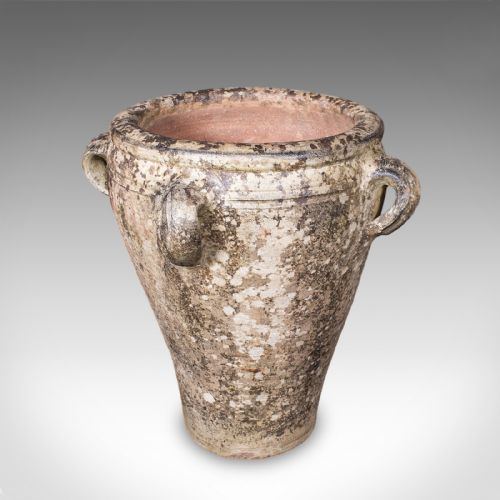


Rustic Clay Pot
A rustic clay pot carries the honest weight of utilitarian earth, shaped for garden and kitchen use.
Rustic Clay Pot
A rustic clay pot provides a functional vessel designed for practical storage, water transport, or planting.
The versions most often met on this page span the nineteenth century, including Victorian examples alongside French, Italian, Portuguese, and Turkish forms.
Forms range from tall garden planters and olive jars to architectural chimney pots and kitchen cooking dishes.
What varies in quality
Quality rests upon the harmony of proportion and the integrity of the thrown clay body.
Patina accrued through decades of exposure to soil and weather separates utilitarian survivors from standard vessels.
Rustic Clay Pot Retail Price Guide 2026
Typical asking prices for rustic clay pot among the pieces listed under this phrase on Sellingantiques today, from the lower quarter to the upper quarter. They describe what is for sale here now, not the wider market.
A late Georgian chimney pot sits among the garden planters, proving that smoke ducts make surprisingly grand garden ornaments.
The Rustic Clay Pot Glossary
- Terracotta
- A porous, unglazed or lightly glazed fired earthenware of a brownish-red colour. It forms the primary material for traditional garden planters and storage jars.
- Amphora
- A two-handled jar with a narrow neck used in the ancient world and emulated in later utilitarian forms. These vessels served for carrying and storing oil or wine.
- Stoneware
- A dense, vitreous or semi-vitreous ceramic fired at high temperatures until impervious to liquids. It offers greater durability than standard earthenware.
- Buff clay
- A pale, yellowish-grey earthen material utilised for architectural elements such as chimney pots. It fires to a lighter hue than standard red terracotta.
Rustic Clay Pot: Frequently Asked Questions
How were these pots originally used?
These vessels served demanding daily roles in domestic and agricultural settings, from storing cooking oil and water to housing garden plants.
Larger jars held liquids in Mediterranean storehouses, while smaller items functioned as kitchenware or architectural accents.
How do I clean a weathered terracotta pot?
Gentle brushing with water preserves the historical patina and weathered surfaces accumulated over decades outdoors.
Avoid harsh chemical cleaners that strip away the aged character intrinsic to nineteenth-century earthenwares.
Can I leave these pots outside in winter?
Porous earthenware and terracotta absorb moisture that expands during freezing temperatures, risking crack formation.
Move delicate jars indoors or protect them from standing ice during harsh winter months.
How do I date a nineteenth-century clay pot?
Dating relies on observing tool marks, clay consistency, and regional forming traditions visible across the body.
Nineteenth-century pieces often display hand-thrown irregularities distinct from later industrial production methods.