




Russian Icon Art
These pieces of russian icon art are devotional panel paintings from the 18th, 19th, and early 20th centuries, prized for their traditional religious imagery and craftsmanship.
Russian Icon Art
When you search for russian icon art, you encounter sacred panel paintings that served as focal points for prayer and worship in homes and churches across the Russian Orthodox tradition. The pieces available here span from the early 18th century through to the early 20th century, capturing centuries of devout craftsmanship.
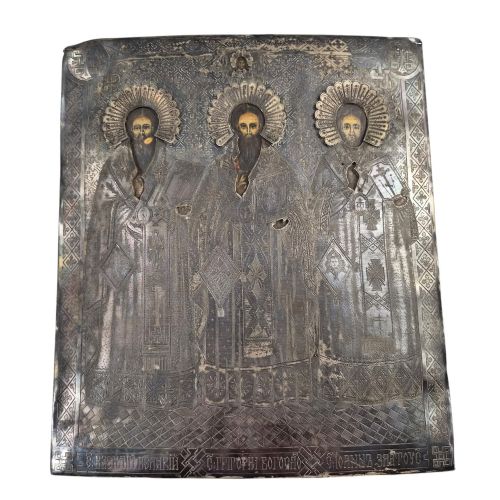
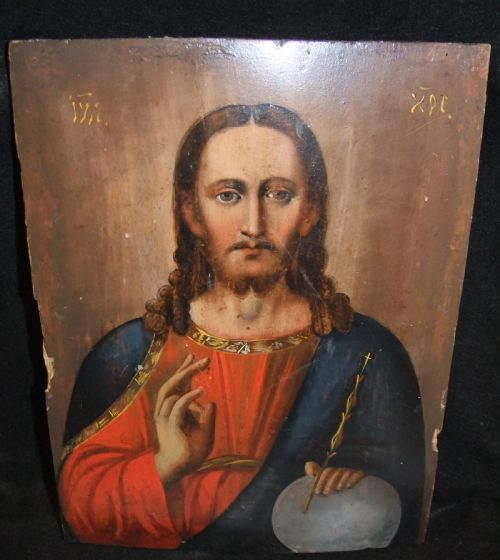
Most examples you meet on this page date from the 19th century, featuring subjects such as Christ Pantocrator, the Three Holy Hierarchs, and narrative scenes like Easter with the Passion of Christ. These works take the form of wall art and religious artefacts created by pious hands for spiritual devotion.
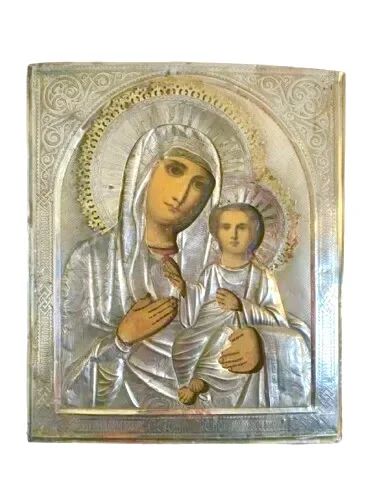
The objects frequently incorporate protective metal covers known as oklads or rizas, which shield all or part of the painted surface except for the faces and hands. These covers range from plain brass to intricately worked silver, adding a layer of tactile and visual richness to the devotional panel.
Materials and construction
The foundation of these works is typically a solid wood panel prepared with gesso, upon which artists applied tempera, egg tempera, or oil paints. Gold leaf frequently highlights haloes and backgrounds, catching the candlelight in a sacred space.
Metalwork forms a significant component, with silver and brass utilised for the protective oklad or riza structures that frame the painted panels. Canvas also appears as a base medium in selected 1800s examples.
Russian Icon Art Retail Price Guide 2026
Typical asking prices for russian icon art among the pieces listed under this phrase on Sellingantiques today, from the lower quarter to the upper quarter. They describe what is for sale here now, not the wider market.
Listings on this site range from 18th-century Volga regional panels to 19th-century Orthodox icons mounted in silver and brass oklads.
Evaluating quality
Quality in these devotional panels lies in the fineness of the brushwork and the expressiveness rendered in the faces and hands of the holy figures. Earlier 18th-century pieces associated with specific regional circles demonstrate particularly meticulous detail in both the tempera painting and the accompanying metalwork.
The execution and metal purity of the oklad or riza also distinguish the pieces, with maker-marked silver covers representing a higher tier of craftsmanship compared to standard brass mountings. The integrity of the wood panel and the preservation of the original gold leaf further influence the overall standing of an icon.
Heinrich Grünbaum·Volga Masters
The Russian Icon Art Glossary
- Tempera
- A permanent, fast-drying painting medium consisting of pigmented powder mixed with a water-soluble binder, usually egg yolk. This technique was standard for traditional icon painting.
- Oklad
- A protective metal cover placed over an icon, leaving only the faces and hands visible. It is often embossed or chased in silver or brass.
- Riza
- An alternative term for an oklad, serving as the protective metal covering or revetment over the painted surface of an icon.
- Christ Pantocrator
- A specific depiction of Christ portrayed as ruler of the universe, shown holding a gospel and raising his right hand in blessing.
- Gilt wood
- Wood treated with a thin layer of gold leaf or gold paint applied to the surface. It provides a luminous background for sacred figures.
Russian Icon Art: Frequently Asked Questions
What is russian icon art?
These pieces are sacred panel paintings created for religious devotion within the Russian Orthodox tradition. They depict holy figures, saints, and biblical narratives using traditional painting and metalworking techniques.
Most examples on this page originate from the 19th century, though some date back to the 18th century or forward to the early 20th century.
How were these icons used?
Icons served as focal points for prayer and veneration in homes and places of worship. Believers lit candles before them and integrated them into daily domestic devotional practices.
They were also hung on walls or transported as portable objects for protection and blessing during travel.
How can I tell the age of an icon?
Dating relies on stylistic clues, the choice of materials such as wood panels versus canvas, and the character of the paint application. 18th-century works often show distinct regional painting styles, while 19th-century examples display characteristic Orthodox iconography.
Documentation, hallmarks on silver oklads, and framing methods also help establish the approximate period of creation.