
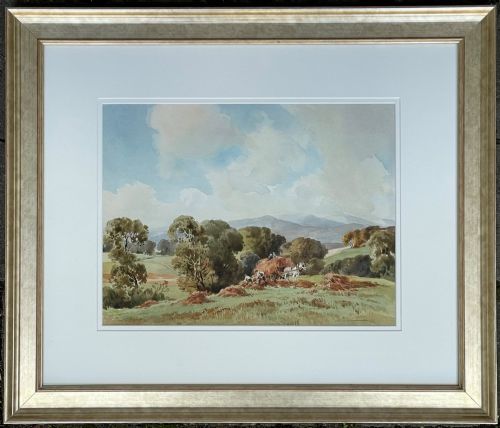


Rural Haymaking Artwork
Rural haymaking artwork captures agricultural labour on canvas and paper, offering buyers a glimpse of traditional field work through period brushwork.
Rural Haymaking Artwork
Rural haymaking artwork encompasses paintings and watercolours depicting agricultural harvest scenes across the nineteenth and early twentieth centuries. These works record pastoral landscapes featuring workers gathering crops, framed within British Impressionism, Victorian, and Edwardian styles.
Buyers encountering this genre will most frequently find nineteenth-century and Edwardian pieces executed in oil on canvas or watercolour on paper. Such works typically measure as wall art objects, portraying regional fields and river valleys.
The category spans diverse hands, from named British painters working around nineteen-twenty to anonymous nineteenth-century creators. Each piece preserves a distinct record of rural topography and traditional farming methods.
How they were made
Makers utilised oil paint applied to canvas or watercolour applied to paper, mounted within wood and glass frames. These traditional supports sustained the layered brushwork characteristic of British Impressionism and Victorian rural naturalism.
Artists built their compositions using pigment and medium to capture natural light across harvest fields and river wharves. The physical application ranges from thin watercolour washes to thick oil impasto on canvas.
Periods represented stretch from eighteen-seventy through the nineteenth century, Edwardian, and up to nineteen-twenty.
What varies in quality
Quality rests upon the confidence of the brushwork and the artist's handling of light and atmosphere within the landscape. Stronger examples display deft management of tone across harvest fields, whereas weaker pieces rely on formulaic composition.
The preservation of the original medium, whether oil on canvas or watercolour on paper beneath glass, influences the visual impact. Works that retain their vibrant pigment without excessive fading or surface degradation command greater visual authority.
Percy Lancaster·Henry Bailey·Herbert Royle·John Atkinson·J.C. Grey·James William Booth·Arthur Walker Redgate·Frederick J. Knowles·William Greaves·George Graham·John Clayton Adams
The Rural Haymaking Artwork Glossary
- Watercolour
- A paint consisting of pigment suspended in a water-based solution, typically applied to paper in translucent washes.
- Canvas
- A heavy woven fabric used as a surface for oil painting, stretched across a wooden frame.
- Impressionism
- A style of painting that focuses on capturing the visual impression of a moment, particularly shifting light and colour.
- Pastoral
- A genre of art depicting rural life and landscapes in a romanticised or peaceful manner.
Rural Haymaking Artwork: Frequently Asked Questions
What periods do these artworks span?
The pieces date from the eighteen-seventies through to nineteen-twenty, encompassing Victorian, Edwardian, and early twentieth-century production.
This timeframe covers the transition from Victorian rural naturalism to British Impressionism in landscape painting.
What materials are typically used?
Artworks are primarily created using oil paint on canvas or watercolour on paper, housed within wood and glass frames.
Canvas supports are common in oil paintings, while watercolours are executed on paper substrates.
How were these paintings displayed?
These pieces function as wall art, designed to be hung within domestic interiors to portray agrarian scenes.
Framed in wood and protected by glass where watercolours are concerned, they served as decorative landscape views.
How do I identify different styles?
Styles range from Victorian rural naturalism to Impressionist realism and Edwardian pastoral painting.
Earlier works tend towards detailed realism, whereas later pieces adopt the looser brushwork of British Impressionism.