
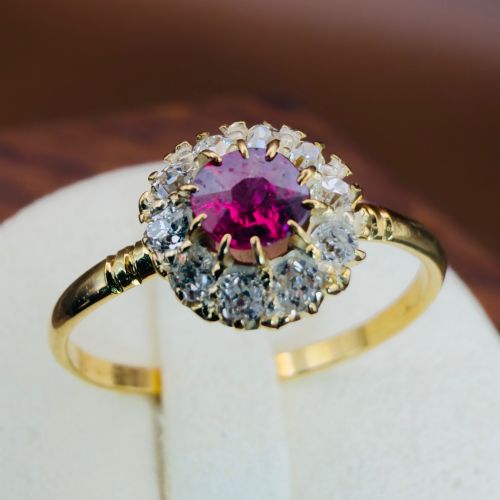
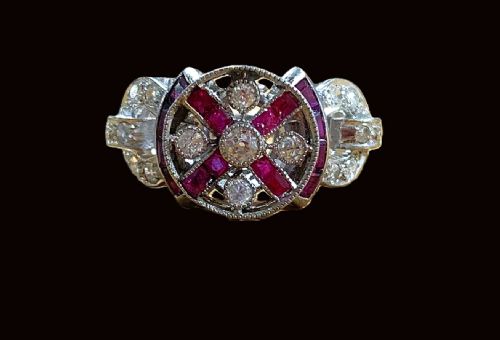
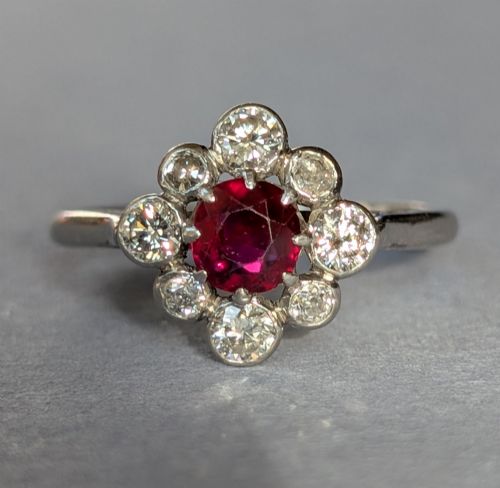
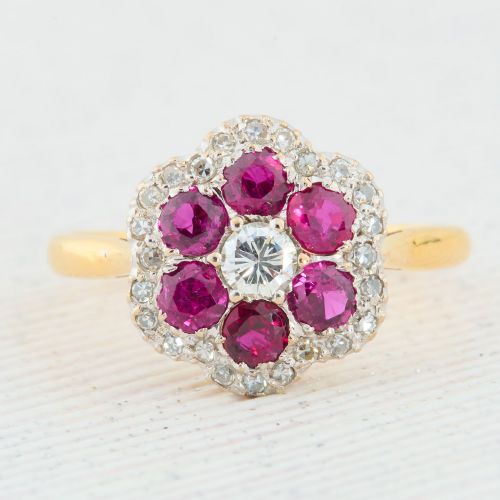


Ruby Target Cluster Ring
A ruby target cluster ring concentrates colour and diamond fire in concentric geometric tiers.
Ruby Target Cluster Ring
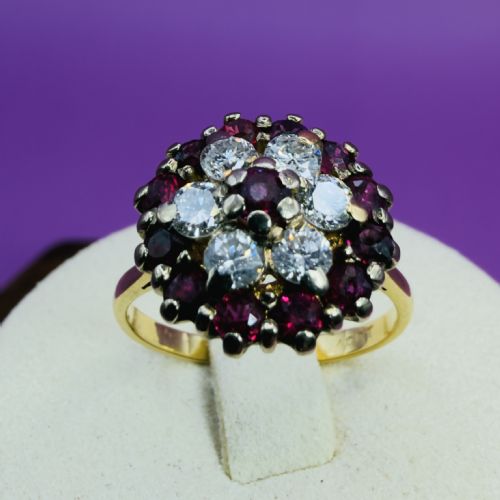
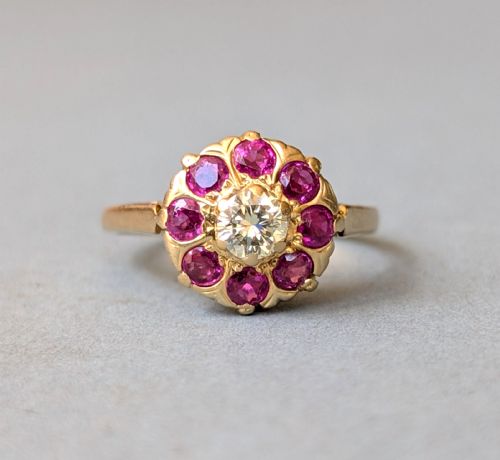
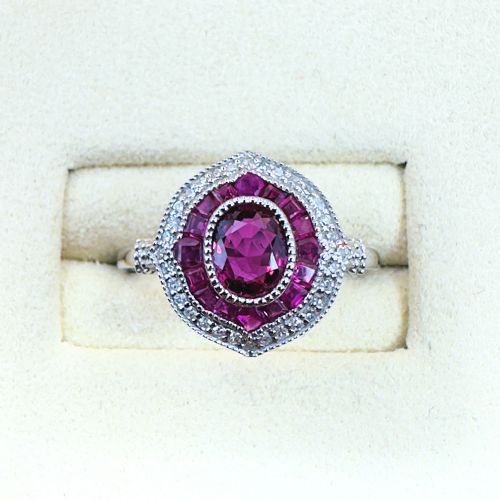
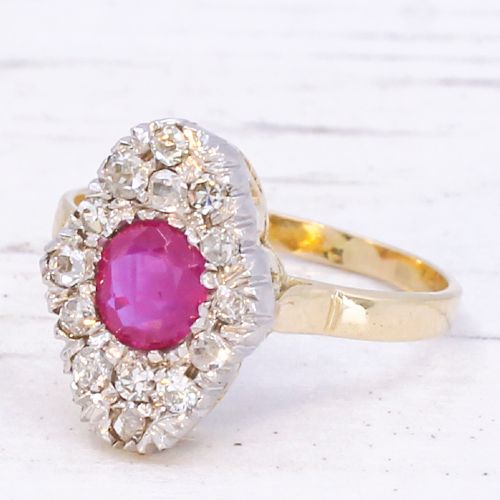
A ruby target cluster ring centres on a vivid red corundum, enclosed by concentric rings of diamonds or contrasting stones. You encounter these most frequently in geometric Art Deco configurations, alongside Victorian and Edwardian iterations.
The layout draws the eye inward toward the central gem, creating a distinct bullseye effect on the finger. Makers built these dress rings across the nineteenth and twentieth centuries, spanning Georgian roots through to mid-century revivals.
How they were made
Goldsmiths utilised platinum and various grades of gold, including yellow, white, and fifteen-carat compositions, to securely house the stones. Platinum became especially favoured during the Art Deco era for creating delicate yet robust millegrain settings around concentric stone tiers.
The construction pairs rubies with old cut, rose cut, or brilliant cut diamonds, occasionally incorporating pearls or emeralds into the outer borders. Stones were hand-set into multi-layered frames designed to maximise the play of light across the face of the ring.
Listings span periods from the Georgian era through to the 1960s, featuring yellow gold, white gold, platinum, and ruby alongside diamond, pearl, and emerald.
What varies in quality
Quality rests upon the origin and saturation of the central ruby, with Burmese stones from Mogok often commanding particular attention from collectors. The visual harmony between the central corundum and the surrounding diamond melee dictates the overall impact of the piece.
Precision in the geometric symmetry of the concentric tiers separates standard production from finer workshop output. The crispness of hand-carved platinum work and the matching of diamond cuts further distinguish superior examples.
The Ruby Target Cluster Ring Glossary
- Target cluster
- A ring design featuring a central stone encircled by one or more concentric rings of contrasting gemstones. This layout creates a concentrated bullseye pattern on the hand.
- Calibré cut
- Small gemstones precision-cut into specific geometric shapes to fit tightly together without visible metal gaps. This technique defines many Art Deco borders.
- Old cut
- A diamond facet configuration typical of antique jewellery, hand-polished with a smaller table and larger culet than modern brilliant cuts. These stones display a softer candlelit sparkle.
- Millegrain
- A decorative technique featuring a row of tiny raised metal beads along the edges of a setting. It provides a refined textural border typical of Edwardian and platinum work.
- Corundum
- The mineral family that includes both ruby and sapphire. Traces of chromium give ruby its characteristic red coloration.
Ruby Target Cluster Ring: Frequently Asked Questions
How do I wear a target ring daily?
These rings work well as standalone dress pieces on the hand due to their striking geometric presence. Their concentric layouts suit middle or ring fingers where the design can sit unobstructed.
Because they contain softer stones alongside diamonds, remove them during heavy manual tasks to protect the settings. Routine cleaning with warm soapy water keeps the concentric tiers bright.
Are these rings strictly Art Deco?
While the concentric target layout achieved immense popularity during the 1920s and 1930s, the form appears across earlier periods. Victorian and Edwardian makers produced distinct floral and halo variations.
Examining the metalwork and diamond cuts helps determine whether a piece belongs to the nineteenth century or the interwar period. Mid-century examples also surface from the nineteen-fifties and sixties.
What is a Mogok ruby?
Mogok is a historic ruby mining region in Burma known for producing stones with exceptional colour saturation and fluorescence. These stones are frequently cited in antique and vintage pieces from the early twentieth century.
The geographical origin adds significant historic interest to the jewellery when documented by period context or certification.
How do I tell an old cut diamond apart?
Old cut diamonds display chunky facets, smaller tables, and open culets visible through the back of the stone. These characteristics reflect the hand-cutting methods used before modern machine precision was standardised.
Under magnification, their faceting pattern produces a distinct softer sparkle compared to twentieth-century brilliant cuts.