



Round Pendulum Clock
These round pendulum clock pieces span wall dials, longcase clocks, and mantel pieces, offering traditional timekeeping mechanics for daily interior use.
Round Pendulum Clock
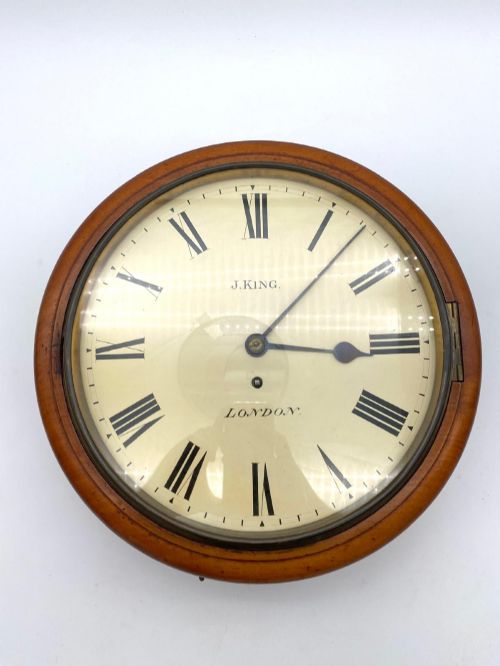
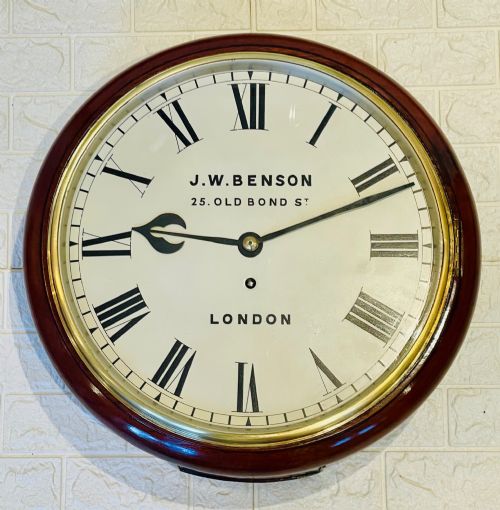
When buyers search for a round pendulum clock, they encounter an assortment of dial wall clocks, longcase clocks, and desk pieces dating from the Georgian period through to the mid twentieth century. The selection leans heavily toward wall mounted fusee dial clocks housed in mahogany or oak frames, often originating from Victorian and late nineteenth century workshops.
Alongside timber wall dials, the inventory includes longcase clocks with circular faces by makers such as Benjamin Peers and Whitelaw of Edinburgh, alongside twentieth century industrial wall pieces and desk timepieces like the Jaeger Atmos. These objects serve both practical timekeeping and interior decoration, appearing in domestic hallways, offices, and living spaces.
Regional British variants feature prominently, including London drop-dial wall clocks and provincial timepieces utilising local hardwoods. Buyers find everything from utilitarian public building clocks to refined domestic pieces with brass bezels and enamelled numerals.
Materials and construction
Movements rely on fusee mechanisms, bell-striking trains, or specialised barometric systems such as the Swiss Atmos design utilising rhodium plating. Iron and metal feature in industrial and mid-century modern iterations, reflecting the shift in materials across the nineteenth and twentieth centuries.
Round Pendulum Clock Retail Price Guide 2026
Typical asking prices for round pendulum clock among the pieces listed under this phrase on Sellingantiques today, from the lower quarter to the upper quarter. They describe what is for sale here now, not the wider market.
Listings feature dial clocks spanning the Georgian, Victorian, Edwardian, and mid-century periods, constructed in mahogany, oak, brass, and glass.
Variations in quality
Quality rests upon the precision of the movement and the integrity of the timber housing, where finer examples display crisply turned bezels and well-figured mahogany or walnut veneers. Maker attribution also elevates a piece, as signed dials from established watchmakers command greater regard than unsigned utility clocks.
The condition of the dial face, whether painted iron or enamelled copper, dictates visual appeal, alongside the original state of the fusee movement and brass work. Higher grade pieces maintain original components and retain their crisp carving and finish without excessive restoration.
J W Benson·Benjamin Peers·Whitelaw of Edinburgh·Payne of Tunbridge Wells·Webster·Jaeger
The Round Pendulum Clock Glossary
- Fusee
- A conical pulley used in clock movements to maintain an even pull as the mainspring unwinds. This mechanism ensures more accurate timekeeping throughout the power reserve.
- Dial clock
- A wall-mounted timepiece featuring a prominent circular face, usually protected by a brass bezel and glass door. These were widely used in railway stations, offices, and domestic halls.
- Drop-dial
- A wall clock design where the circular dial sits above an extended wooden box that houses the pendulum swing. This style became popular in nineteenth century British interiors.
- Longcase clock
- A tall pendulum clock housed in a wooden case, commonly known as a grandfather clock. The design protects the weights and pendulum while displaying the dial at eye level.
- Atmos clock
- A mechanical timepiece manufactured by Jaeger-LeCoultre that is powered by minute temperature fluctuations in the surrounding air. It requires no manual winding.
Round Pendulum Clock: Frequently Asked Questions
How do I wind a fusee wall clock?
You insert the winding key into the small hole on the dial face and turn it gently clockwise until resistance is felt. Care must be taken not to overwind the spring.
Ensure the pendulum hangs freely before starting the movement, giving it a gentle push to begin the beat.
Where should I hang a heavy dial clock?
Mount the clock directly onto a solid wall stud or masonry using appropriate fixings to support the considerable weight of the timber and movement. Stability prevents vibration from affecting the pendulum swing.
Position the dial at eye level in a room with minimal temperature fluctuations to maintain accurate timekeeping.
What is the difference between a fusee and a spring-driven clock?
A fusee movement uses a conical pulley and chain to equalise the power delivered from the mainspring as it loses tension. This provides consistent torque for superior accuracy.
Standard spring-driven clocks attach the mainspring directly to the gear train, resulting in a slight decrease in driving force as the spring unwinds.
How do I date an antique round wall clock?
Examine the timber, the construction of the rear wooden box, and the style of the numerals painted on the dial face. Mahogany and fusee movements frequently point to the nineteenth century.
Signatures on the dial often provide a direct link to the maker and their operational dates, narrowing the period of manufacture.