


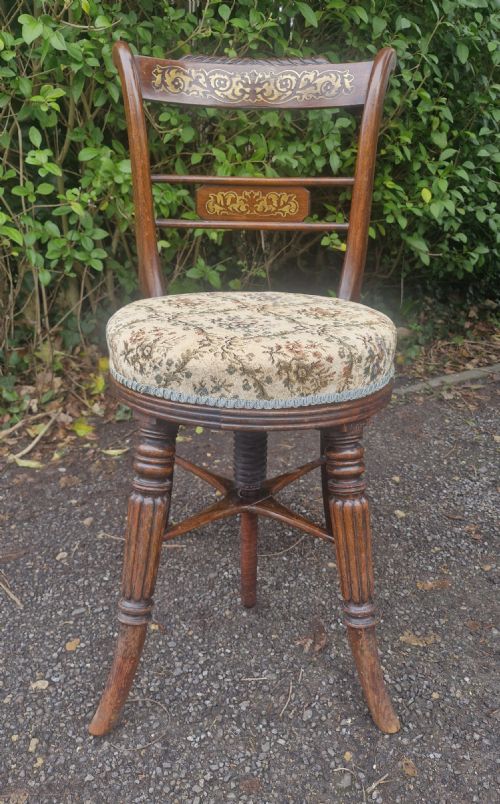
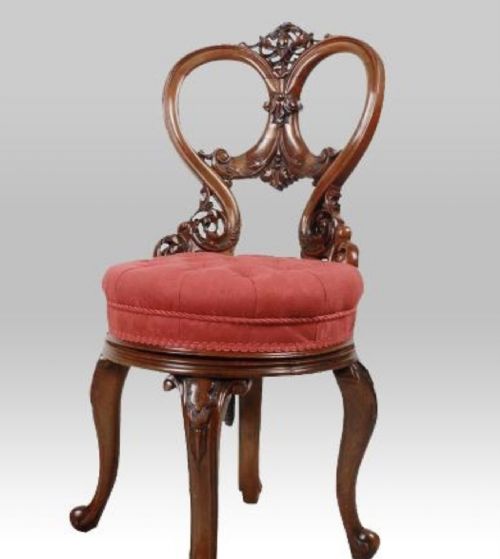


Rosewood Swivel Chair
These rosewood swivel chair examples are sophisticated rotating seats crafted for the music room or dressing table, prized for their mechanical ingenuity and rich timber grain.
Rosewood Swivel Chair
A rosewood swivel chair primarily manifests on this page as a piano stool, music chair, or dressing table stool designed with a rotating or height-adjustable mechanism. These seating forms span the Georgian, Regency, William IV, and Victorian eras, including Arts and Crafts interpretations.
Makers designed these pieces for practical use at keyboard instruments, harp performance, or personal grooming while maintaining elegance in the principal reception rooms. The rotating and rising seats allowed musicians and performers to adjust their height and orientation easily during practice or performance.
Materials and construction
Cabinet makers utilised dense, richly figured rosewood timber, frequently complemented by decorative boxwood inlay, brass mounts, and simulated rosewood finishes. The primary structural framework relied on solid hardwoods capable of supporting the internal screw threads and rotating mechanisms.
Upholstery forms a vital component of these pieces, utilising traditional fabrics, velvet, tapestry, and textiles to cover the padded revolving seats. Mechanical metal assemblies hidden within the wooden columns allowed the top section to rise and turn smoothly.
Listings on this site span the Georgian, Regency, William IV, and Victorian periods, showcasing rosewood combined with velvet, brass, and boxwood inlay.
Judging quality and craftsmanship
Superior examples distinguish themselves through the precision and smoothness of the revolving or rising mechanism, which should operate without excessive wobble or binding in the screw thread. The quality of the rosewood grain, the crispness of any boxwood inlay, and the integration of brass hardware dictate the piece's standing.
Proportion and stability separate finer workshop productions from simpler utilitarian seating. A well-proportioned base with balanced legs supports the dynamic movement of a rotating top without compromising the aesthetic harmony of the silhouette.
Druce & Co
The Rosewood Swivel Chair Glossary
- Rosewood
- A dense, heavily figured timber prized for its dark purple-brown coloration and distinctive grain patterns. It polishes to a high gloss and forms the primary material for these seating pieces.
- Rise and fall mechanism
- An internal screw or ratchet system operated by turning the seat itself to alter the height of the sitter. This ingenious hardware defines functional music stools.
- Simulated rosewood
- A surface treatment where painters grain-paint cheaper timber to mimic the appearance of genuine rosewood. This technique provided an opulent look at a more accessible cost during the Regency period.
- Boxwood inlay
- Contrasting pale wood inserted into recesses within the darker rosewood surface to create geometric or floral patterns. It adds refined linear detail to the frame.
- Revolving piano stool
- A rotating seat specifically engineered for keyboard players requiring freedom of movement. The top turns continuously on a central wooden or metal spindle.
Rosewood Swivel Chair: Frequently Asked Questions
How do you adjust the height?
Most examples adjust by manually spinning the upholstered seat top clockwise or anti-clockwise around a central wooden or metal screw shaft. This action raises or lowers the seat relative to the base.
Some variants utilise a rise and fall mechanism with internal levers or ratchets. Users should turn the top gently to test the thread without forcing the mechanism past its natural stop.
How do I date a rosewood piece?
Dating relies on stylistic clues, such as the curved legs and brass inlay of Regency examples compared to the heavier proportions of Victorian pieces. The complexity of the turning and the joinery methods underneath also offer chronological markers.
Examine the secondary woods used in the underframe and the type of upholstery webbing or tacks. These construction details help align the piece with Georgian, William IV, or Arts and Crafts periods.
Are these chairs comfortable for daily use?
While padded with velvet, tapestry, or traditional textiles, these stools were designed for upright posture during musical practice rather than lounging. The revolving seat adds convenience, but the firm padding reflects nineteenth-century preferences.
Placing one at a writing desk or dressing table works well for short periods. Collectors often prioritize mechanical authenticity over modern ergonomic plushness.