



Rosewood Envelope Table
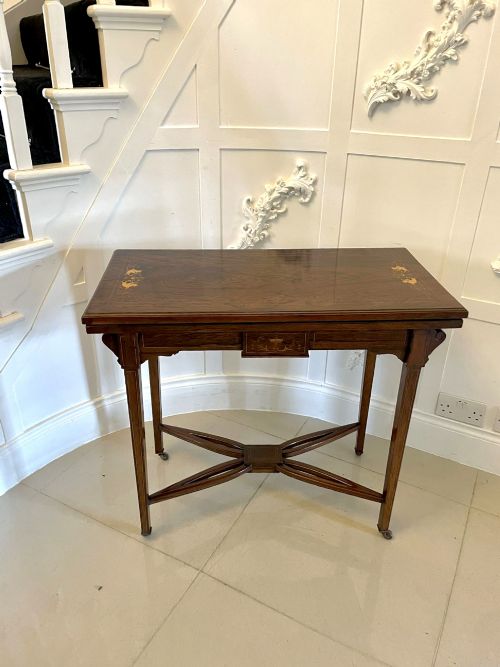
A rosewood envelope table brings a clever unfolding mechanism and rich grain into a room, offering both a card table and an occasional surface.
Rosewood Envelope Table
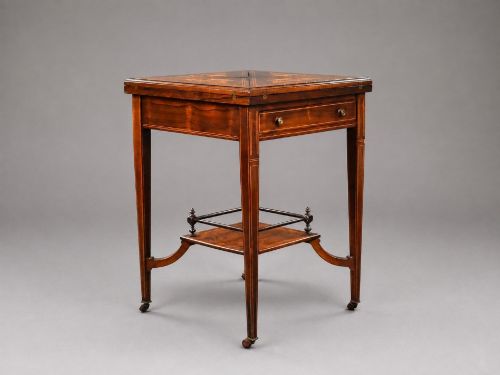
A rosewood envelope table is a clever multi-functional form designed primarily for games and cards. The top consists of four triangular flaps that rotate and fold outward to reveal a baize-lined playing surface, closing back down into a neat square when not in use.
The pieces listed on this page span the Victorian and Edwardian periods, including dates around 1870, 1890, and 1900. Alongside standard envelope card tables, the selection includes fold-over card tables, swivel top games tables, and drop-flap or drop-leaf occasional tables.
Most examples found here hail from the Edwardian era or the late Victorian period, reflecting a strong preference for refined domestic furniture. They serve flexibly as side tables, occasional tables, or dedicated games surfaces in a sitting room.
How they were made
Makers built these tables using solid timber and veneers of richly grained rosewood, frequently incorporating contrasting lighter woods. Satinwood inlay, boxwood, and general wood inlay create delicate borders, floral motifs, and geometric patterns across the tops and legs.
Structural hardware played a vital mechanical role, particularly in the folding flaps and swivel mechanisms. Brass fittings and ormolu details occasionally appear to mount, accent, or protect the vulnerable corners and edges of the woodwork.
Rosewood Envelope Table Retail Price Guide 2026
Typical asking prices for rosewood envelope table among the pieces listed under this phrase on Sellingantiques today, from the lower quarter to the upper quarter. They describe what is for sale here now, not the wider market.
The secret mechanical ballet of four folding leaves turning a square top into a star.
What varies in quality
Quality rests significantly in the precision of the rotating mechanism and how smoothly the four triangular leaves unfold. A superior table operates with exact balance, ensuring the flaps rest flush and level in both the open and closed positions without sagging hinges.
The finesse of the decorative inlay distinguishes standard production from finer workshop output. Crisp, detailed satinwood and boxwood marquetry set into the dark rosewood grain demands high technical skill, elevating the visual impact of the piece.
Maple and Co.
The Rosewood Envelope Table Glossary
- Envelope table
- A square table with a four-flap top that opens diagonally to reveal a baize-lined interior. This clever design protects the playing surface while keeping the footprint compact.
- Baize
- A coarse woollen material resembling felt, traditionally used to line the playing surfaces of card and games tables. It provides a soft, non-slip texture for handling cards.
- Marquetry
- The art of applying pieces of veneer to a structure to form decorative patterns and pictures. Makers utilise contrasting timbers such as satinwood and boxwood against rosewood.
- Swivel top
- A table construction where the upper surface rotates on its base to reveal a hidden compartment or to support the unfolding leaves securely. This mechanism requires precise carpentry.
- Drop-flap
- A table featuring hinged side leaves that drop down when not supported by brackets or swing legs. It allows the furniture to adapt to smaller spaces.
Rosewood Envelope Table: Frequently Asked Questions
How does an envelope table open?
The top consists of four triangular leaves hinged diagonally across the centre. When you rotate the upper section, the flaps unfold outwards to reveal the playing surface.
Underneath, supporting arms swing out automatically to hold the leaves level as they open. Closing the table reverses the sequence into a compact square.
What were these tables used for?
They served primarily as compact card and games tables for drawing rooms and parlours during the Victorian and Edwardian eras. The enclosed top kept the baize surface clean between evening card games.
When closed, they functioned as ordinary occasional tables or side pieces for holding decorative objects. This dual purpose made them popular in homes with limited space.
How do I date a rosewood table?
Dating relies on stylistic details, construction methods, and materials recorded in the specific piece. Victorian examples often display heavier proportions, while Edwardian pieces lean towards lighter, more delicate inlay.
Makers' marks or stamps, where present, offer a direct link to a specific firm or workshop active in years like 1890 or 1900.
Are all these tables made of solid rosewood?
Most pieces utilise rosewood veneers applied over secondary structural timbers to achieve stable and beautifully figured surfaces. Solid rosewood was generally reserved for smaller mouldings, legs, and specific structural components.
Inlays of satinwood, boxwood, and general wood inlay provide contrast against the dark background timber.