
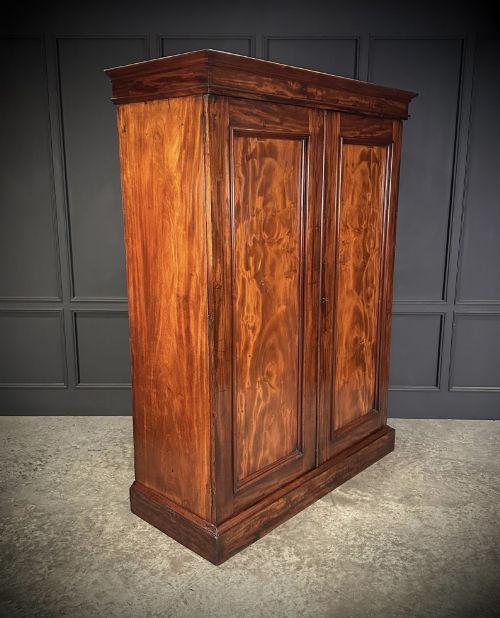
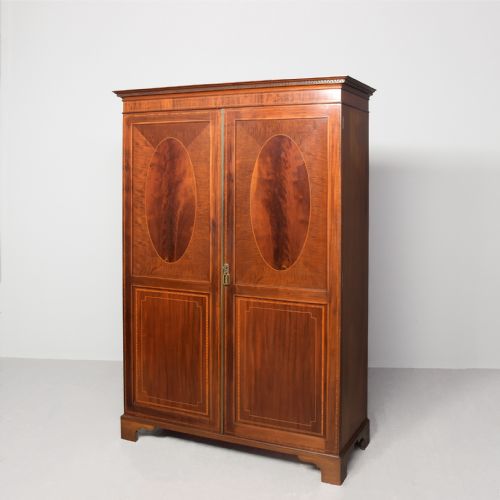
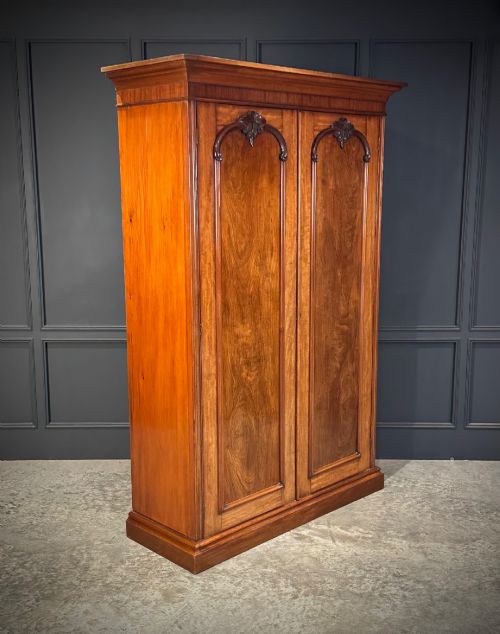


Rich Mahogany Armoire
A rich mahogany armoire brings deep grain and architectural presence to a bedroom, offering substantial storage built to last.

Rich Mahogany Armoire
When you search for a rich mahogany armoire, you encounter grand bedroom pieces designed for storing garments and linens with traditional elegance. The selections here span the eighteenth and nineteenth centuries, taking forms such as large double wardrobes, linen presses, and compactums.
You are most likely to meet Victorian and Georgian examples on this page, alongside William IV, Regency, and Biedermeier interpretations. These wardrobe pieces often incorporate panelled doors, breakfront cornices, and generous hanging space behind timber facades.
How they were made
Cabinet makers utilised solid mahogany and flame mahogany veneer over secondary timbers to create deeply figured surfaces with natural lustre. Artisans applied boxwood inlay and brass mounts to accent the structural lines of the doors and cornices.
Construction relied on traditional joinery techniques, ensuring the large carcases remained stable and capable of supporting heavy panelled doors. Glass panels and internal shelving or hanging rails were integrated according to the specific domestic purpose of the wardrobe.
Gentlemen's robes and campaign wardrobes prove that historical travellers and tidy gentlemen took their wardrobes very seriously indeed.
What varies in quality
The distinction between ordinary and exceptional pieces rests in the selection of the mahogany veneer and the crispness of the inlay work. Finer examples display symmetrical flame patterns across the doors and well-proportioned architectural cornicing.
Internal configuration and original hardware also dictate the standing of a piece, with superior wardrobes retaining integrated drawer chests and functioning locks. The integrity of the timber movement and the weight of the solid sections further define the tier of craftsmanship.
The Rich Mahogany Armoire Glossary
- Flame mahogany veneer
- A thin slice of mahogany timber cut from the fork of the tree where branches meet the trunk. This creates a distinctive, fiery grain pattern highly prized by cabinet makers.
- Linen press
- A tall piece of furniture featuring sliding trays or shelves in the upper section for folded textiles, with clothes drawers below. They often share the grand proportions of large wardrobes.
- Compactum
- A multi-functional wardrobe designed to maximise storage by combining hanging spaces, drawers, and shelving within a single unified carcase.
- Boxwood inlay
- Narrow strips of pale boxwood inserted into grooves cut into the darker mahogany surface. This technique creates contrasting geometric borders and decorative motifs.
Rich Mahogany Armoire: Frequently Asked Questions
How do I date a mahogany wardrobe?
Dating relies on examining the structural joinery, the thickness of the timber panels, and the prevailing decorative style of the period. Details such as boxwood inlay or brass hardware provide additional clues to the decade of manufacture.
Cabinet construction methods shifted across the eighteenth and nineteenth centuries, moving from pegged joints to machine-cut elements in later Victorian production.
Where should I place a large armoire?
These tall pieces require a wall with sufficient ceiling height and structural stability to support their considerable weight and depth. Position them away from direct heat sources and strong sunlight to protect the mahogany polish and veneer.
Ensure the room has adequate clearance for the large doors to swing open fully without obstruction from other furniture.
Can an armoire be dismantled for moving?
Many larger wardrobes and presses were built in modular sections specifically to allow for transport through domestic doorways and up staircases. Cornices, sides, and base sections often separate from the main central carcase.
Checking the construction reveals whether the piece relies on knock-down bed bolts or fixed pegged joinery that requires professional handling.
What is the difference between a wardrobe and a compactum?
A standard wardrobe focuses primarily on vertical hanging space enclosed by two or more full-length doors. A compactum divides the interior space to include dedicated drawer stacks, linen slides, and shoe compartments alongside the hanging area.
Both forms utilise the rich grain of mahogany timber but serve different domestic organizational needs.