



Rich Brown Pedestal Desk
A rich brown pedestal desk brings warmth and architectural presence to a room, offering deep timber tones and practical compartmentalised storage.
Rich Brown Pedestal Desk
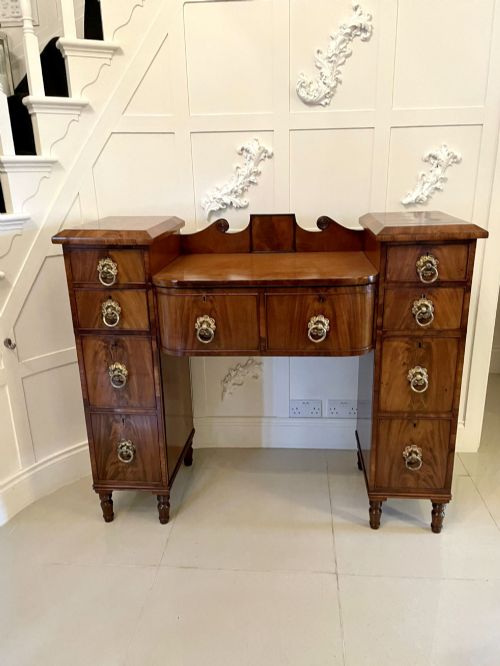
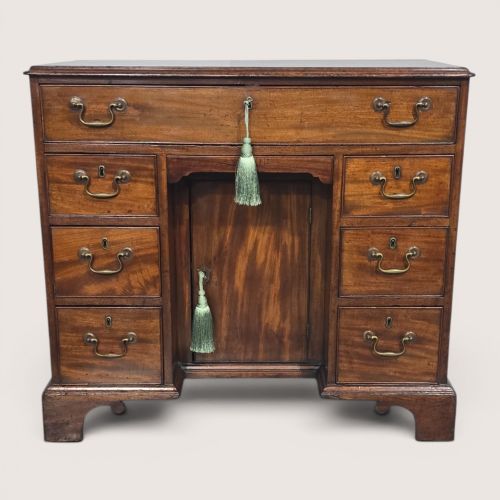
A rich brown pedestal desk is a substantial writing or working surface supported by two independent banks of drawers, known as pedestals, positioned beneath the main top. These pieces emerge predominantly from the eighteenth and nineteenth centuries, spanning Georgian, Regency, and Victorian eras.
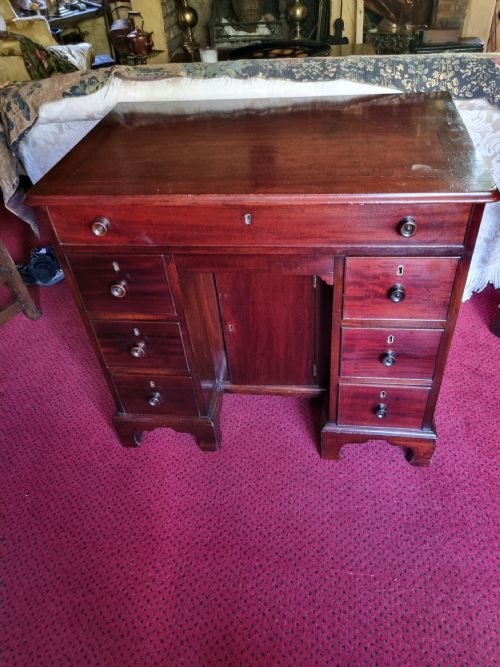
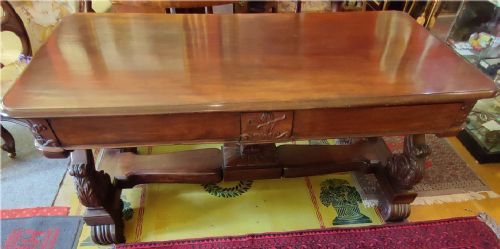
The format frequently appears as a kneehole desk or a library table, incorporating traditional configurations of small drawers alongside a central writing drawer. Examples range from compact Georgian pieces to grander mid-Victorian burr walnut variations.
Makers and workshops across Britain and further afield, including Calcutta, produced these items to serve the studies and libraries of large houses. They remain central working furniture for domestic and professional interiors.
Materials and construction methods
Construction relies heavily on dense timbers such as mahogany and burr walnut, chosen for their deep grain patterns and durability. These woods are frequently paired with secondary woods for drawer linings and internal framing.
Surface treatments incorporate inset writing surfaces of leather or fabric, often finished with gilt tooling around the perimeter. Brass hardware, including drop handles, escutcheons, and castors, completes the structural assembly.
Rich Brown Pedestal Desk Retail Price Guide 2026
Typical asking prices for rich brown pedestal desk among the pieces listed under this phrase on Sellingantiques today, from the lower quarter to the upper quarter. They describe what is for sale here now, not the wider market.
Current listings feature mahogany, burr walnut, brass, leather, and fabric across Georgian, Victorian, Regency, and early twentieth-century periods.
Distinguishing quality across examples
Quality reveals itself in the selection of timber veneers and the precision of the cabinetwork, particularly in the dovetailing of drawers and the matching of grain across the pedestals. Finer pieces demonstrate superior carving or crisp brass mounts that remain tight to the wood.
Exhibition or architect-designed examples show an elevated level of finish, including secondary woods of higher grade and sophisticated internal mechanisms. Lesser examples display simpler construction and plainer secondary timbers while maintaining the standard pedestal form.
Gillows·Currie & Co
The Rich Brown Pedestal Desk Glossary
- Pedestal desk
- A writing table supported by two upright banks of drawers that rest directly on the floor. The top spans across the space between them, leaving a central kneehole.
- Kneehole desk
- A compact variety of pedestal desk featuring a central recess for the user's legs, flanked by narrow columns of small drawers. This form is common in eighteenth-century pieces.
- Library table
- A large freestanding table designed to hold books and papers, often finished on all sides so it can sit in the middle of a room rather than against a wall.
- Burr walnut
- A highly figured timber taken from the wart or burl of a walnut tree. It produces intricate, swirling grain patterns prized for decorative veneering.
- Escutcheon
- A protective metal plate surrounding a keyhole, usually made of brass on these desks. It prevents the timber around the lock from splitting or wearing.
Rich Brown Pedestal Desk: Frequently Asked Questions
What is a pedestal desk?
A pedestal desk is a heavy writing table built with two structural columns of drawers that support a wide top. The user sits in the open space between the pedestals.
These pieces provide substantial storage capacity alongside a formal surface for writing or administrative work.
How do I date an older desk?
Dating relies on observing construction methods, timber choices, and hardware styles. Eighteenth-century pieces often utilise solid mahogany and hand-cut dovetails, while Victorian examples introduce broader use of walnut veneers and mechanical roll tops.
Secondary woods inside the drawers and the style of the brass handles offer further clues to the manufacturing period.
Can I use one every day?
These desks were built for heavy daily use in studies, offices, and libraries. Their solid timber construction and durable leather writing surfaces suit modern working requirements.
Care should be taken to protect the timber and leather from direct heat sources and moisture.
Where should I place it?
Because many of these desks are finished on all four sides, they can stand in the centre of a room as well as against a wall. Library tables in particular benefit from being positioned away from boundaries.
Allow enough surrounding clearance to pull out the drawers and use the chair comfortably.