



Revolving Height Stool
A revolving height stool provides adjustable seating for the piano or dressing table, offering both utility and period character.
Revolving Height Stool
A revolving height stool is primarily designed for musicians and dressing tables, allowing the user to alter the seat level by turning the top.
The selections span the nineteenth century and the early twentieth century, taking forms such as piano stools, music chairs, and workshop stools.
Mahogany, walnut, and rosewood examples appear frequently alongside industrial pieces built from cast iron and wood.
How they were made
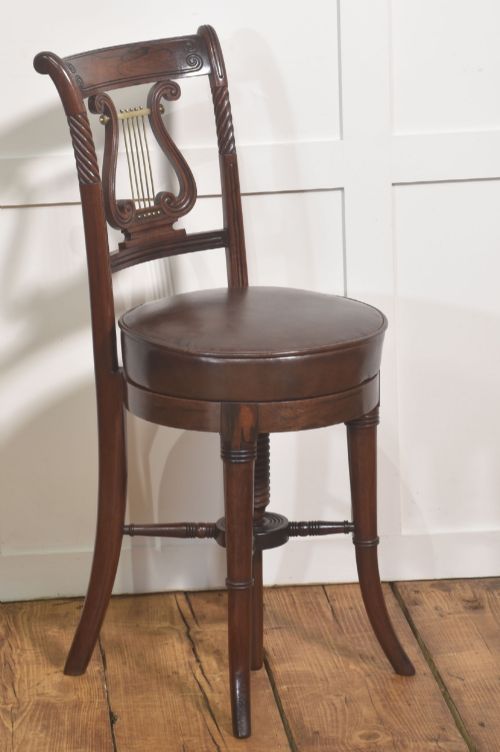
Cabinet makers utilised dense hardwoods like mahogany, walnut, and rosewood, often shaping the timber with carved details or brass inlay.
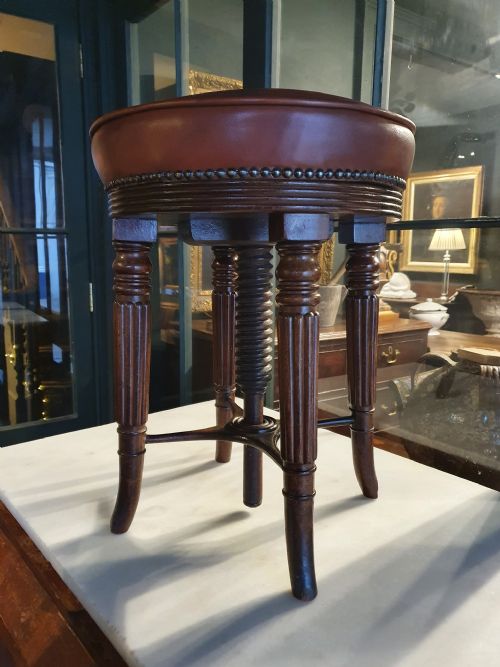
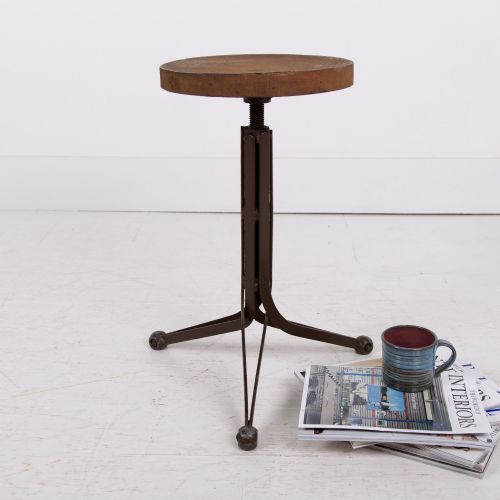
The height adjustment relies on a central wooden screw mechanism or iron screw thread concealed beneath the revolving top.
Seats are upholstered in fabric, leather, or left as plain wood depending on whether the piece originates from a domestic parlour or an industrial workshop.
Some nineteenth century piano stools double as music cabinets with hidden internal compartments for sheet music beneath the revolving top.
What varies in quality
The smoothness and stability of the screw mechanism dictate the functional standard of a revolving height stool.
Cabinet work quality shows in the crispness of the wood carving, the choice of figured veneers, and the joinery of the turning base.
Makers such as Gillows or James Shoolbred introduce higher craftsmanship through refined proportions and superior brass or timber components.
Gillows·Rubery Owen·James Shoolbred
The Revolving Height Stool Glossary
- Rise and fall
- A mechanism that allows the seat height to be adjusted by turning it upward or downward on a central screw.
- Swivel top
- A revolving seat surface that rotates horizontally without necessarily altering the vertical height.
- Ebonised
- Timber treated with a dark finish to imitate the appearance of expensive ebony.
- Brass inlay
- Thin strips or motifs of brass fitted flush into the wooden surface for decoration, seen in Regency pieces.
Revolving Height Stool: Frequently Asked Questions
How do I adjust the height?
The seat top turns clockwise or anticlockwise on a central wooden or metal screw thread to raise and lower the sitting level.
Once the desired height is reached, the user sits down, and the weight of the body locks the threaded mechanism in place.
Were these only used for pianos?
While the majority function as piano or music stools, similar revolving designs serve dressing tables and industrial workshops.
Domestic versions feature upholstered seats in rosewood or mahogany, whereas workshop variants utilise plain wood and cast iron.
How do I care for the swivel mechanism?
The internal screw requires occasional cleaning and light lubrication to ensure the wood or metal threads move smoothly without binding.
Avoid forcing the seat past its maximum extension to protect the central thread from stripping or jamming.
How do I date a revolving stool?
Stylistic details such as heavy turned legs, brass inlay, or ebonised finishes point toward specific periods like the Regency or Victorian eras.
Industrial workshop examples often display cast iron components and simpler timber tops characteristic of the early twentieth century.