


Revolving Book Rack
A revolving book rack turns smoothly on a central spindle to keep a working library close at hand without crowding the room.
Revolving Book Rack
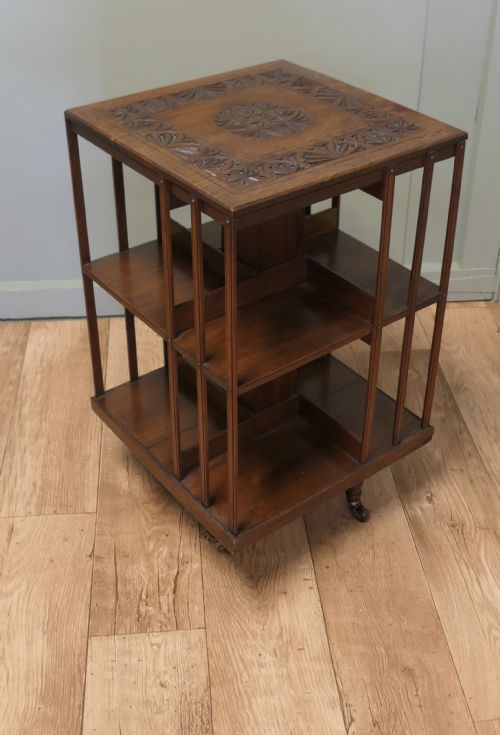
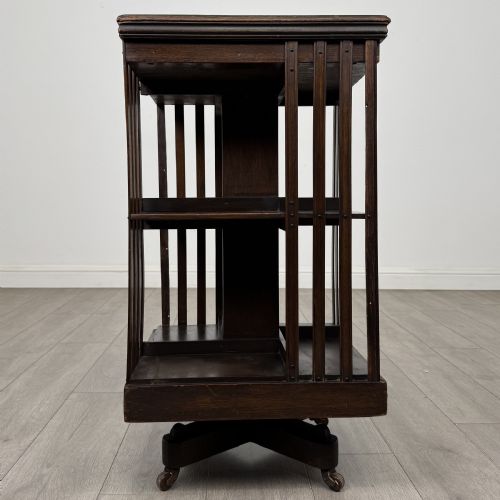
A revolving book rack serves as a compact and accessible home for frequently consulted volumes, designed to spin freely for easy selection. These pieces keep reference books or daily reading material within arm's reach while occupying minimal floor or table space.
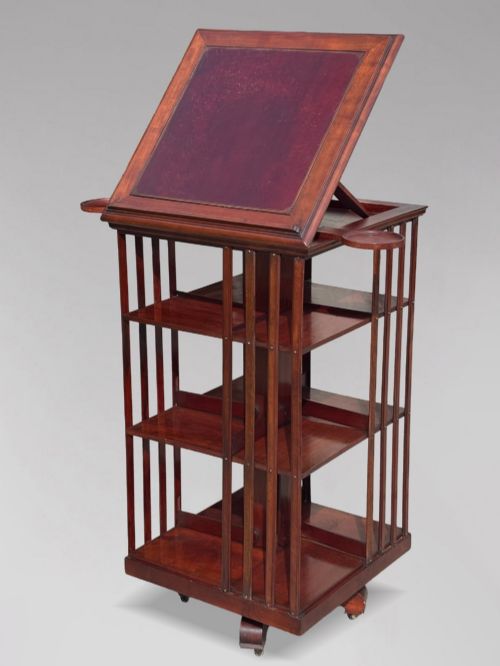
The versions most commonly found here belong to the Victorian and Edwardian periods, appearing both as floor-standing furniture and smaller desktop bookstands. They reflect an era that valued both scholarly convenience and neat domestic organisation.
Makers shaped these revolving book rack designs to suit various domestic settings, ranging from low desktop stands to taller cabinets with compartments for magazines and heavier bindings.
How they were made
Cabinet makers constructed these pieces primarily from solid timber and rich veneers, favouring mahogany, walnut, and oak for their durability and grain. Selected examples incorporate contrasting boxwood inlay to define the panels and shelves.
Functional metal components, including brass mounts, cast iron mechanisms, and occasionally marble tops, added weight and stability to the rotating structures. These materials worked together to ensure the stand could turn smoothly under the varying weight of heavy books.
Some desktop models were designed specifically to keep parliamentary acts close at hand for drowsy politicians.
What varies in quality
Quality in a revolving book rack lies in the engineering of the internal pivot mechanism and the stability of the revolving action. A superior piece turns evenly without listing or catching, supported by a solid base that prevents tipping.
Material selection and decorative detailing further distinguish finer examples, such as those featuring careful boxwood inlay, inset marble surfaces, or well-chosen mahogany and walnut grains. Simpler pieces rely on plain oak or straightforward joinery without supplementary ornamentation.
The Revolving Book Rack Glossary
- Revolving book case
- A freestanding or table-top rack built on a central pivot so the shelves turn through a full circle. This design allows access to multiple sides of shelving from a single stationary position.
- Boxwood inlay
- A decorative technique where small strips of pale boxwood are fitted into recesses cut into darker woods like mahogany or walnut. It creates contrasting geometric lines or floral motifs across the timber surface.
- Rotary bookstand
- A smaller variant designed to sit upon a desk or table surface rather than standing on the floor. It holds a curated selection of current reading material or reference volumes.
- Magazine stand
- A specialised rack with partitioned sections designed specifically for holding periodicals and unbound journals upright. These often feature decorative wooden slats or brass framing.
Revolving Book Rack: Frequently Asked Questions
Where should I place a revolving book rack?
These pieces suit positions beside an armchair, beside a desk, or near a reading corner where books need to be accessible from multiple angles.
Because they spin freely, they require a small clearance zone around them so the shelves can turn without striking nearby furniture or walls.
How do I maintain the revolving mechanism?
Most swivel actions require very little intervention beyond occasional light cleaning of dust and debris from the central pivot area.
Avoid using heavy oils or modern lubricants unless specified, as older wooden components and brass fittings respond best to simple, dry maintenance.
Can these stands hold heavy books?
Many Victorian and Edwardian examples were built to support substantial reference volumes, encyclopaedias, and bound journals without straining the frame.
Distributing heavier books evenly across the lower tiers helps maintain stability and ensures the smooth rotation of the central spindle.
How do I distinguish Victorian from Edwardian models?
Victorian pieces often display darker, heavier timbers like mahogany and walnut, sometimes paired with marble tops or intricate brass and boxwood inlay work.
Edwardian versions tend to feature lighter oak or simpler mahogany constructions, reflecting a shift towards more restrained domestic interiors.