



Revival Hat Stand
A revival hat stand brings heavy architectural presence and practical entrance storage into a hallway.
Revival Hat Stand
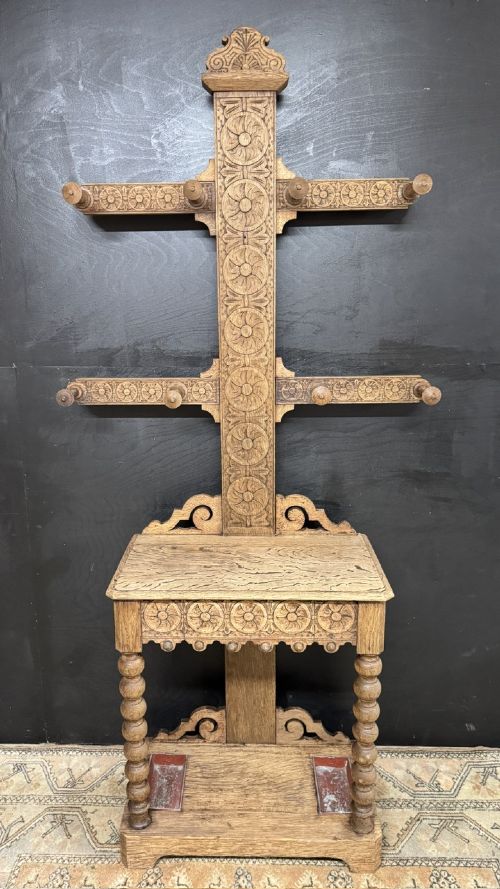
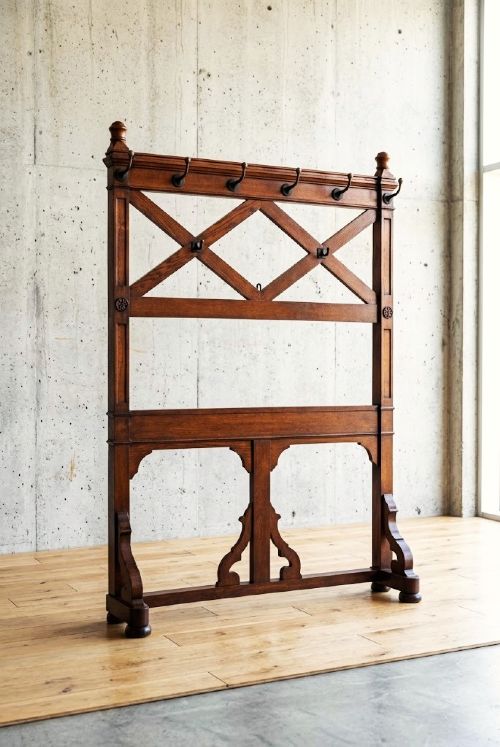
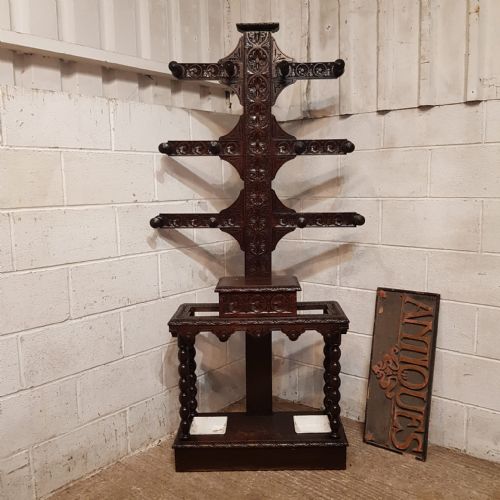
A revival hat stand is a substantial piece of entrance furniture designed to hold coats, hats, and walking implements. These items belong primarily to the Victorian period, appearing in forms such as hall stands and stick stands.
Most examples found here date from the nineteenth century, specifically around the 1870s and 1880s. The dominant style is Gothic Revival, alongside Flemish Renaissance Revival and Jacobean Revival influences.
Makers utilised architectural vocabulary to decorate these items, incorporating pointed arches, linenfold panels, and heavily carved crestings. The scale ranges from compact hallstands to very large, imposing proportions intended for grand vestibules.
How they were made
Solid oak provides the primary structural timber for these pieces, often deeply carved with foliage, grotesque masks, or geometric motifs. Workshops employed robust joinery methods to support the heavy loads of winter garments and walking canes.
Metal components such as cast iron, brass, and zinc appear extensively in structural frames, drip pans, and coat hooks. Some examples integrate glass elements or mirrored panels within the central wooden framework.
Revival Hat Stand Retail Price Guide 2026
Typical asking prices for revival hat stand among the pieces listed under this phrase on Sellingantiques today, from the lower quarter to the upper quarter. They describe what is for sale here now, not the wider market.
Keep an eye out for the occasional Greenman glaring from the foliage.
What varies in quality
Depth and crispness of the carving distinguish standard production from superior craftsmanship, particularly on mask carvings and foliate panels. The ambition of the architectural design, from simple fretted crests to elaborate Flemish Renaissance structures, dictates the grade of the piece.
Integration of secondary materials like cast iron backplates and heavy brass hooks marks out the better examples. Overall timber selection and proportion also separate utilitarian items from imposing architectural showpieces.
The Revival Hat Stand Glossary
- Gothic Revival
- An architectural and decorative style drawing inspiration from medieval forms, featuring pointed arches and trefoils. This aesthetic dominates nineteenth century ecclesiastical and domestic furnishings.
- Flemish Renaissance Revival
- A decorative style popular in the later nineteenth century characterised by scrollwork, heavy strapwork, and exuberant carvings. It often manifests on large oak hallstands.
- Hall stand
- A piece of hallway furniture combining coat hooks, a hat shelf, an umbrella rack, and frequently a central mirror or glove box. These served as practical storage for outdoor apparel.
- Greenman
- A sculptural motif representing a face carved from or entwined with leaves and vines, symbolising rebirth. This detail appears frequently in nineteenth century architectural woodwork.
Revival Hat Stand: Frequently Asked Questions
What is a revival hat stand?
A revival hat stand is a nineteenth-century hall piece designed to organise outdoor wear in entrance halls.
They combine wooden framing with hooks, shelves, and umbrella holders.
How do I date these stands?
Dating relies on stylistic markers such as Gothic Revival or Flemish Renaissance details typical of the Victorian era.
Most examples originate from the period between 1870 and 1890.
Where were they placed?
These pieces stood in the entrance halls or vestibules of Victorian homes to greet visitors.
Their substantial scale required robust wall space near the main entrance.
What woods were used?
Solid oak is the predominant timber found in these nineteenth-century hall stands.
Workshops favoured it for its strength and suitability for deep carving.