


Retro Gold Ear Studs
These retro gold ear studs bring mid-century punch and modernist geometry straight to the lobe.
Retro Gold Ear Studs
When you search for retro gold ear studs, you encounter pieces spanning the 1930s to the 1960s, capturing Art Deco geometry through to mid-century modernism. These earrings focus the eye with compact designs that sit directly on the earlobe.
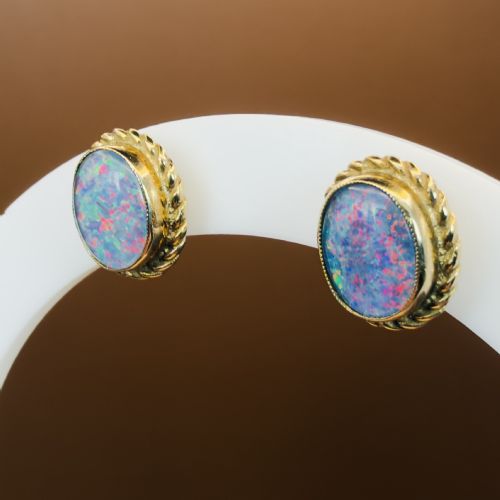
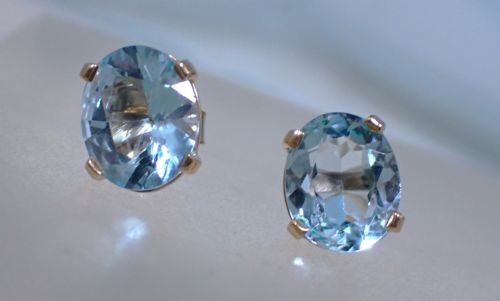
You are most likely to meet pairs fashioned in 9ct or 18ct gold, often housing central gemstones like aquamarine, sapphire, garnet, or black opal doublets. The forms lean towards clusters, floral motifs, and sculptural modernist shapes.
The aesthetic bridges the linear precision of the 1930s with the bolder, organic textures of 1950s and 1960s modernist design. They offer an everyday way to wear period gold without the drop of dangles or chandeliers.
How they were made
Jewellers utilised yellow and white 14ct and 18ct gold alongside 9ct gold to construct the foundational settings and mounts for these earrings. Stones such as diamonds, emeralds, and zircons were securely claw-set or cluster-arranged to maximise light reflection against the warm metal.
Techniques combined traditional casting with precise geometric wirework and cluster grouping, particularly visible in floral and twirl configurations. Gemstones like black opal doublets and rose quartz were cut and polished to sit flush or rise prominently within sculptural bezels.
Current listings feature pieces spanning the 1930s through to the 1960s, utilising 9ct and 18ct gold alongside diamonds, sapphires, and black opal doublets.
What varies in quality
The calibre of the central gemstones, from deep blue sapphires to vibrant aquamarines and matched diamond clusters, dictates the upper tier of these pieces. Heavier gauge gold and substantial stone carat weights elevate the structural presence of the stud.
Design pedigree and originality of setting define the finer examples, particularly when distinct modernist or maker-attributed hands shape the gold. The integration of secure screw backs or robust butterfly closures ensures structural integrity matches the visual weight.
Andrew Grima
The Retro Gold Ear Studs Glossary
- Doublet
- A composite gemstone made of two joined layers, often pairing a thin slice of precious opal with a protective quartz dome. This technique created greater depth and durability in mid-century jewellery.
- Cluster
- An arrangement of smaller gemstones clustered tightly around a larger central stone or focal point. This setting style maximises sparkle and creates dense floral or geometric patterns on the lobe.
- Bezel
- A collar of metal that securely holds a gemstone in place by folding over its edge. It provides a clean, smooth outline popular in mid-century modernist designs.
- Twirl
- A swirling or spiralling metal motif characteristic of 1940s and 1950s abstract design. It adds dynamic movement to static stud earrings.
- White gold
- An alloy of gold mixed with white metals such as palladium, silver, or nickel, often plated with rhodium. It offered a bright, silvery alternative to yellow gold for diamond settings during the mid-century period.
Retro Gold Ear Studs: Frequently Asked Questions
How do I date retro gold ear studs?
Examine the overall design language, noting whether the piece leans towards the linear symmetry of the 1930s Art Deco era or the sculptural textures of the 1950s and 1960s.
Asshield marks, gold purity stamps, and specific mechanisms like screw backs also help anchor the piece within its respective decade.
Are these comfortable for daily wear?
Most stud configurations sit flat against the lobe, making them practical for everyday routines without catching on clothing or hair.
Heavier cluster designs require secure butterfly or screw backs to distribute the weight evenly across the ear.
What is the difference between yellow and white gold settings?
Yellow gold provides the warm, rich tone favoured across mid-century organic and floral designs.
White gold supplies a neutral, reflective backdrop that enhances the icy brilliance of diamonds and aquamarines.
How should I care for vintage opal doublets?
Protect black opal doublets from prolonged immersion in water and harsh chemicals to preserve the adhesive layer joining the stone sections.
Store them separately in soft pouches to prevent surface scratches on the softer composite dome.