





Renaissance Style Sideboard
A renaissance style sideboard brings substantial historical weight and heavy architectural carving into a room, offering deep storage beneath a commanding display surface.
Renaissance Style Sideboard
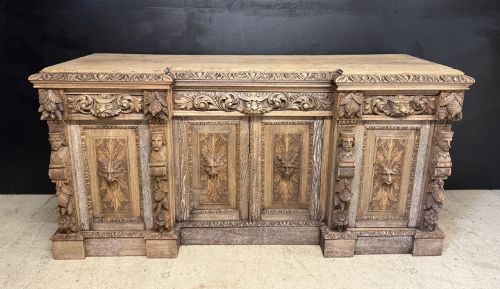
A renaissance style sideboard draws upon historical forms from the seventeenth century and nineteenth century revivals, presenting itself through sturdy cabinets, cupboards, buffets, and dressers. These pieces originate across diverse regions, encompassing French, Italian, and wider continental workshops alongside British cabinetmakers.
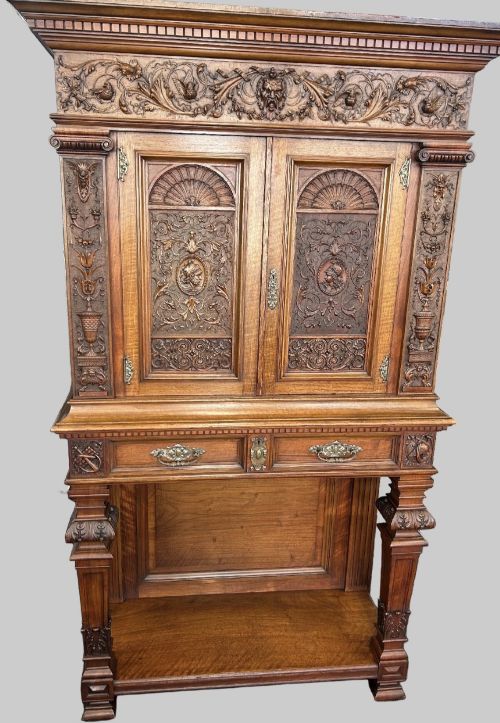
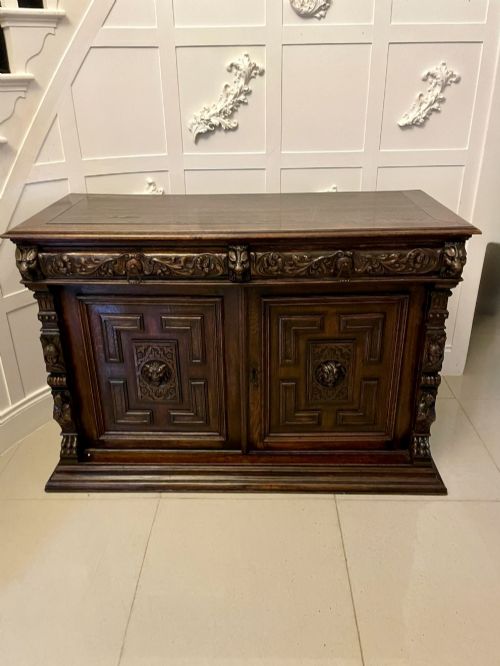
The most common examples encountered on this page date to the nineteenth century, particularly from the eighteen eighties and eighteen nineties under the Victorian Renaissance Revival. They frequently manifest as carved oak sideboards or walnut cabinets featuring substantial architectural doors and enclosed lower storage.
Beyond the standard dining room sideboard, the selection extends to hall cupboards, game cupboards, and buffets de corps. These varied forms share a common architectural gravity, often raised on plinths or legs with pronounced cornices and heavy panelled construction.
Materials and Construction
Makers relied primarily on oak and walnut as the foundational timbers for these heavy pieces, shaping them through deep relief carving and panel assembly. These woods provided the structural integrity necessary for elaborate sculptural ornament and deep mouldings.
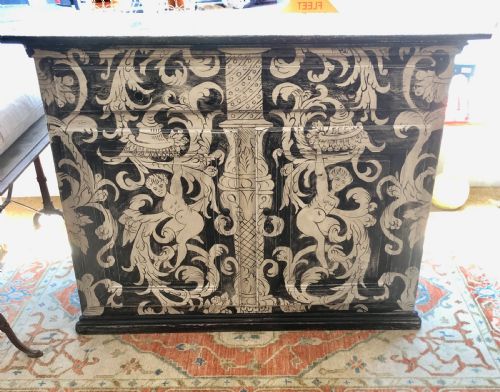
Secondary materials such as brass, iron, marble, and glass appear selectively for hardware, surface insets, and upper display compartments. Hand-painted finishes also occur on specific French pieces, notably incorporating grotesque decoration over wood surfaces.
Renaissance Style Sideboard Retail Price Guide 2026
Typical asking prices for renaissance style sideboard among the pieces listed under this phrase on Sellingantiques today, from the lower quarter to the upper quarter. They describe what is for sale here now, not the wider market.
Listings span the seventeenth century to the early twentieth century, with the nineteenth century forming the core of the inventory.
Distinctions in Quality
The depth and crispness of the carving dictate much of the distinction between standard production and exceptional work. Superior pieces display fluid, undercut relief figures and architectural motifs that show careful hand execution rather than mechanical repetition.
The choice of timber grain and the integrity of the cabinet construction further separate the grades. High-tier examples utilise well-figured walnut or quarter-sawn oak with robust joinery that maintains structural alignment across heavy doors and top surfaces.
Gillows·Melissa White
The Renaissance Style Sideboard Glossary
- Buffet de corps
- A tall French sideboard or two-tier cupboard featuring enclosed storage in both upper and lower sections. This form provides substantial capacity for household linens and dining provisions.
- Renaissance Revival
- A nineteenth-century design movement that reinterprets sixteenth-century architectural and sculptural motifs. It manifests through heavy cornices, columns, pilasters, and mythological carvings.
- Grotesque
- A style of decorative painting or sculpture consisting of whimsical human and animal figures intertwined with foliage. It appears on painted panels within certain continental pieces.
- Quarter-sawn
- A method of cutting log timbers that exposes striking grain patterns while increasing dimensional stability. This technique reduces warping in large sideboard panels.
Renaissance Style Sideboard: Frequently Asked Questions
What is a renaissance style sideboard?
A renaissance style sideboard is a heavy storage cabinet or buffet inspired by sixteenth-century architecture, typically constructed in oak or walnut during the nineteenth century.
These pieces feature prominent cornices, panelled doors, and deep relief carvings designed to anchor a dining room or hall.
How do I date these sideboards?
Dating relies on examining the timber preparation, tool marks on the interior secondary woods, and stylistic indicators from the nineteenth-century revival periods.
While the aesthetic mimics earlier seventeenth-century work, construction methods and hardware often reveal the true Victorian or early twentieth-century origin of the piece.
Where were these sideboards placed?
These sideboards historically stood in grand dining rooms and entrance halls to store tableware, serving dishes, and game.
Today, they function well in large living spaces or hallways where their substantial proportions provide both a surface for display and deep interior storage.
Are these pieces solid wood?
The listings show construction primarily in solid oak and walnut, occasionally augmented by painted decoration, marble inserts, and metal hardware.
Makers utilised heavy timber scantlings to support the deep architectural carvings and structural demands of the revival styles.