
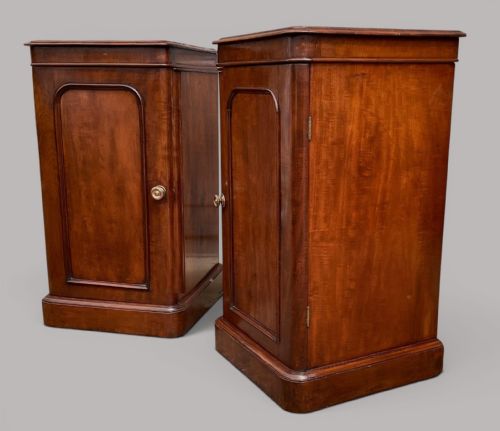
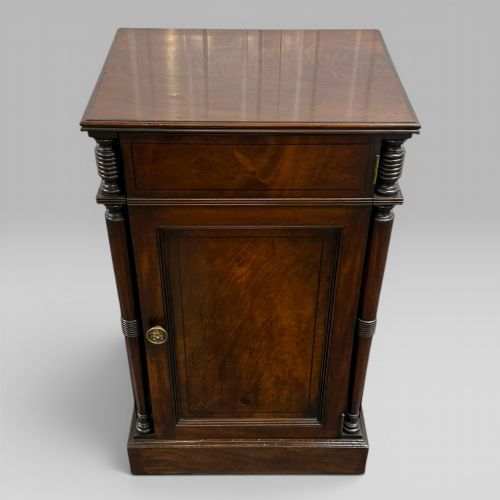


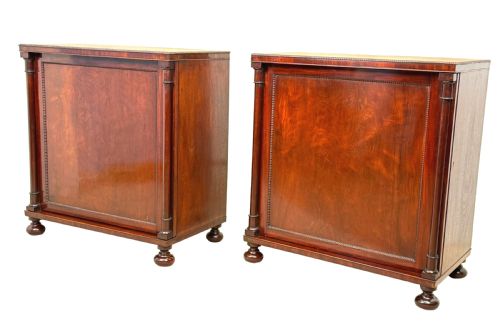


Regency Pedestal Cupboards
Regency pedestal cupboards are columnar storage units built to stand beside a bed or in a hall, offering compact enclosed space with distinct classical proportions.
Regency Pedestal Cupboards
Regency pedestal cupboards appear as cylindrical, hexagonal, or square freestanding vertical units designed to hold chamber utensils, books, or plate. These pieces span the 19th Century, drawing heavily on Georgian proportions and evolving through William IV and Early Victorian iterations.
The buyer meets many bedside variations alongside architectural column designs, cylinder cabinets, and side pieces. Dating ranges from around 1800 through the Regency and George IV periods into later Victorian revivals.
Materials and Construction
Cabinetmakers utilised solid mahogany and applied flame mahogany veneer over structural timbers to create deep grain figures. Brass mounts, ebony stringing, and faux marble surfaces complete the structural vocabulary.
Exotic timbers such as rosewood and gonçalo alves appear on select cabinets, requiring precise joinery to curve doors around cylindrical carcases and shape hexagonal pedestals.
The listings feature mahogany, rosewood, and gonçalo alves across periods spanning from 1800 through the Regency, William IV, and Victorian eras.
Assessing the Pieces
The distinction between tiers rests upon the choice of timber figure, such as highly swirled flame mahogany or scarce gonçalo alves, matched across curved doors and panelled sides. Plain secondary woods and flat-cut veneers occupy the lower end of the range.
Holland and Sons·Gillows·S Jamar
The Regency Pedestal Cupboards Glossary
- Flame mahogany
- A timber veneer displaying a distinct torch-like or feather pattern caused by cutting across the branch junction.
- Pedestal cabinet
- A tall, freestanding enclosed furniture piece standing on a single base or plinth.
- Cellarette
- A fitted storage compartment or box designed originally to hold wine bottles securely.
- Gonçalo alves
- A dense exotic hardwood featuring strong dark brown and pale contrasting streaks.
- Cylinder cupboard
- A vertical storage form built with a fully rounded, tubular carcase and a curved door.
Regency Pedestal Cupboards: Frequently Asked Questions
What were pedestal cupboards used for?
These tall units served primarily as bedside cabinets to hold chamber pots, night lights, and personal belongings out of sight. In other rooms, smaller versions acted as stands for sculptures, books, or plate-warmers.
Their narrow footprint allowed them to fit neatly into tight corners or beside high-post beds without blocking walking routes.
How do I tell Regency from Victorian pieces?
Regency and George IV examples typically display restrained classical proportions, architectural column motifs, and subtle brass or ebony inlay. Timber selection leans toward finely figured flame mahogany.
Later Victorian and Edwardian iterations often introduce heavier mouldings, broader proportions, or Gothic Revival elements while retaining the basic vertical pedestal form.
Are cylinder cupboards stable on carpets?
Cylindrical and hexagonal pedestals possess a compact base that distributes weight evenly over a central point. While stable on flat floors, thick carpets can cause slight wobbling on narrower models.
Most original pieces rely on a solid plinth base rather than feet, which helps maintain contact with the floor surface.
Can I use a bedside cabinet in a hallway?
The enclosed door and flat top make these cabinets well suited for narrow hallways as key drops or small storage stands. Their vertical orientation occupies minimal floor space while hiding clutter inside.
Matching pairs can frame a doorway or sit beneath a hallway mirror to echo classical room layouts.