

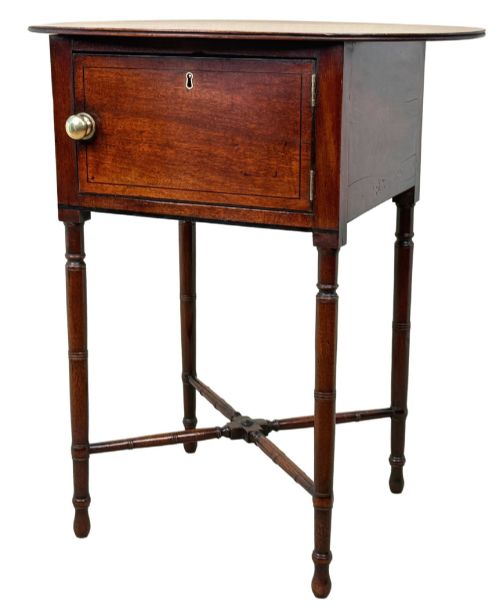


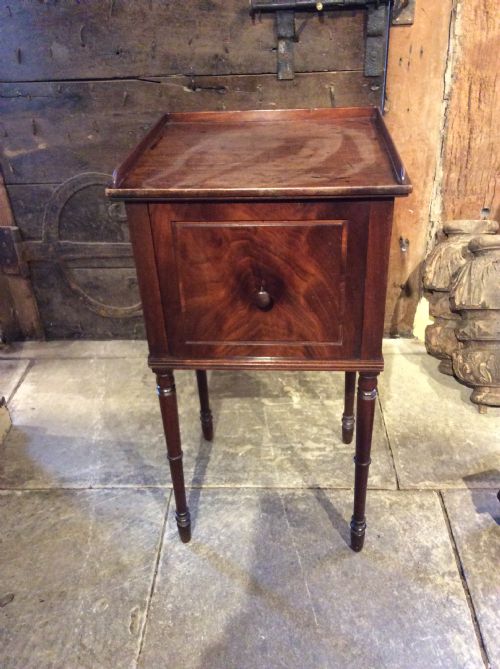
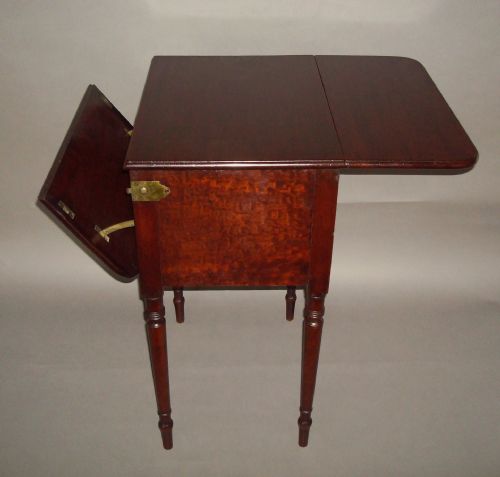


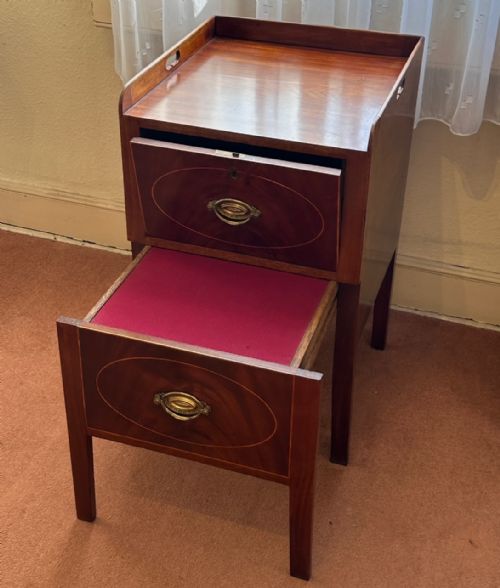
Regency Night Cupboard
A regency night cupboard brings quiet geometry to a bedroom, offering a secure bedside space shaped by early nineteenth-century hands.
Regency Night Cupboard
A regency night cupboard is a compact bedside form designed to hold necessities close to the bed while concealing them behind doors or drawers. When you search for a regency night cupboard, you encounter bedside cabinets, bedside tables, pedestal cabinets, and small commodes.
The pieces on this page span the Regency period, the late Georgian era, and the wider nineteenth century. Most examples take the form of enclosed cabinets or cylindrical cupboards, often showing the distinct proportion favoured by makers of the early eighteen hundreds.
Makers of the period also produced deception tables and commode chests that served the same domestic function beside the bed. These variations provide functional surfaces for lamps and personal items while keeping chamber furniture discreetly tucked away.
How they were made
Timber selection dictates the surface character, with solid mahogany and flame mahogany veneer providing deep grain patterns across doors and tops. Workshops employed boxwood inlay to trace delicate borders and geometric lines along drawer fronts and cabinet edges.
Structural hardware relies on brass fittings, from handles to hinges, selected for durability and contrast against dark wood. Internal fittings sometimes include practical additions such as a pull-out step alongside the main storage compartment.
Regency Night Cupboard Retail Price Guide 2026
Typical asking prices for regency night cupboard among the pieces listed under this phrase on Sellingantiques today, from the lower quarter to the upper quarter. They describe what is for sale here now, not the wider market.
One exceptional Regency cabinet includes a built-in pull-out step, proving that early morning dignity required some mechanical assistance.
What varies in quality
Quality rests in the choice of timber and the precision of the veneer work, particularly where flame mahogany is matched across curved or flat surfaces. Superior cabinets demonstrate careful timber selection that maintains consistent grain direction and colour balance.
Refinement shows in secondary details like boxwood stringing and the integration of functional elements such as pull-out steps or fitted interiors. Better examples retain crisp edges and original hardware that complement the overall proportion without crowding the design.
The Regency Night Cupboard Glossary
- Flame mahogany
- A veneer cut from the fork of the mahogany tree, producing a distinctive flickering flame pattern across the wood. Cabinet makers used this figure on prominent surfaces like drawer fronts and doors.
- Boxwood inlay
- Narrow strips of pale boxwood set flush into dark timber to create contrasting lines and geometric decoration. This technique defines the edges of panels and tabletops.
- Pedestal cabinet
- A tall, narrow freestanding cupboard designed to stand beside a bed or chair. These pieces often feature a single door enclosing shelving or storage space.
- Commode chest
- A low cabinet with drawers or doors, used in bedrooms for storage during the Georgian and Regency periods. They combine decorative presence with practical enclosed space.
- Cylindrical cupboard
- A circular bedside cabinet where the door curves with the body of the piece. This form requires precise woodworking to ensure smooth movement around the curved frame.
Regency Night Cupboard: Frequently Asked Questions
What is a regency night cupboard used for?
These cabinets served bedrooms as discrete storage for chamber equipment, personal items, and nighttime necessities. The enclosed top surface also held candlesticks or lamps.
Today they function effectively as bedside tables, offering concealed storage alongside a flat surface for contemporary lighting and books.
How do I identify a regency piece?
Look for proportions typical of the early nineteenth century, clean geometric lines, and the use of solid mahogany or flame mahogany veneer. Details such as boxwood stringing and brass hardware are also common.
Comparing the construction methods and timber quality to dated examples helps confirm the period of manufacture.
Are all these cabinets cylindrical?
Not at all, though cylindrical bedside cupboards appear alongside square and rectangular pedestal cabinets. Workshops produced various shapes to suit different bedroom layouts.
Forming curved doors required specialist woodworking skills, which distinguishes cylindrical variants from standard rectangular bedside tables.
What woods were used in these cabinets?
Mahogany is the primary timber found in these listings, often enhanced by flame mahogany veneer across prominent exterior surfaces. Boxwood provides contrast through fine inlay work.
Secondary timbers were used for interior framing and drawer linings, hidden from view behind the main cabinet doors.