


Regency Newspaper Rack
A regency newspaper rack is a low compartmentalised stand built to hold daily journals and sheets close at hand.
Regency Newspaper Rack
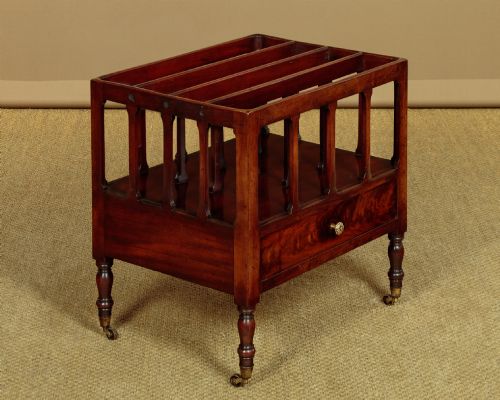
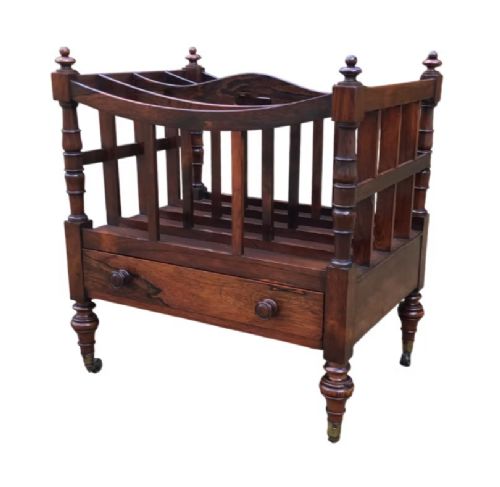
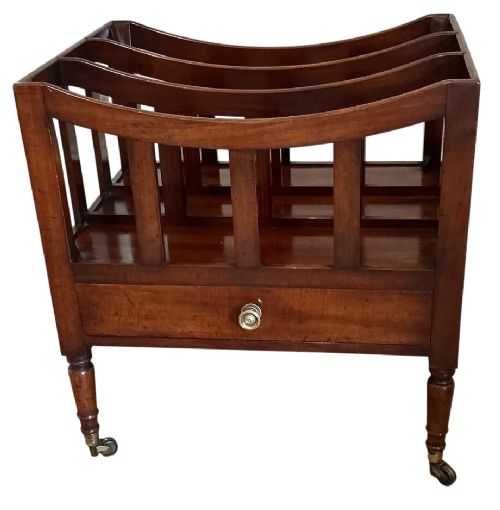
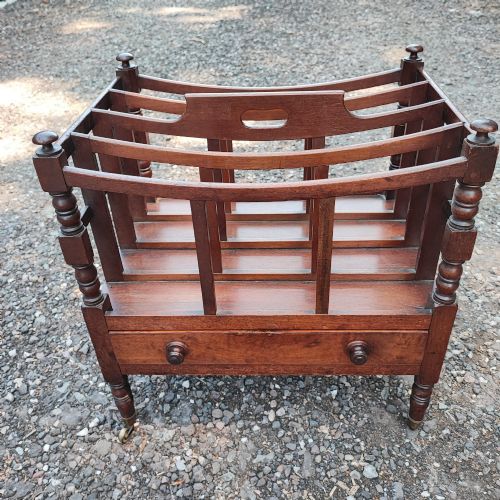
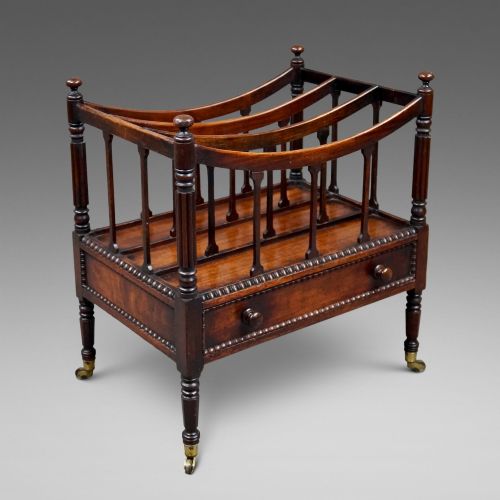
When buyers search for a regency newspaper rack, they encounter open wooden frames designed to hold folded sheets, folios and periodicals off the floor. The forms on this page span the Georgian, Regency, William IV and George IV periods, alongside later revival pieces.
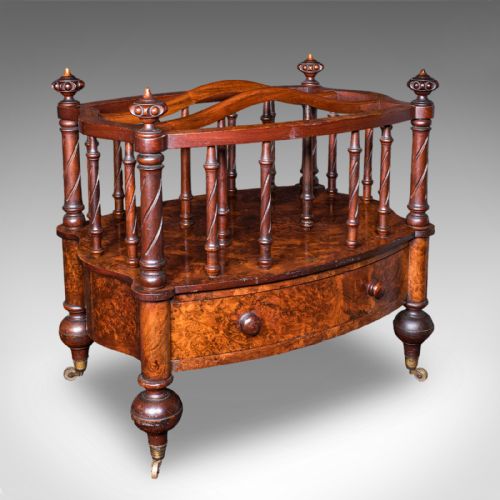
Mahogany and rosewood dominate the selection, often shaped with slatted or pierced divisions and low legs fitted with castors. Many examples take a boat shape or incorporate a small base drawer for smaller items.
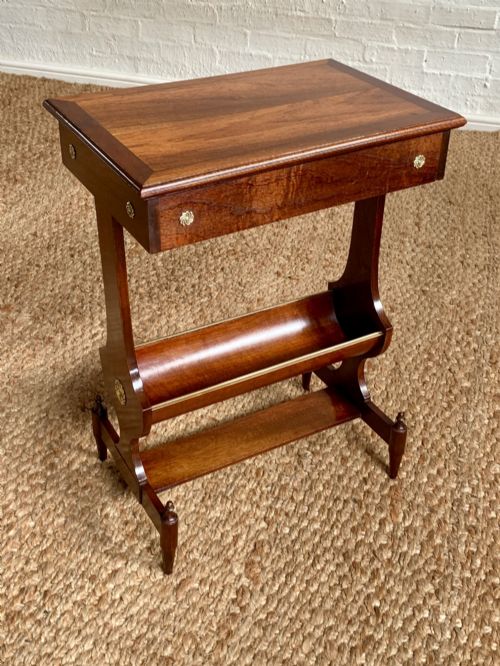
Alongside standard wooden canterburys, the listings include occasional brass and copper designs from the twentieth century. These variations reflect how the form adapted from holding sheet music and newspapers to later domestic periodicals.
Materials and construction
Cabinet makers relied heavily on dense timbers such as mahogany and rosewood to build sturdy partitions that could support heavy stacks of paper. Burr walnut and ebony banding appear on select pieces as decorative veneers and stringing.
Metal components play a structural and mobile role, utilising brass for castors, carrying handles and division rods. Later twentieth-century versions introduce brass and copper work entirely, moving away from traditional timber frames.
Listings feature mahogany, rosewood, burr walnut, brass and copper across periods from the eighteenth century to the mid twentieth century.
Assessing quality and finish
Quality rests in the crispness of the turned legs, the joinery of the vertical dividers, and the figure of the timber grain. Finer examples display careful attention to internal corners and smooth movement in any integrated drawer.
The choice of secondary woods and the subtlety of inlay or ebony banding separate standard workshop production from pieces of higher design standing. Original castors and undisturbed timber patination elevate the standing of an individual piece.
Gillows of Lancaster·Maison Jansen
The Regency Newspaper Rack Glossary
- Boat shaped
- A curved profile given to the rails of certain canterburys, resembling the hull of a vessel. This contour softens the rectangular rigidity of the stand.
- Divisions
- The vertical partitions that split the upper section of a rack into separate compartments. They keep unbound papers upright and sorted.
- Castors
- Small wheel attachments fitted to the base of the legs to allow easy movement across the floor. They are frequently made of brass.
- Bandings
- Narrow strips of contrasting timber, such as ebony, inlaid into the primary surface for decorative effect.
Regency Newspaper Rack: Frequently Asked Questions
What was a regency newspaper rack used for?
These stands kept daily broadsheets, journals and unbound sheet music organised and within reach of a seating area. The compartmented design prevented large formats from slumping or sliding onto the floor.
Over time, households adapted them to hold modern magazines and periodicals while maintaining their traditional placement beside reading chairs and sofas.
How do I identify a genuine period piece?
Examination of the timber surfaces, construction joints and internal drawer linings helps determine age. Period pieces from the Georgian and Regency eras show hand-cut joinery and timber patination consistent with active nineteenth-century use.
Revival pieces from later decades often display heavier machine finishing or different secondary woods beneath the primary mahogany or rosewood veneers.
Where should I place a canterbury in a room?
A canterbury sits comfortably beside a sofa, desk or armchair where reading materials accumulate. Because they are finished on all sides as freestanding items, they function well away from walls.
The low profile ensures they do not block sightlines or overwhelm surrounding furniture arrangements.
Did these racks hold newspapers only?
Makers originally constructed these stands to accommodate sheet music, folios and writing paper alongside contemporary news sheets. The flexible vertical divisions accommodated various paper sizes used in nineteenth-century parlours.
This multi-purpose utility explains why many period examples appear in records under both newspaper rack and music stand classifications.