


Regency Marquetry Box
A regency marquetry box brings precise cabinet work into daily use, offering small-scale storage crafted from figured timbers.
Regency Marquetry Box
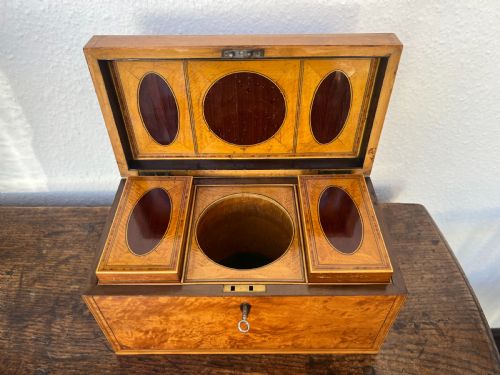
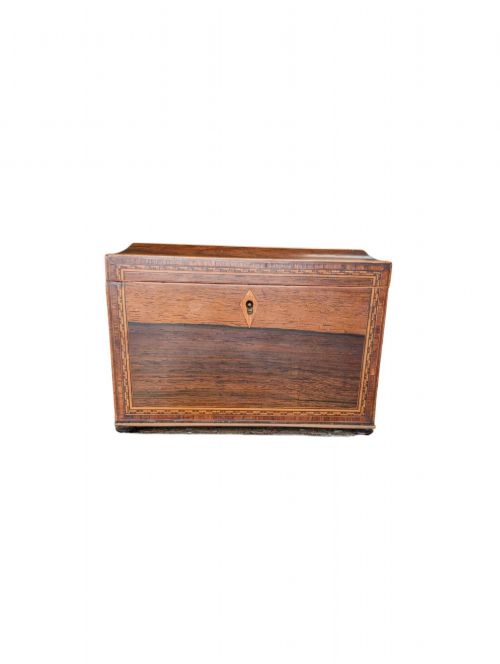
A regency marquetry box is a tabletop receptacle intended for correspondence, tea, sewing or valuables, emerging predominantly from the Regency, Georgian and nineteenth-century periods. These containers take diverse forms, appearing as tea caddies, writing boxes, work tables, and decorative cabinets designed to sit upon larger furniture. Rosewood and mahogany serve as the primary foundational timbers for these pieces, often enriched with contrasting wood veneers and metal inlays.
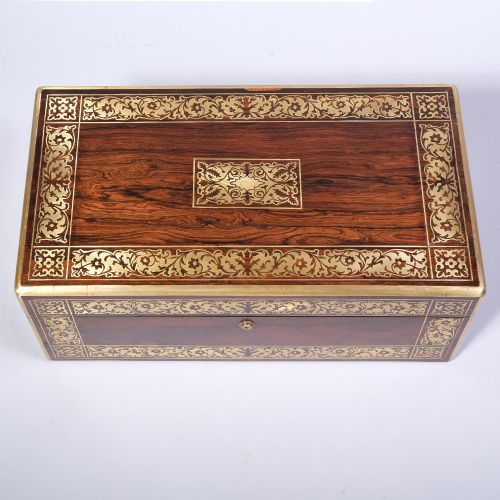
The version most frequently encountered on this page is the tea caddy or writing box executed in rosewood with brass inlay. These boxes often feature rectangular, tapered, or sarcophagus silhouettes, sometimes raised on pillar stands or feet. Alongside these, buyers find specialised forms like Tunbridge ware sewing baskets, games boxes, and document boxes reflecting the period's taste for intricate surface decoration.
What varies in quality
Quality in a regency marquetry box rests upon the precision of the cabinet work and the selection of the timber. Finer examples display tightly figured rosewood or amboyna veneers paired with complex, multi-wood marquetry or sharply executed brass inlay that sits flush with the surface. Lesser pieces rely on simpler construction with plain mahogany or secondary woods and minimal ornamentation.
The interior fitments also distinguish better items, as superior boxes retain original compartmentalised trays, inner canisters, velvet linings, and working locks with keys. Structural integrity of the box carcass, minimal warping of the lid, and the crispness of the parquetry or Tunbridge mosaic dictate the standing of an individual piece within its period.
Some nineteenth-century tea caddies include secret locking mechanisms that required pressing hidden springs just to reach the sugar.
The Regency Marquetry Box Glossary
- Marquetry
- Decorative veneer work forming pictures or geometric patterns by assembling thin pieces of wood, shell, or bone. This technique requires exact cutting to fit elements flush onto the carcass of the box.
- Teapoy
- A small stand or table fitted with containers for storing tea, often taking the form of an elaborate box mounted on a pillar base. These pieces frequently feature compartments and mixing bowls.
- Tunbridge Ware
- Woodwork decorated with mosaic patterns made from thousands of tiny tinted wood blocks, named after the Kent town where the craft flourished. It creates detailed pictorial or geometric surface designs.
- Sarcophagus
- A box shape featuring a domed or steeply sloped lid resting on a rectangular base, reminiscent of ancient stone coffins. Regency makers adopted this silhouette for grand tea caddies.
- Parquetry
- Geometric mosaic woodwork arranged in repeating patterns such as cubes, triangles, or chequers. It differs from marquetry by using strictly geometric grids rather than pictorial scenes.
- Gonçalo Alves
- A dense exotic hardwood with striking dark brown and cream striping, valued by Regency cabinet makers for decorative box facades. It provides a highly figured contrast to simpler timbers.
Regency Marquetry Box: Frequently Asked Questions
What is a teapoy?
A teapoy is a lidded box designed to hold tea leaves, frequently mounted on a central pillar with feet rather than sitting purely on a tabletop.
These pieces often contain internal canisters and mixing bowls for preparing tea in a drawing room.
How do I care for rosewood?
Rosewood boxes require stable indoor humidity away from direct sunlight and heat sources to prevent the timber from drying and the veneer from lifting.
Gentle dusting with a dry cloth suffices for routine maintenance, avoiding harsh modern chemical polishes.
What is Tunbridge ware?
Tunbridge ware is a specialised form of decorative woodwork characterised by mosaic surfaces assembled from thousands of tiny tinted wood segments.
Craftsmen arranged these microscopic tiles to depict floral motifs, butterflies, or geometric borders on box lids.
How do I date a box?
Dating relies on observing the primary timber choices, hardware styles, construction methods, and prevailing design motifs associated with periods like the Regency or Victorian eras.
Rosewood with cut brass inlay points towards the early nineteenth century, while later Victorian pieces often display different interior fittings and joinery.