

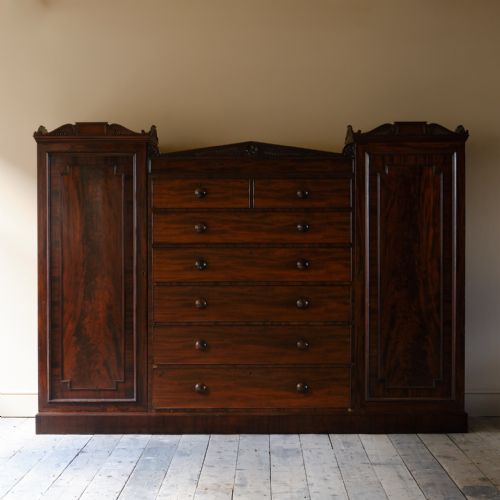


Regency Mahogany Clothes Chest
A regency mahogany clothes chest is a substantial household piece designed to store garments, combining deep timber grain with architectural proportion.
Regency Mahogany Clothes Chest
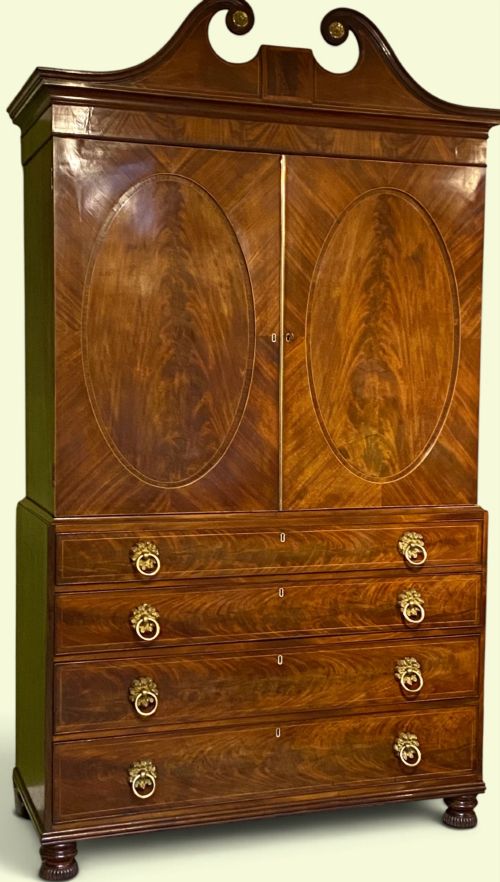
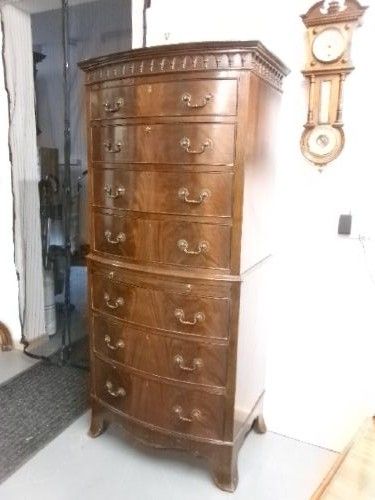
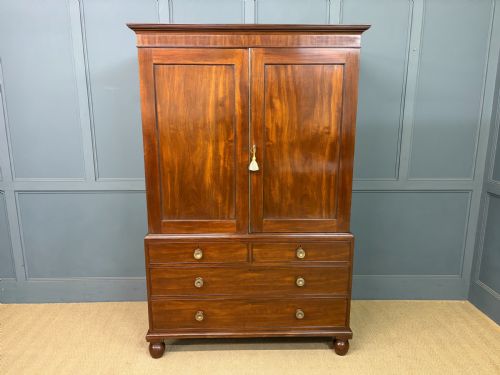
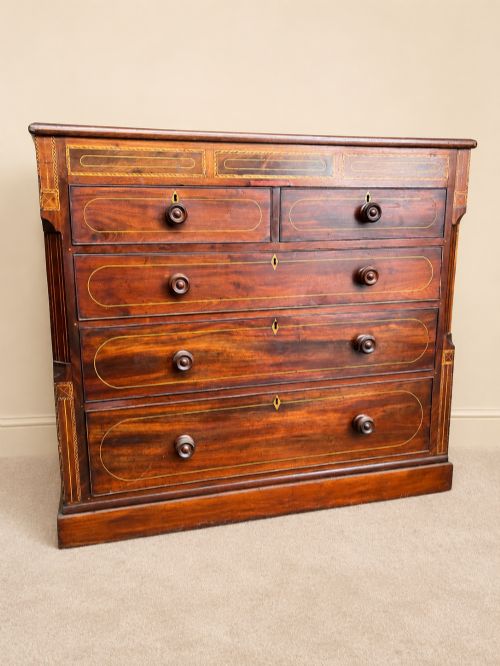
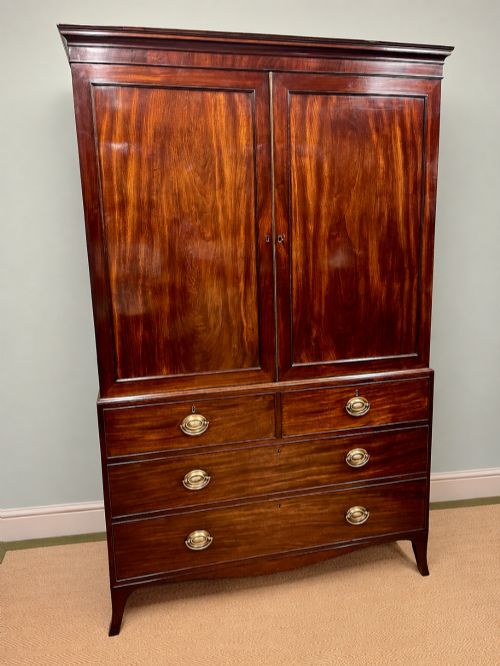
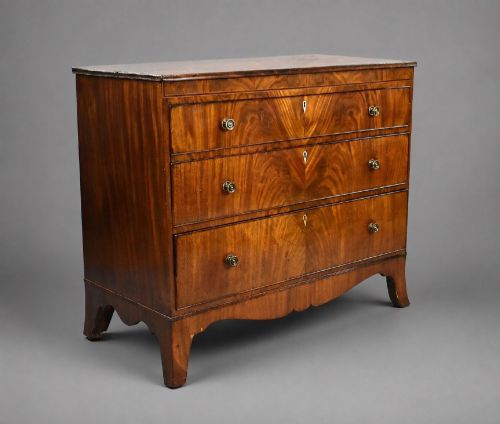
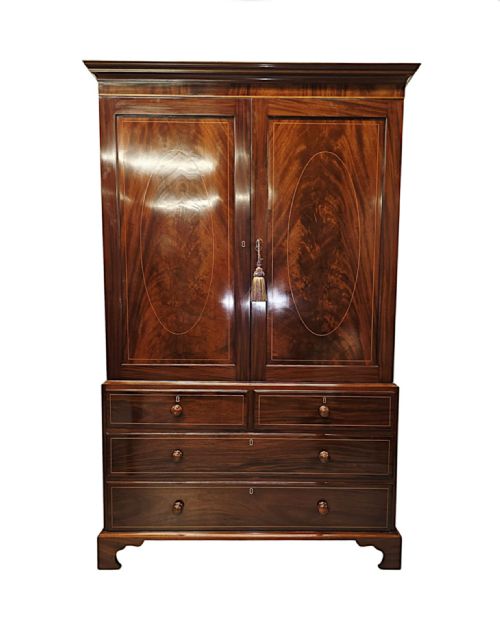
A regency mahogany clothes chest typically takes the form of a linen press, a chest of drawers, or a wardrobe, bridging the gap between storage and display. The selection here leans heavily towards linen presses and chests of drawers produced across the Regency, Georgian, and Victorian periods.
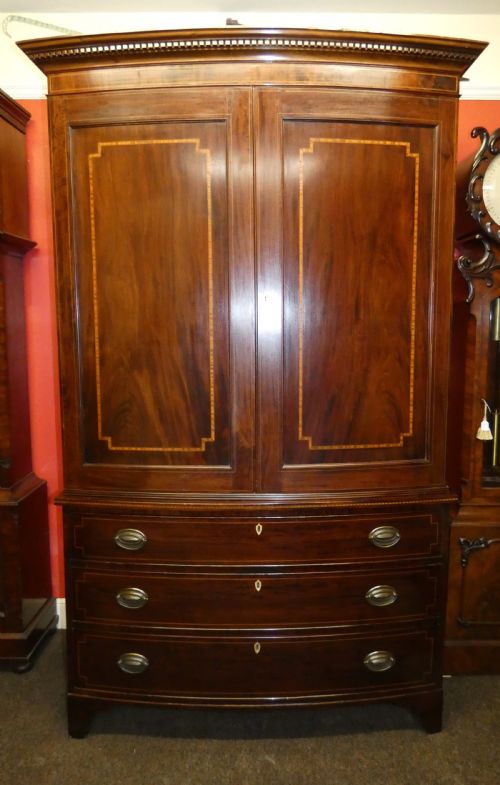
Makers of the era constructed these items to dominate a bedroom or dressing room, offering deep internal sliding trays or hanging space above a lower tier of drawers. Pieces range from straightforward bowfront designs to grand examples featuring elaborate stringing and architectural cornices.
The materials and forms vary slightly across the centuries, shifting from strict Regency proportions to later William IV and Victorian interpretations, yet the core utility as a clothes chest remains constant.
What varies in quality
The superiority of a piece rests upon the choice of timber, particularly the liveliness of the flame mahogany veneer and the precision of the boxwood or satinwood inlay work. Finer examples display continuous grain matching across the drawer fronts and well-figured Cuban mahogany.
Construction details such as the thickness of the oak drawer linings, the integration of original brass fitments, and the crispness of the mouldings separate standard production from superior workshops.
Regency Mahogany Clothes Chest Retail Price Guide 2026
Typical asking prices for regency mahogany clothes chest among the pieces listed under this phrase on Sellingantiques today, from the lower quarter to the upper quarter. They describe what is for sale here now, not the wider market.
Forms on this page include linen presses, compactum wardrobes, and bowfront chests of drawers.
The Regency Mahogany Clothes Chest Glossary
- Linen press
- A tall storage piece comprising an upper section with sliding trays enclosed by doors, sitting above a chest of base drawers. This form was traditionally used for storing folded textiles and garments.
- Flame mahogany
- A veneer cut from the fork of the mahogany tree where the branch meets the trunk. This technique produces a distinctive, fiery pattern with intense grain movement.
- Bowfront
- A curved cabinet front that swells outwards in the centre. This shape softens the angular lines typical of standard rectangular chests.
- Stringing
- A narrow strip of contrasting wood inlay used to outline panels and drawer edges. It defines the geometric boundaries of the woodwork.
- Compactum
- A multi-functional wardrobe combining hanging space, drawers, and shelving within a single unit. It represents a more complex evolution of the standard clothes chest.
Regency Mahogany Clothes Chest: Frequently Asked Questions
What is a linen press?
A linen press is a large two-piece cabinet featuring upper sliding shelves behind doors and lower drawers. It was built to store household linens and folded garments before modern wardrobes became common.
Today, these lower drawers and upper compartments function effectively for modern clothing storage while serving as a focal point in a bedroom.
How do I date a mahogany chest?
Dating relies on examining the construction methods, handles, and secondary woods like oak drawer linings. Earlier pieces often feature hand-cut dovetails and subtle inlay patterns.
Stylistic shifts between the Georgian, Regency, and Victorian eras also reveal themselves in the proportions, feet designs, and cornices of the cabinet.
Where should I place a clothes chest?
These substantial pieces require adequate wall space and a stable environment away from direct heat sources to protect the mahogany veneer. Bedrooms and dressing rooms remain the traditional locations for daily use.
Because of their height and weight, particularly linen presses, ensure the floor level can support the heavy timber construction.
What is flame mahogany?
Flame mahogany is a decorative veneer sliced from the junction where branches join the main tree trunk. The cutting process exposes a rippled, flickering grain pattern that catches the light.
Cabinet makers reserved this prized material for the primary display surfaces, such as drawer fronts and door panels, to create visual drama.