



Regency Interior Artwork
Regency interior artwork captures domestic and domestic stable scenes from the nineteenth century in oil, watercolour and chrystoleum.
Regency Interior Artwork
Buyers seeking regency interior artwork find nineteenth century paintings, watercolours and framed prints depicting domestic rooms, stable interiors and figures within panelled settings. The selection on this page ranges from early nineteenth century oil paintings to later Victorian genre works and twentieth century pieces.
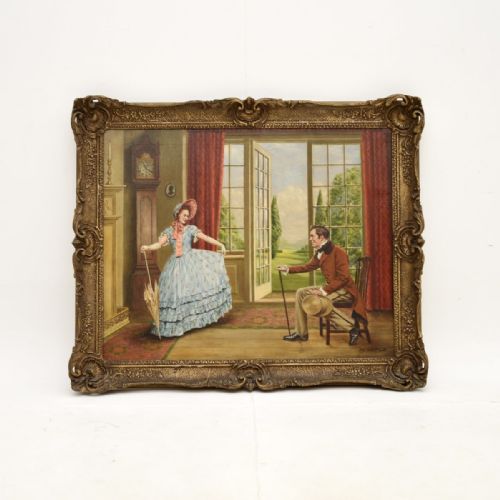
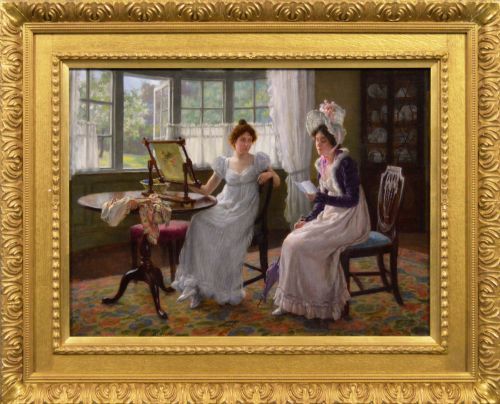
The subjects include domestic scenes such as shaving rituals and courtship, alongside English school sittings rooms and stable views. These works record period furniture, architectural details and human activity through the eyes of artists working from the 1800s onwards.
Most examples originate from British traditions, encompassing Georgian, Regency and Victorian stylistic influences. Framed artwork and painted tiles complete the selection, offering varied scales and formats for interior display.
How they were made
Artists painted these works using oil on canvas or watercolour on paper, applying pigments to capture light within domestic and stable settings. Framing often incorporated wood, gesso and gold leaf to house the paintings and prints.
Specialised techniques such as chrystoleum production involved applying hand-coloured prints to glass and finishing them with oil paints. Original painted tiles utilised ceramic bases decorated with pigments to record interior or decorative subjects.
One domestic interior painting captures a gentleman's shaving ritual abruptly interrupted by his wife.
What varies in quality
The finesse of brushwork and the precision of architectural perspective separate skilled compositions from simpler student exercises. Works by documented hands demonstrate a stronger grasp of human anatomy and interior lighting.
The preservation of the primary medium, whether oil on canvas or watercolour on paper, influences the visual impact of the piece. Frame construction and the retention of original backing materials or period labels also distinguish finer survivals.
Alfred Lyndon Grace·George Kilburne·Charles Haigh Wood·Rolinda Sharples·John Nost Sartorius·Stephen Taylor
The Regency Interior Artwork Glossary
- Chrystoleum
- A Victorian method of applying a hand-coloured paper print to the inside of a convex glass pane and then painting it from behind in oil.
- Watercolour
- A painting method where fine pigment is suspended in a water-based solution on paper.
- Genre painting
- The pictorial representation of scenes from everyday life, typically depicting domestic interiors or social interactions.
- Gesso
- A plaster-like mixture applied to wood frames to create a smooth surface for gilding with gold leaf.
- Oil on canvas
- A technique using pigments bound in a drying oil medium applied to a stretched canvas support.
Regency Interior Artwork: Frequently Asked Questions
What periods do these interior artworks date from?
The pieces span the nineteenth century and extend into the early twentieth century, reflecting changing tastes in domestic representation.
Examples range from the early 1800s through Victorian revival periods up to 1930.
How were chrystoleum pictures produced?
Makers took a paper print, glued it face down to glass, rubbed away the paper backing, and painted the reverse with oils.
This created a luminous, three-dimensional effect popular during the Victorian era.
What subjects appear in these interior scenes?
Paintings show domestic moments, sitting rooms with period furniture, stable interiors with horses, and courtship narratives.
Artists recorded specific interior architecture alongside human figures and everyday rituals.
Are these artworks framed?
Many examples are presented in period frames constructed from wood, gesso and gold leaf.
Some retain original labels on the reverse that provide provenance details.