

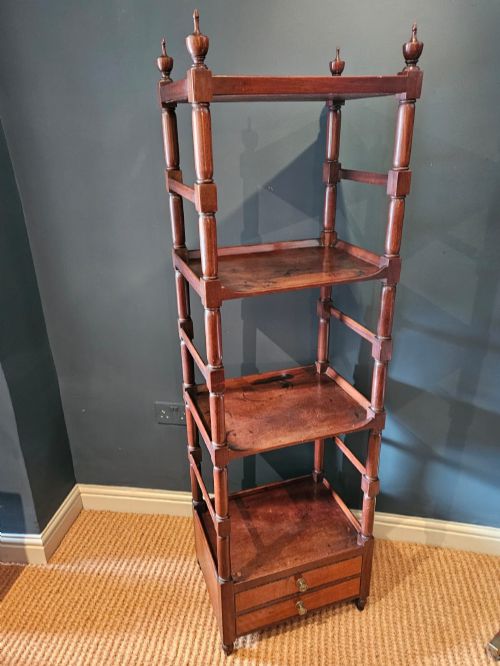
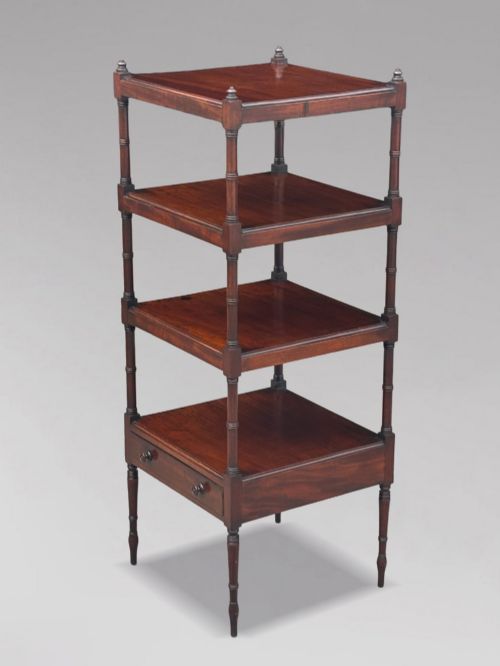


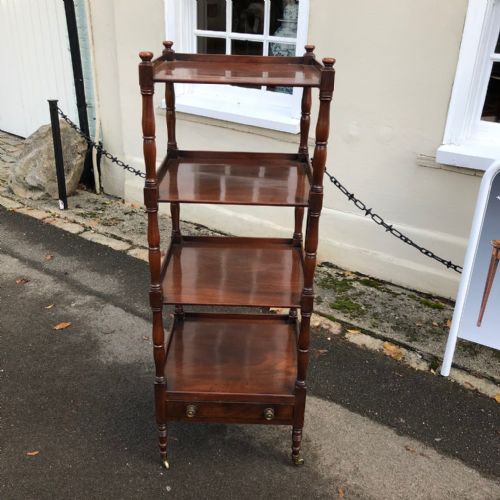

Regency Four Tier Whatnot
These regency four tier whatnot stands are tiered display pieces built for books and reading materials, prized for vertical storage.
Regency Four Tier Whatnot
A regency four tier whatnot is a tiered shelving unit designed for books, music stands, and display items. You are most likely to meet mahogany or rosewood examples spanning the Regency, George III, George IV, and Victorian periods.
These pieces appear in various forms including library reading models, music stands, and A-frame or tapering etageres. The archive shows that four tier formats dominate both current listings and past sales, frequently featuring open shelves supported by turned columns.
Materials and Construction
Makers built these pieces primarily from solid and veneered mahogany and rosewood, incorporating brass castors and occasional cane work. Timber selection dictated the character of the piece, with dense grain and rich natural colour prized by cabinet makers.
Construction methods involved tiered platforms secured by upright supports, sometimes incorporating a drawer base or music stand adjustments. These tiered structures balanced delicate vertical proportions with sturdy joints to hold books and display objects.
Regency Four Tier Whatnot Retail Price Guide 2026
Typical asking prices for regency four tier whatnot among the pieces listed under this phrase on Sellingantiques today, from the lower quarter to the upper quarter. They describe what is for sale here now, not the wider market.
Some reading whatnots double as music stands, proving that Georgian scholars liked to jam.
Distinctions in Quality
Superior quality shows in the choice of timber figure, such as richly grained rosewood or well-figured mahogany with good colour. Finer examples display refined turning on the upright supports and crisp detailing in the joinery rather than plain utility framing.
The integration of functional elements like a drawer base or a reading stand elevates the utility and sophistication of the piece. Better proportioned etageres maintain structural harmony across all four tiers without heavy or clumsy secondary woods.
The Regency Four Tier Whatnot Glossary
- Whatnot
- A piece of furniture with open shelves for displaying small objects, books, or ornaments. They typically feature multiple tiers supported by slender columns.
- Etagere
- A French term for a display shelf or stand with multiple tiers. These function similarly to English whatnots.
- Regency
- An English design period spanning the early nineteenth century. Furniture from this era often draws on classical Greek and Roman motifs.
- Rosewood
- A heavy, durable timber with distinctive dark grain patterns used in fine cabinet making. It yields a polished surface with deep reddish-brown tones.
- A-frame
- A structural silhouette where the sides taper inward toward the top. This configuration provides stable support across graduating tier sizes.
Regency Four Tier Whatnot: Frequently Asked Questions
What is a regency four tier whatnot used for?
These pieces served as versatile display and storage units for books, reading materials, and decorative objects in principal rooms.
Library reading variants also accommodated sheet music and writing materials alongside standard display functions.
How do I identify a George IV whatnot?
George IV pieces typically date between eighteen twenty and eighteen thirty, showing classical Regency influence in their turned supports and timber choices.
They rely heavily on mahogany and rosewood construction with upright tiers and occasional drawer bases.
What is the difference between an etagere and a whatnot?
The terms are largely interchangeable in British furniture history, though etagere sometimes denotes a French stylistic origin.
Both describe tiered open shelving units designed for display and convenience.
Where should I place a whatnot in a room?
Their open vertical format allows them to sit against walls or function as freestanding room dividers without blocking light.
They suit libraries, studies, and drawing rooms where books and small display items need accessible storage.