

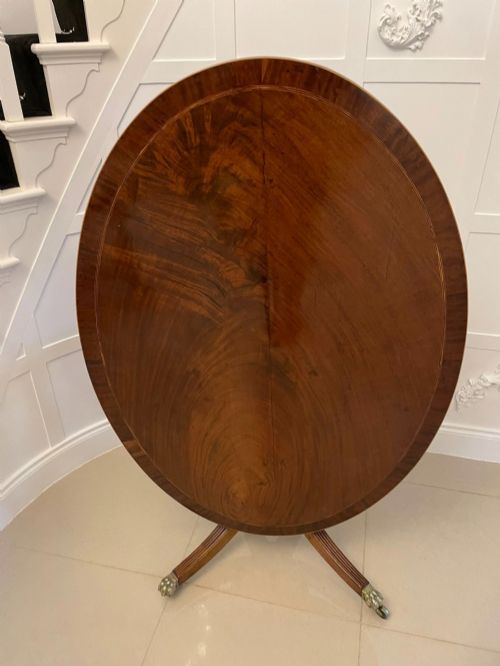
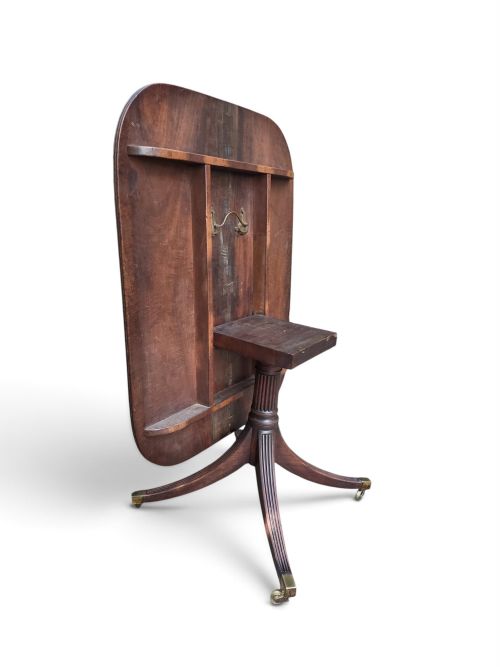
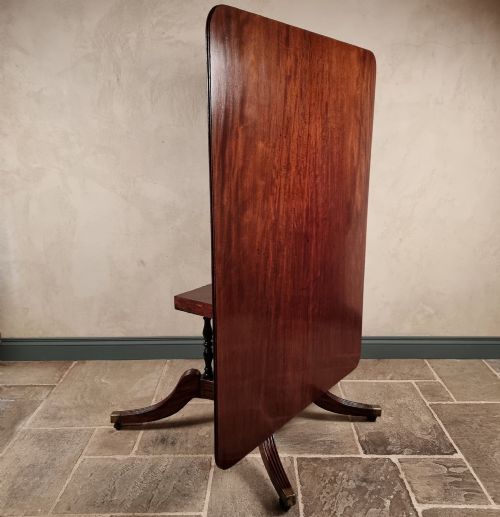
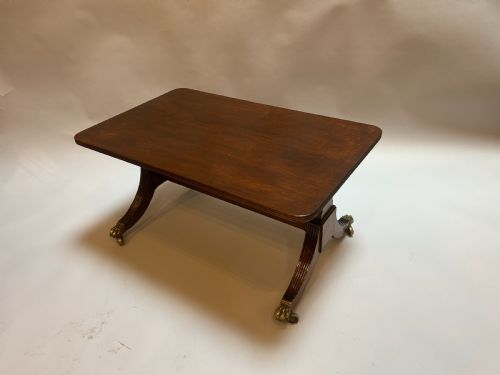
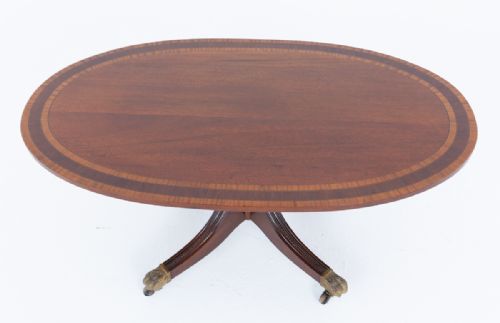


Reeded Leg Centre Table
A reeded leg centre table brings architectural proportion and turned grace into a room, offering a versatile surface designed to stand free of the wall.
Reeded Leg Centre Table
A reeded leg centre table represents a convergence of architectural refinement and domestic utility, designed to occupy a prominent position within a room rather than sit against a wall. The search for a reeded leg centre table leads you to examples spanning the Georgian, Regency, and Victorian eras, alongside later revival pieces.
The most common interpretations on this page include mahogany breakfast tables, coffee tables, and dining tables featuring distinctive carved parallel mouldings on the legs. These pieces draw upon design vocabularies associated with the Regency and George III periods, maintaining a slender silhouette supported by turned or tapering uprights.
Makers and workshops of the nineteenth century frequently utilised rich timbers to execute these freestanding forms, resulting in occasional, work, and drum tables equipped with the characteristic grooved leg detail. The overarching aesthetic prioritises balanced proportions and understated classical ornament over heavy carving.
Materials and construction methods
Makers constructed these tables primarily from dense tropical hardwoods such as mahogany and rosewood, occasionally incorporating exotic veneers like goncalo alves and satinwood for contrasting borders. Solid timber formed the structural framework, while decorative surfaces relied on carefully selected grain patterns.
The characteristic reeding on the legs was achieved through painstaking hand-carving or specialised scratch stocks, cutting parallel convex mouldings directly into the solid wood. Turning lathes shaped the upper sections of the supports before craftsmen finished the linear details by hand.
Reeded Leg Centre Table Retail Price Guide 2026
Typical asking prices for reeded leg centre table among the pieces listed under this phrase on Sellingantiques today, from the lower quarter to the upper quarter. They describe what is for sale here now, not the wider market.
Listings feature tables spanning the Georgian, Regency, and Victorian periods, constructed from mahogany, rosewood, and goncalo alves.
Distinguishing quality across examples
Superior execution is evident in the crispness of the hand-carved reeding and the integration of the leg into the frieze block, where inferior examples show softened edges or blunt profiling. The selection of timber also dictates grade, with dense, figured mahogany commanding greater appreciation than plain stock.
Structural integrity rests upon the joinery connecting the pillar to the platform base or leg assembly, alongside the fidelity of period revival details to authentic eighteenth and nineteenth-century proportions.
Gillows
The Reeded Leg Centre Table Glossary
- Reeding
- Parallel convex mouldings carved into wood, resembling a bundle of reeds placed side by side. This decorative technique is frequently applied to table legs and furniture borders during the Regency and Georgian periods.
- Centre table
- A freestanding table finished on all sides, intended to stand in the middle of a room rather than against a wall. These pieces often serve as display surfaces or occasional writing tables.
- Tilt top
- A table mechanism allowing the top to pivot to a vertical position when not in use, enabling the piece to be stored compactly against a wall. This construction appears frequently on breakfast and dining tables from the Georgian era.
- Goncalo Alves
- A dense, highly figured exotic timber featuring striking dark brown and warm golden-brown contrasting stripes. Cabinet makers utilised this decorative wood for select nineteenth-century tables.
- Drum table
- A circular library or centre table featuring a deep frieze fitted with alternating real and dummy drawers, resting on a central pillar. The upper surface is commonly lined with leather or fabric.
Reeded Leg Centre Table: Frequently Asked Questions
What is a centre table used for?
A centre table provides a freestanding surface intended to occupy the middle of a room rather than resting against a perimeter wall. Historically, these pieces accommodated lamps, books, or serving items in principal reception rooms.
Modern interiors continue to utilise them as statement coffee tables or occasional surfaces where access from all sides is required.
How do I identify a Regency table?
Regency tables typically exhibit classical architectural influences, featuring elements such as brass mounts, sabre legs, and crisp reeding carved into solid mahogany or rosewood. Proportions remain balanced and lean, reflecting the neoclassical taste of the early nineteenth century.
Secondary indicators include turned pillar supports resting on platform bases with hipped or scrolled feet.
What does a tilt top mechanism do?
A tilt top mechanism utilises a wooden catch and pivot block beneath the surface, allowing the tabletop to swing from a horizontal position to a vertical one. This ingenious design enabled larger breakfast and dining tables to be stored against room walls when floor space was needed.
Evidence of this construction includes original brass latches and pivoting blocks housed within the frieze.
How do I care for antique mahogany?
Antique mahogany requires stable indoor humidity and protection from direct sunlight to prevent the rich timber from fading or splitting. Regular dusting with a soft cloth preserves the polished surface without the need for heavy silicone sprays.
Applying microcrystalline wax periodically helps nourish the wood and protects the historical patina.