


Red Velvet Fireside Chairs
These red velvet fireside chairs bring warmth and comfort to a room, offering deep seats and sturdy timber frames built for long evenings.
Red Velvet Fireside Chairs
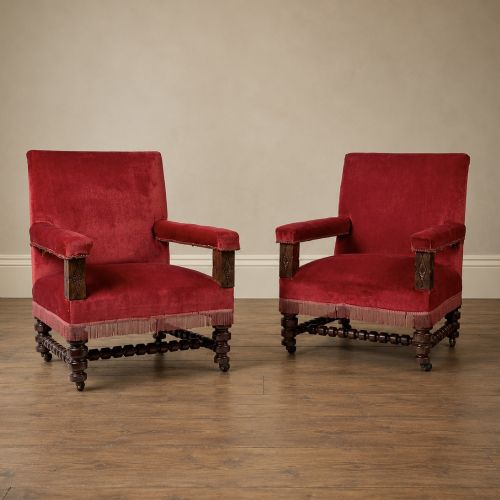
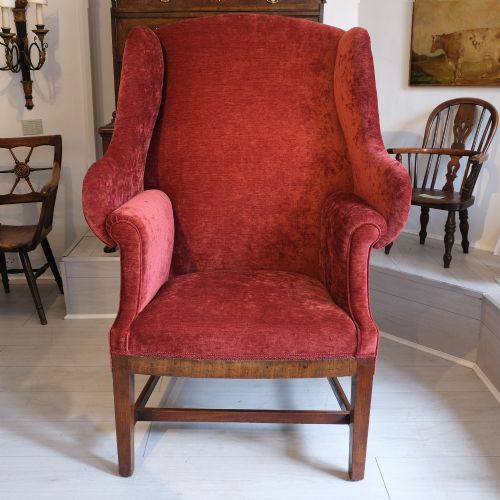
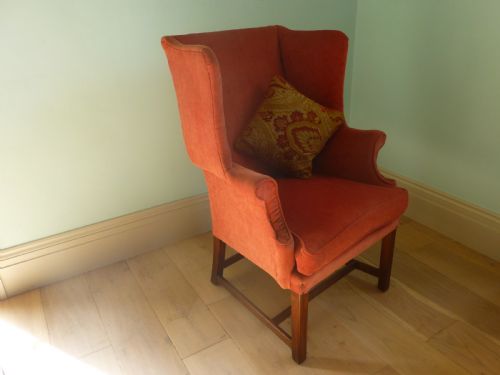
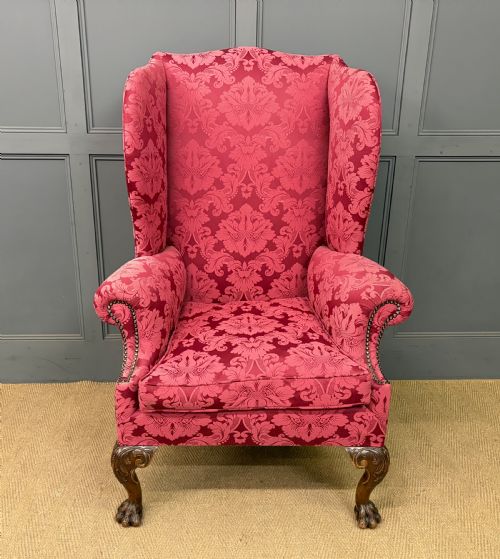
Red velvet fireside chairs encompass a variety of robust seating options designed for comfort near the hearth, primarily taking the form of armchairs and wingbacks. You will frequently encounter Victorian and nineteenth-century pieces alongside Georgian and Edwardian examples on this page.
The selection ranges from oversized oak and walnut frames to smaller parlour chairs and matching pairs. Common structural variations include wing backs, spoon backs, and Bergere frames upholstered in rich red velvet or related textiles.
Originating largely from British workshops and country houses, these chairs display distinct regional styles spanning the eighteenth, nineteenth, and early twentieth centuries. Each piece combines practical domestic seating with traditional craftsmanship.
How they were made
Makers built the structural frames of these chairs using dense hardwoods such as mahogany, walnut, oak, and general timber. Joinery methods relied on traditional pegging and framing to support the substantial weight of the upholstery.
Upholstery techniques involved durable textiles like velvet, damask, and chenille twill pulled tight over padded internal structures. Details such as brass tacks and carved wooden elements completed the construction of each armchair.
Materials recorded across the inventory include solid oak, walnut, mahogany, brass, and velvet.
What varies in quality
The distinction between standard and superior examples rests upon the integrity of the timber frame and the refinement of its carved details. Chairs featuring solid walnut or mahogany frames with intricate carving represent a higher standard than simpler timber constructions.
Proportion and scale also dictate quality, where generous wing backs and well-balanced pairs demonstrate superior design ambition. The choice and execution of the upholstery, from plain velvet to detailed tufting and brass accents, further set individual pieces apart.
HOWARD AND SONS
The Red Velvet Fireside Chairs Glossary
- Wingback
- An armchair with side panels attached to the back, designed to shield the sitter from drafts. These panels extend downward to form armrests.
- Bergere
- A closed-arm armchair with an exposed wooden frame and cane or upholstered back and sides. This style gained popularity in various periods.
- Spoonback
- An upholstered chair featuring a padded back shaped in the contour of a spoon. It is commonly found on Victorian parlour seating.
- Damask
- A reversible figured fabric woven on a jacquard loom, frequently utilised for upholstery. It displays patterns created by contrasting warps and wefts.
- Chenille
- A fuzzy fabric yarn resembling a caterpillar, used in heavier twills for durable upholstery. It provides a soft yet robust textured finish.
Red Velvet Fireside Chairs: Frequently Asked Questions
Are these chairs comfortable for daily use?
These fireside chairs offer deep seats and high backs designed for relaxation.
Their robust timber frames and upholstered cushioning provide substantial support for everyday sitting.
How do I identify a Victorian armchair?
Victorian armchairs often feature dark woods like walnut or mahogany alongside distinctive carved details.
They frequently employ heavy upholstery fabrics such as velvet and span the middle to late nineteenth century.
What is a wingback chair used for?
Wingbacks were originally designed to trap heat from an open fire and block cold drafts.
The side panels offered additional shelter and comfort for whoever sat near the hearth.
Can I find matching pairs on this page?
Several listings include pairs of armchairs from the Victorian and Edwardian periods.
These matching sets often share identical wood frames and velvet upholstery.
What woods were used for the frames?
Cabinet makers utilised domestic and imported hardwoods including oak, walnut, and mahogany.
Less specific timber and general wood frames also appear across various country house styles.