

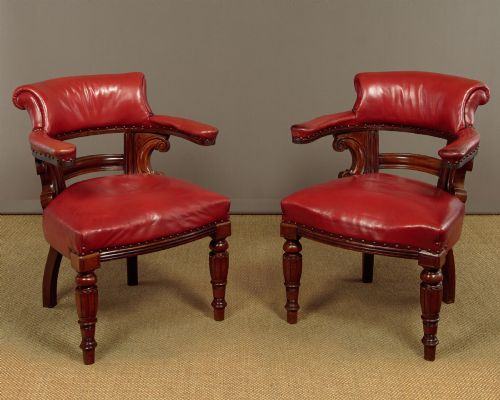


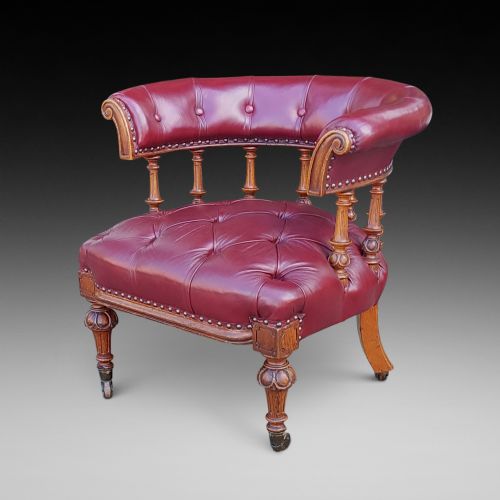
Red Leather Tub Armchairs
These red leather tub armchairs bring rich colour and curved comfort to a study or library, prized for their deep seats and enclosing backs.
Red Leather Tub Armchairs
When searching for red leather tub armchairs, a buyer encounters a focused selection of seating designed for libraries, desks, and studies. These pieces combine an enclosing curved back with upholstered seats, often described as tub chairs, library chairs, or desk chairs.
The versions most commonly met on this page span the Victorian and Edwardian periods, stretching from the mid-nineteenth century into the early twentieth century. They appear in woods such as mahogany, oak, walnut, and occasional Regency or Queen Anne styles.
Makers and designers of the past built these forms for utility at the desk or comfort by the fireside, resulting in sturdy wooden frames wrapped in leather hides. The red, burgundy, or similar rich tones of the leather dominate their character across the various decades.
How they were made
Makers constructed the frames of these armchairs from dense hardwoods like mahogany, oak, and walnut, providing the structural strength needed for daily desk use or library reading. These timbers were shaped into curved tub backs and sturdy legs, sometimes accented with brass fittings.
Upholsterers stretched leather over padding to cover the enclosing backs and seats, securing the edges with careful fastening. The natural hides used in these pieces display the tactile grain and deep colour that define their appearance.
Red Leather Tub Armchairs Retail Price Guide 2026
Typical asking prices for red leather tub armchairs among the pieces listed under this phrase on Sellingantiques today, from the lower quarter to the upper quarter. They describe what is for sale here now, not the wider market.
Listings span the Victorian and Edwardian eras, utilising mahogany, oak, walnut, and brass.
What varies in quality
The distinction between standard examples and the finest pieces lies in the choice of timber and the sophistication of the joinery in the frame. Superior items show more refined carving, particularly in styles referencing earlier periods like Queen Anne or Regency.
The quality of the leather upholstery and the depth of its colour tone also set pieces apart. Finer examples retain supple hides that have aged gracefully, whereas simpler versions show more straightforward construction without decorative flourishes.
The Red Leather Tub Armchairs Glossary
- Tub chair
- An armchair featuring a continuous low curved back that wraps around to form the arms. This shape provides an enclosing, comfortable seat well suited to desks and reading rooms.
- Library chair
- A sturdy armchair designed for use among bookshelves and reading tables. These pieces often feature durable wood frames and upholstered leather surfaces.
- Captain's chair
- A wooden swivel or fixed armchair with a rounded low back. They were traditionally used at ship's desks and office tables.
- Gainsborough armchair
- A wide, upholstered seat with an open wooden frame and armrests, dating from the mid-eighteenth century onward. The style is frequently referenced in later library seating.
Red Leather Tub Armchairs: Frequently Asked Questions
Where do red leather tub armchairs work best?
These armchairs find a natural home beside a partner desk or writing table, where their enclosed shape supports working. They also suit corners of a library or study for reading.
The low curved back allows them to sit comfortably beneath desk overhangs or in smaller spaces where bulky armchairs would crowd the room.
How do I care for antique leather?
Leather upholstery responds best to gentle cleaning with a dry cloth and occasional treatment with suitable conservation waxes. Keeping the material away from direct heat sources prevents drying and cracking.
Allowing the natural patina to develop preserves the character accumulated over the Victorian and Edwardian periods.
What is a tub back?
A tub back is a curved, semicircular backrest that flows directly into the arms of the chair in one continuous line. This enclosed form wraps around the sitter to offer support from multiple angles.
Originating in earlier centuries, the design remained popular through the nineteenth and twentieth eras for desk and library seating.
How do I distinguish Victorian from Edwardian pieces?
Victorian pieces, dating from the mid-nineteenth century, often feature heavier mahogany or walnut frames with dense construction. They emphasise utility and solid presence in libraries and studies.
Edwardian examples from the early twentieth century sometimes introduce lighter proportions or revival styles such as Queen Anne, reflecting changing domestic tastes.