
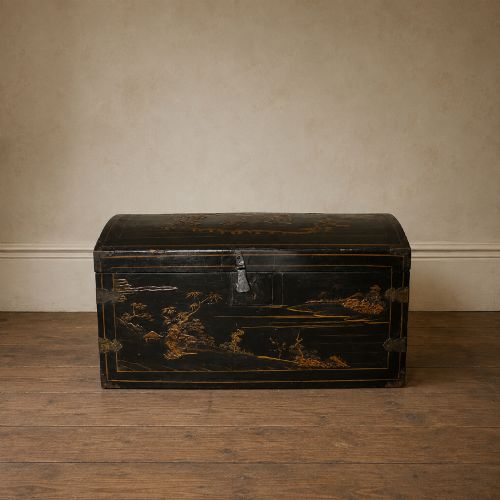


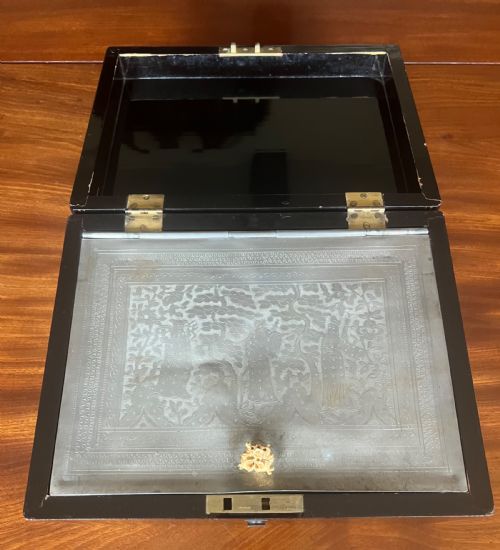


Qing Dynasty Export Chest
A qing dynasty export chest brings trade history into a room, offering practical storage finished in lacquer, leather, or hardwood.
Qing Dynasty Export Chest
When you search for a qing dynasty export chest, you encounter pieces made for overseas trade spanning the eighteenth and nineteenth centuries, alongside Victorian-era examples. These items include trunks, coffers, tea caddies, table cabinets, and travelling jewellery boxes.
The versions most commonly met on this page are black lacquer or red leather trunks, camphorwood chests with brass mounts, and small table cabinets or tea caddies carrying gilded decoration.
Originating as items made in China for Western markets, these pieces combine traditional forms with the utility required for long-distance travel and storage.
How they were made
Makers utilised timber and hardwood, notably camphorwood, as the structural base for trunks and coffers, applying lacquer surfaces finished with gold leaf or gilt decoration.
Metalwork played a structural and decorative role, incorporating brass and iron for hinges, mounts, and bindings on campaign cases and chests.
Surface ornamentation also included leather and carved elements, distinguishing larger furniture pieces from smaller tea caddies and decorative boxes.
Camphorwood trunks retain a distinct, lingering scent from trees grown centuries ago, designed originally to keep insects away from stored silks.
What varies in quality
The standard of a qing dynasty export chest depends on the execution of the surface decoration, from finely applied gold leaf and lacquer to simpler leather or carved finishes.
The integrity of the structural timber, the weight and fit of brass or iron hardware, and the complexity of internal drawers or compartments separate standard items from finer examples.
The Qing Dynasty Export Chest Glossary
- Lacquer
- A durable resin finish applied to wooden surfaces in multiple layers, often decorated with gilt or painted motifs. It provides a smooth, protective coating characteristic of Asian decorative arts.
- Camphorwood
- An aromatic hardwood used for making trunks and chests because its natural scent repels insects. It forms a sturdy carcase for items designed to store textiles and valuables.
- Coffer
- A chest or box with a lid, traditionally used for keeping valuables. These pieces often feature sturdy timber construction and metal hardware.
- Tea caddy
- A small box or chest designed to store tea leaves safely. They frequently include internal compartments and fine decorative details.
- Campaign case
- A portable box or chest fitted with brass hardware for travel. These items were built to withstand movement while maintaining a refined appearance.
Qing Dynasty Export Chest: Frequently Asked Questions
What is a qing dynasty export chest?
A qing dynasty export chest is a trunk, cabinet, or box produced in China during the Qing period for Western trade and travel. These items served practical storage purposes for merchants and travellers.
They range from large camphorwood trunks with brass bindings to small table cabinets and lacquered tea caddies featuring gilt decoration.
How were these chests used?
These pieces were utilised for storing clothing, documents, tea, and valuables during long sea journeys and domestic life. Their robust construction suited transit.
Smaller variants like tea caddies and jewellery boxes kept precious commodities secure inside homes or aboard ships.
What materials are common?
Wood, hardwood, and timber form the primary structure, with camphorwood frequently chosen for trunks. Lacquer surfaces finished with gold leaf are also typical.
Metal fittings in brass and iron provide reinforcement and contrast against the dark wood or red leather exteriors.
How do I date these pieces?
Dating relies on stylistic markers, materials, and documented production eras spanning the eighteenth and nineteenth centuries. Elements such as brass mounts offer chronological clues.
Comparison with documented pieces helps assign items to specific decades or periods like the Victorian era.