
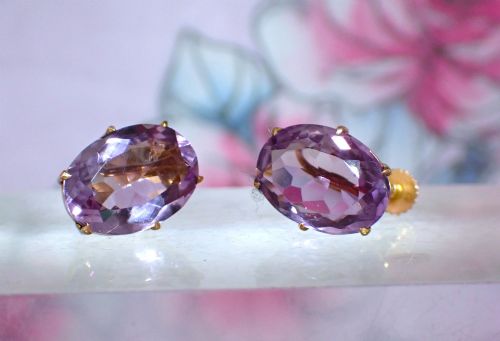


Purple Gemstone Studs
Purple gemstone studs bring together deep violet tones and straightforward settings, offering a wearable way to enjoy period amethyst.
Purple Gemstone Studs
Purple gemstone studs centre on amethyst, appearing across periods from Georgian and Edwardian eras through to the mid-twentieth century. These earrings take the form of simple stud earrings, cluster designs, dress studs, and drop earrings configured for pierced or screw-on fittings.
Buyers browsing purple gemstone studs frequently encounter mid-century examples alongside earlier Georgian and Edwardian pieces. The selection spans straightforward round and oval cuts as well as emerald-cut stones mounted in yellow or white gold and silver.
How they were made
Makers set amethyst stones into gold, 9ct yellow gold, 9ct white gold, and silver mounts, occasionally pairing the purple quartz with diamonds. Stones utilise flat cuts and faceted cuts such as emerald and oval profiles to catch the light.
Earrings incorporate traditional construction methods, including screw-on mechanisms for non-pierced ears alongside standard post fittings and drop elements. Metalwork ranges from simple solid bezels to cluster arrangements surrounding the central gemstone.
Materials documented in the inventory include amethyst, diamond, silver, and various grades of gold.
What varies in quality
The distinction between ordinary and finer examples lies in the saturation and clarity of the amethyst itself, alongside the precision of the stone cutting. Deeper, more even colour distribution and sharper facet work elevate the overall presence of the piece.
Construction quality depends on the weight and durability of the gold or silver setting, particularly around the claws or bezels securing the stone. Substantial metalwork and secure fittings distinguish the better finished pairs from lighter commercial output.
The Purple Gemstone Studs Glossary
- Amethyst
- A purple variety of quartz prized for hues ranging from pale lilac to deep violet. It serves as the primary gemstone across these listings.
- Flat cut
- An early stone-cutting technique featuring a faceted top and a flat base, commonly seen in Georgian pieces. This style predates modern brilliant cutting standards.
- Cluster
- An arrangement of smaller stones set closely around a larger central gem. This method maximises visual impact and sparkle.
- Screw-on
- A fastening mechanism utilising a threaded post and nut to secure earrings without requiring pierced lobes. It is frequently found on vintage and antique pairs.
- Emerald cut
- A rectangular stone cut with cropped corners and step-cut facets. This geometry highlights the clarity and colour depth of the gemstone.
Purple Gemstone Studs: Frequently Asked Questions
Are purple gemstone studs suitable for daily wear?
Amethyst possesses a reasonable hardness that makes these earrings practical for regular use when handled with standard care. Simple stud configurations sit securely against the earlobe.
Heavier drop versions or older Georgian mounts benefit from more careful handling to protect the settings and metalwork from unnecessary strain.
How do I identify Edwardian amethyst earrings?
Edwardian pieces often feature delicate metalwork and specific design motifs characteristic of the early twentieth century. The integration of lighter gold or silver settings provides a visual clue.
Examining the fastening style and the cut of the amethyst helps confirm the period context alongside any accompanying hallmarks.
What is the difference between studs and dress studs?
Standard stud earrings are designed specifically to be worn in pierced or screw-on earlobe fittings for personal adornment. Dress studs typically refer to functional fasteners used historically on garments such as shirts.
While both share similar decorative stone faces, their underlying mechanical posts and intended uses differ significantly.
Do these earrings use yellow or white gold?
The listings show both 9ct yellow gold and 9ct white gold options, alongside silver and unmarked precious metal settings. Yellow gold provides a warm contrast to the purple amethyst.
White gold and silver alternatives offer a cooler tone that alters the overall aesthetic of the mounted gemstone.