




February Birthstone Jewellery
February birthstone jewellery brings together rich purple amethysts in gold settings, offering a vibrant splash of colour for every collection.
February Birthstone Jewellery
February birthstone jewellery centres on the deep purple quartz known as amethyst, fashioned into rings, earrings, necklaces and pendants. Pieces span periods from the Edwardian era through the mid-twentieth century, including the 1940s, 1950s, 1960s, and later decades.
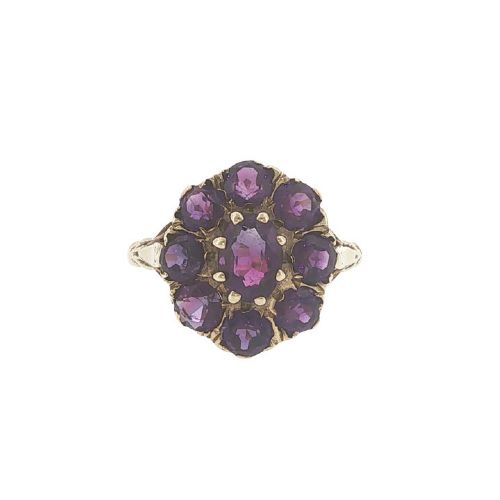
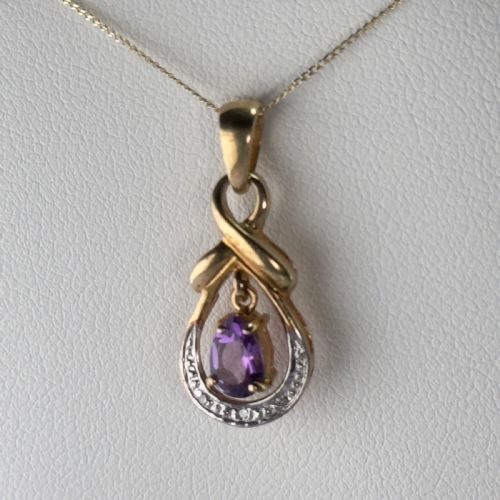
The selections available here rely heavily on rings and stud drop earrings, frequently paired with diamonds or seed pearls. Cluster rings and emerald-cut solitaires dominate the ring selections, whilst drop earrings and pendant necklaces form the bulk of the hanging pieces.
Victorian revival and traditional styles sit alongside mid-century and vintage designs, reflecting changing tastes across the twentieth century. Most items utilise nine-carat yellow or white gold alongside the defining purple stones.
How they were made
Makers set amethysts into nine-carat gold, employing both yellow and white metal variations to complement the purple hue of the stone. Stones receive various cuts, including emerald cuts, oval cuts, and pear drops, depending on the specific form of the ring or pendant.
Cluster and halo designs incorporate secondary stones such as diamonds and seed pearls around a central amethyst. Hallmarks stamped into the gold provide official records of assay office origins and dates of manufacture.
Ancient Greeks believed amethysts prevented intoxication, making purple February birthstone jewellery a remarkably spirited choice for an evening out.
What varies in quality
Quality rests upon the saturation and clarity of the amethyst itself, alongside the precision of its cutting and the security of its setting. Deeper, more even purple tones distinguish superior stones from paler or unevenly coloured examples.
The intricacy of surrounding work, such as the arrangement of accompanying diamonds and seed pearls, separates standard commercial items from finer pieces. Metalwork finish and the crispness of hallmarks further mark out the standard of construction.
The February Birthstone Jewellery Glossary
- Amethyst
- A purple variety of quartz prized for centuries as a decorative gemstone. Its purple shade ranges from pale lilac to deep violet.
- Seed pearl
- A very small natural or cultured pearl, often used in Edwardian halo rings to frame a central gemstone. These tiny pearls add a delicate white contrast to the purple amethyst.
- Cluster ring
- A ring featuring a central stone surrounded by a cluster of smaller gems. In these listings, diamonds or pearls frequently encircle the main amethyst.
- Emerald cut
- A rectangular gemstone cut with stepped facets and cropped corners. This cut emphasises the clarity and rich colour of large amethysts.
- Hallmark
- An official stamp or series of marks applied to precious metals indicating purity and assay origin. British gold items often carry these to verify their metal standard.
February Birthstone Jewellery: Frequently Asked Questions
What is the traditional February birthstone?
The traditional birthstone for February is the amethyst, a purple quartz that has been utilised in jewellery for centuries. Its distinct violet hue makes it instantly recognizable in rings, pendants, and earrings.
Amethysts range in tone from light lavender to deep purple, offering versatile options across Edwardian and mid-century designs.
What metals are used in these pieces?
Most items utilise nine-carat gold, appearing in both yellow gold and white gold configurations. These gold alloys provide a durable setting for daily wear while securing the amethysts and accompanying diamonds.
White gold alternatives offer a cooler tone, whereas yellow gold provides a traditional warm contrast to the purple stones.
How do I identify an Edwardian piece?
Edwardian jewellery often incorporates delicate details like seed pearls set in halo arrangements around a central amethyst. The craftsmanship from this period emphasises lightness and intricate floral or geometric motifs.
Checking for hallmarks and studying the specific claw or bezel settings can also help confirm the era of manufacture.
Are diamonds commonly paired with amethysts?
Diamonds frequently appear as accent stones in cluster rings, drop earrings, and pendant necklaces alongside amethysts. These small diamonds add brilliance and highlight the deep purple colour of the primary birthstone.
Such combinations are particularly common in mid-century dress rings and cluster necklaces.