
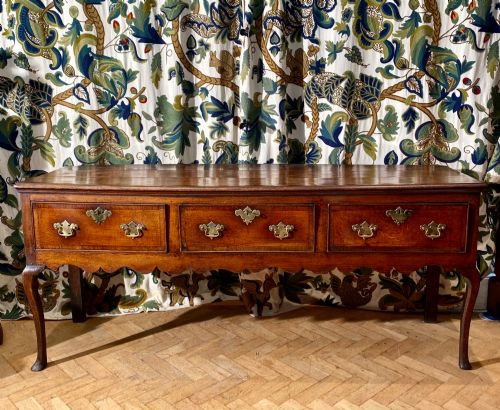
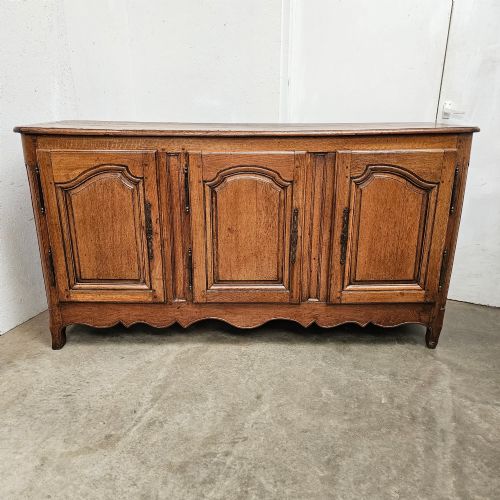
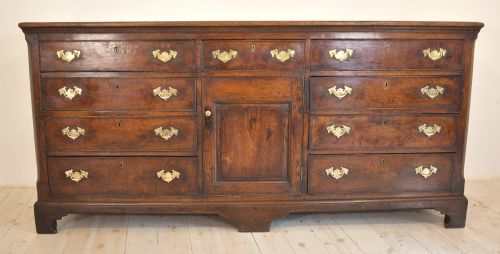
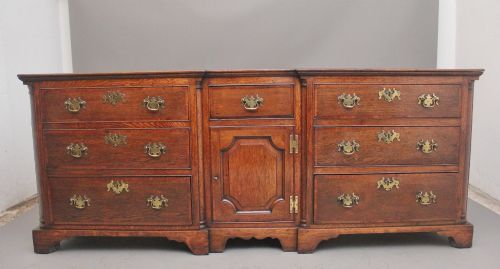
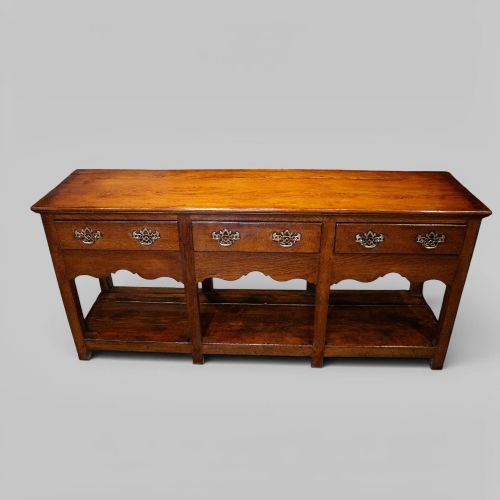


Provincial Oak Dresser Base
A provincial oak dresser base grounds a country interior with honest utility and deep grain.
Provincial Oak Dresser Base
A provincial oak dresser base brings utilitarian storage and regional character into a room, serving as a heavy-duty sideboard or low cabinet. Buyers seeking a provincial oak dresser base encounter pieces originating from English and French country workshops, spanning the eighteenth and nineteenth centuries.
The surviving forms include Lancashire designs with pot boards and three drawers, alongside French enfilades and house maid cupboards. These low storage furniture pieces were built for rural domestic life, prioritizing robust timber over courtly veneer.
Construction and materials
Construction relies primarily on solid oak, frequently paired with secondary fruitwood or pine for internal linings, drawer bottoms, and backboards. Structural hardware utilises hand-forged wrought iron and steel, while opening mechanisms often feature brass drop handles or key escutcheons.
Joinery methods reflect regional traditions, employing pegged mortise and tenon frames alongside hand-cut dovetails for drawer construction. Surfaces are typically finished with natural wax over aged timber rather than high-gloss varnish.
Current listings span the eighteenth and nineteenth centuries, featuring oak, fruitwood, brass, and wrought iron across English and French provincial styles.
Judging quality and proportion
Quality rests in the integrity of the timber and the retention of original surface patination, where centuries of handling leave a warm, tactile skin. Heavy oak boards with minimal later replacement command greater regard among purists.
Proportion and structural honesty separate finer examples from more utilitarian or heavily altered survivors. The articulation of drawer fronts, the presence of original pot boards, and the retention of period brass or iron hardware determine the standing of each piece.
The Provincial Oak Dresser Base Glossary
- Pot board
- A low open shelf situated beneath the main body of a dresser base, originally designed for storing heavy pots and pans. This lower tier rests directly on the floor runners or low stile feet.
- Enfilade
- A long sideboard or cabinet form originating in France, typically featuring multiple doors in a continuous linear arrangement. It provides extensive low-level storage for dining rooms and large kitchens.
- Fruitwood
- Dense, fine-grained timber such as pear, apple, or cherry, utilised alongside oak for secondary elements and decorative contrasting details. It offers a smooth surface that takes polish differently than coarse-grained oak.
- Dovetail
- A traditional interlocking joint used to join drawer sides to drawer fronts, cut by hand with distinct triangular pins and tails. This joint provides exceptional tensile strength without requiring metal fasteners.
Provincial Oak Dresser Base: Frequently Asked Questions
What is a provincial oak dresser base?
A provincial oak dresser base is a heavy low storage unit built in regional workshops, featuring drawers and sometimes a lower pot board.
Unlike urban formal furniture, these pieces were designed for everyday utility in country houses and rural kitchens.
How were these dresser bases used?
They served as practical work surfaces for food preparation and storage hubs for household tableware, linens, and culinary pots.
The wide top surface accommodated daily tasks while the drawers and cupboards kept essentials close at hand.
How do I style a dresser base at home?
A dresser base fits naturally in a kitchen or dining room as a serving surface or sideboard, topped with ceramics or lighting.
The lower storage accommodates books, baskets, or tableware while anchoring the room with rustic timber tones.
How do I tell eighteenth and nineteenth century pieces apart?
Eighteenth-century examples often display simpler hand-planed surfaces, pegged joinery, and deeper patination acquired over centuries of use.
Nineteenth-century pieces may introduce more formalized hardware, machine-sawn elements inside, or French regional styling like enfilade doors.